What happens when you reach the edge of everything? This question has puzzled scientists and philosophers for centuries. Today, astronomers use telescopes and math to explore what was once just imagination.
The universe began with the Big Bang about 13.787 billion years ago. Since then, space has been expanding in all directions. In the 1930s, Edwin Hubble found galaxies moving away from each other. This changed how we see the universe.
Now, scientists know a lot about the universe’s shape and future. Arno Penzias and Robert Wilson found cosmic microwave background radiation in 1965. This confirmed the Big Bang theory. Albert Einstein’s work, along with others, helps us understand what’s at the universe’s end.
Most scientists think the universe is flat and will keep expanding forever. This means parallel lines stay parallel over vast distances. It raises questions about the universe’s ultimate fate. Will stars burn out? Will galaxies drift apart into darkness? The answers involve dark energy, quantum mechanics, and the strange physics at the universe’s edges.
Understanding the Observable Universe and Its Limits
The universe is much bigger than what we can see. Scientists have mapped its visible parts with great accuracy. The observable universe limits aren’t because space ends. It’s because light from far away hasn’t reached Earth yet, since the Big Bang 13.8 billion years ago.
The Cosmic Horizon and What We Can See
The cosmic horizon is like an invisible wall around Earth. Things beyond it are forever hidden from us. This is because light travels at a fixed speed, making some parts of space unreachable, even for our best telescopes.
Measuring the Observable Universe
Scientists say the edge of space we can see is about 46.5 billion light-years away in all directions. This might seem odd, given the universe is only 13.8 billion years old. But, space has been growing since then. Tools like the James Webb Space Telescope help us explore these vast areas:
- The James Webb Space Telescope captures light from the earliest galaxies
- NASA’s NICER and IXPE satellites measure X-rays from distant objects
- The Euclid mission creates detailed 3D maps of billions of galaxies
Why Light Creates Boundaries in Space
Light’s speed limits what we can see. A star 100 light-years away looks like it did a century ago. As distance grows, so does the delay, until we hit the cosmic horizon. There, the universe is too young for light to have traveled from there to us.
The Shape of the Universe and Cosmic Boundaries
Scientists have wondered if the universe has edges or goes on forever. The answer comes from understanding how matter and energy affect space. Just like Earth’s surface is curved, the universe might also curve in ways that show its edges.
Flat, Open, and Closed Universe Models
The universe’s shape depends on a key value called the density parameter, or omega. This number shows how much matter and energy there are compared to what’s needed for balance. There are three main possibilities:
- Closed universe (omega greater than 1): Space curves like a sphere. Here, a triangle’s angles add up to more than 180 degrees. No parallel lines exist in this geometry.
- Open universe (omega less than 1): Space curves like a saddle. Triangle angles sum to less than 180 degrees in this hyperbolic shape.
- Flat universe (omega equals 1): Space follows familiar rules. Triangles have exactly 180 degrees and parallel lines never meet.
How Geometry Determines the Universe’s Edge
Each shape leads to different outcomes for the universe’s edge. A closed universe loops back on itself like traveling around Earth. An open or flat universe goes on forever without edges. The way light travels and galaxies move apart changes in each model.
Current Evidence from the Wilkinson Microwave Anisotropy Probe
The Wilkinson Microwave Anisotropy Probe measured ancient light from the Big Bang. It found we live in a flat universe within 0.4% accuracy. Dark energy makes up about 68% of everything, pushing the universe apart. For gravity to win and create collapse, we’d need seventeen times more matter than exists today.
What’s at the end of the universe?
Since 1998, scientists have been trying to figure out what lies beyond our universe. They noticed something strange when they looked at distant supernovas. The universe wasn’t slowing down as thought—it was actually speeding up.
This discovery changed everything we thought we knew. It made us question if the universe has an edge at all.
Physical Boundaries vs. Infinite Expansion
The universe might not have a traditional edge like a wall or barrier. Instead, space itself stretches in all directions. Current evidence suggests an open universe that goes on forever.
Since the Big Bang 14 billion years ago, space has been growing. About 7.5 billion years later, the expansion rate started to increase.
The Role of Dark Energy in Defining Cosmic Limits
Dark energy is a mysterious force pushing galaxies apart. It makes up about 68% of the universe and decides its ultimate fate. Scientists use the term for hypothetical fields with negative pressure.
Einstein once added a cosmological constant to his equations. He thought it explained a static universe. But after Edwin Hubble discovered cosmic expansion, Einstein called it his “greatest blunder.”
Scientific Theories About the Universe’s Edge
There are three main theories about what’s at the end of the universe:
- Eternal expansion driven by dark energy
- A curved space that loops back on itself
- An infinite expanse with no boundaries
The answer depends on the universe’s shape and dark energy’s behavior. Current measurements suggest our universe will exist for a very long time.
The Expanding Universe and Spacetime Continuum
The universe is growing every second. It started 14 billion years ago with a huge explosion called the Big Bang. This explosion turned a dense point into the stars and galaxies we see today.
Scientists used to argue about the universe’s behavior. In 1948, Fred Hoyle suggested the Steady State theory. It said the universe stays the same, with new matter appearing all the time. But, the discovery of cosmic microwave background radiation proved the Big Bang theory right.
Astronomers are still puzzled by the universe’s expansion. Stars, galaxies, and dark matter should slow things down. But, galaxies are moving away from each other faster than ever. This is due to dark energy, a mysterious force pushing against gravity.
Think of raisins in rising bread dough. Each raisin moves away from the others as the dough grows. Galaxies are like raisins in the universe, moving apart. This creates a problem for what we can see in the universe.
This fast expansion changes how we see the universe and its boundaries. It makes us wonder what lies beyond what we can see.
Heat Death Theory and the Ultimate Fate of the Universe
Scientists have long wondered about the ultimate fate of the universe. The heat death theory paints a chilling picture. It says everything will slowly fade into darkness.
This scenario predicts our universe will keep expanding until it reaches perfect stillness. Every star will burn out, and every galaxy will drift apart. The cosmos will become an empty, cold void.
Maximum Entropy and the Big Freeze Scenario
The Big Freeze is the most likely end of time, based on current observations. As the universe expands, it will approach absolute zero temperature. Energy will spread out evenly across space until nothing can move or change.
This maximum entropy state means no life, no light, and no activity can exist. It’s like a cup of hot coffee left in a cold room – it eventually reaches the same temperature as everything around it.
Timeline for Star Formation Shutdown
Stars will continue forming for the next 1 to 100 trillion years before running out of gas. Different types of stars face different fates:
- Blue giants will explode as supernovas within a few million years
- Yellow stars like our Sun will shed their outer layers after billions of years
- Red dwarf stars will be the last to fade, surviving the longest
The Role of Black Holes and Hawking Radiation
Black holes will outlive all stars but won’t last forever. They slowly evaporate over unimaginable timescales through Hawking radiation. The ultimate fate of the universe includes even these cosmic giants disappearing into nothingness.
This heat death theory paints a lonely picture of the end of time, where darkness reigns supreme.
Alternative Endings: Big Crunch and Big Rip Theories
Many scientists think the universe will keep growing forever. But other theories show different futures. These range from a dramatic collapse to space tearing apart violently. Each theory gives us new insights into gravity, dark energy, and the universe’s vastness.
The Big Crunch Hypothesis and Universal Collapse
The big crunch theory says gravity might win in the end. If there’s enough matter, expansion could slow, stop, and then reverse. Everything would come back together into a single point, like the start of the Big Bang.
But, this theory is not likely. Scientists have only watched the universe expand for a short time. The discovery of faster expansion in 1998 made this scenario less likely.
Dark Energy and the Big Rip Scenario
A more violent end is the Big Rip. Dark energy grows stronger, causing everything to break apart. Galaxies, stars, atoms, and even particles would be torn apart. This could happen in about 22 billion years.
Cyclic Universe Models and the Big Bounce
Some theories suggest the universe goes through endless cycles. The Big Bounce model says our universe came from a previous one’s collapse. This avoids infinite density thanks to quantum effects. It creates an eternal sequence of universes, each having its own Big Bang.
Dark Energy and Dark Matter’s Role in Cosmic Evolution
The universe is filled with two mysterious forces. Dark matter makes up 27% of the cosmos, while dark energy accounts for about 68% of all energy in space. These invisible components control how galaxies form and determine the cosmic boundaries of our expanding universe.
Dark matter acts like cosmic glue that holds galaxies together. Without it, stars and planets couldn’t exist in their current forms. Scientists discovered proof of dark matter’s unique properties when they observed two galaxy clusters colliding billions of years ago. The collision ripped away hot gas from both clusters, but the dark matter remained in place. This showed that dark matter particles don’t interact with each other during these cosmic crashes.
Dark energy remains even more puzzling to scientists. This force pushes the universe expansion faster each day, yet we know little about how it works. Some researchers think dark energy might be a constant force built into empty space itself. Others suggest it could be a changing quantum field that varies over time. Black holes might hold clues to understanding these cosmic boundaries better.
Space telescopes like James Webb, Euclid, and Nancy Grace Roman are gathering new data about dark energy. Ground-based observatories will add more information in coming years. Scientists hope these tools will reveal whether dark energy changes over time and help solve current mysteries about the universe expansion rate.
Future of Galaxies and Star Systems
The universe’s galaxies are on a collision course that will change everything in the night sky. As we near the end of time, these galaxies will merge and change. This will define the ultimate fate of all star systems.
Galaxy Mergers and Elliptical Formation
Galaxies grow by eating their smaller neighbors. This happens across cosmic infinity. In galaxy clusters, hundreds of galaxies move toward their center, causing spectacular collisions.
When spiral galaxies crash, they lose their elegant shapes. They turn into blob-shaped elliptical galaxies.
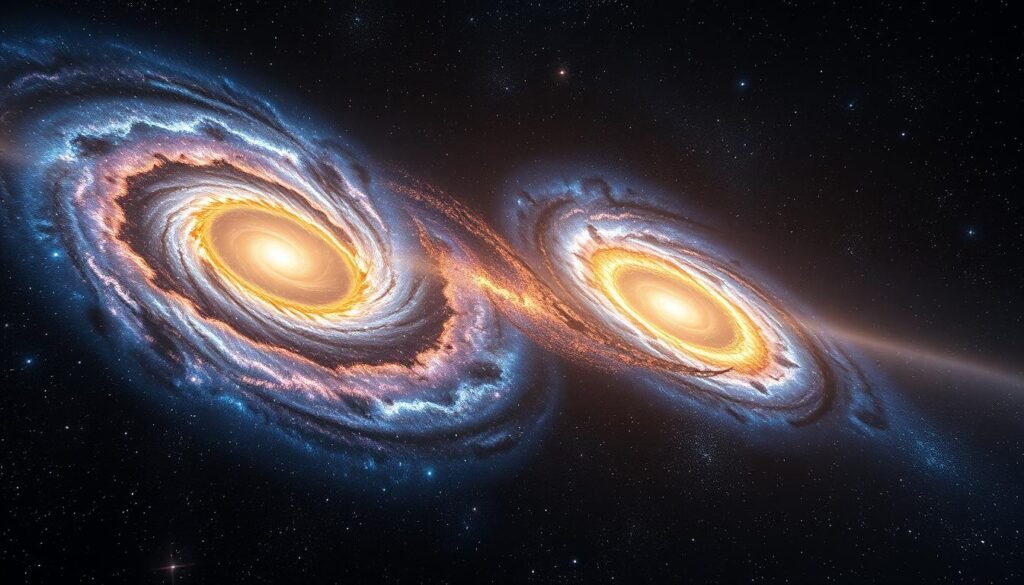
This change means the universe will have fewer spiral galaxies over time. The chaotic mergers create elliptical galaxies that will dominate the cosmos later.
The Milky Way and Andromeda Collision
Our Milky Way will collide with the Andromeda galaxy in about four billion years. Despite the dramatic merger, stars won’t collide because of the vast distances between them. The Sun, now halfway through its 10-billion-year lifetime, will keep shining through this event.
Red Dwarf Stars as the Last Light Sources
Star lifetimes depend on their size:
- Blue giant stars burn out quickly
- Yellow stars like our Sun live about 10 billion years
- Red dwarf stars survive trillions of years
Red dwarfs will be the last light sources before everything goes dark. These tiny stars fade slowly over times much longer than the universe’s age. Eventually, they will leave only darkness.
Time, Space, and the Concept of Infinity
The connection between time and space is key to understanding the ultimate fate of the universe. Scientists have come up with interesting theories about how life might keep going forever. These ideas make us question what existence really means and when time might end.
Freeman Dyson’s Eternal Intelligence Theory
In 1979, physicist Freeman Dyson came up with a mind-blowing idea. He thought that life could live forever by using energy wisely. As the universe cools, life could think using less energy, sleeping for long periods between thoughts.
This idea works if the universe keeps expanding and cooling. With lower temperatures, less energy is needed for thinking. This could mean infinite thoughts with just a little energy. But, the universe’s expansion is speeding up, causing problems for this theory. Parts of spacetime will soon be cut off from each other.

Poincaré Recurrence and Infinite Time Scales
The Poincaré recurrence theorem offers another view on cosmic infinity. It says that any closed system will return to its original state over infinite time. This means entropy could decrease, leading to the creation of ordered structures, even universes.
Quantum Effects at Universal Scales
Quantum mechanics adds a layer of complexity to our understanding of the end of time. At huge scales, quantum gravity effects are important but hard to grasp. The universe might be our home for billions of years, supporting our society and curiosity.
Conclusion
The mystery of what’s at the end of the universe is still a big question. Scientists think the universe might end in the Big Freeze. In this scenario, stars will stop forming, and galaxies will turn red and fade.
Galaxy clusters will merge into huge elliptical galaxies. The universe’s expansion will push everything beyond our local group out of sight. This could take trillions of years.
The fate of the universe depends on dark energy and the nature of cosmic boundaries. New discoveries could change our understanding of the end. The universe might transform into something we can’t imagine yet.
Some scientists think our universe has no edge. It could exist in ways we can’t understand, cycling through phases or expanding into new dimensions.
We are living in an incredible time in the universe’s story. Stars, galaxies, and planets are all around us. Humans have billions of years to explore and find answers.
The James Webb Space Telescope and future missions will test our theories. While the Big Freeze is the main idea, the universe’s fate is still open. Our cosmos has enough energy and matter for discovery and wonder for generations to come.