
Our world holds countless astonishing secrets. This collection of discoveries will truly blow mind expectations about the universe we inhabit.
From the vastness of space to the complexity of our own biology, reality often proves more incredible than fiction. These science facts are grounded in verified research, making complex ideas easy to grasp.
You will explore revelations from astronomy, physics, and human physiology. Each entry challenges common understanding and reveals hidden truths about everyday life.
This journey demonstrates that knowledge is not just academic. It is a source of wonder that touches every part of our existence, inviting you to see your surroundings with fresh eyes.
Introduction: Journey into the Weird Science Universe
Methodical exploration of natural phenomena continues to yield insights that reshape conventional thinking. This journey reveals how documented reality often operates beyond our initial assumptions.

What Makes These Facts So Fascinating
Unusual discoveries captivate us because they challenge preconceived notions about how the world works. They reveal unexpected connections between seemingly unrelated phenomena.
These insights demonstrate that reality follows principles far more complex than surface observations suggest. What makes them particularly engaging is their accessibility—they translate abstract concepts into tangible examples anyone can appreciate.
The intersection of discovery and human wonder creates experiences that transform how people perceive ordinary processes in daily life.
The Role of Science in Uncovering the Unbelievable
Scientists employ rigorous methodologies including observation, experimentation, and mathematical modeling. These approaches reveal counterintuitive truths verified through repeated testing over time.
The role of scientific inquiry extends beyond practical innovations to satisfy fundamental curiosity about nature and existence. As one researcher noted, “The most exciting phrase to hear in science isn’t ‘Eureka!’ but ‘That’s funny…'”
This methodical process transforms mysteries into understood principles, reminding us that learning extends far beyond textbooks into continuous questioning of assumptions.
Bizarre Astronomy and Cosmic Wonders
The cosmos operates on principles that frequently defy our everyday intuition. Astronomical discoveries reveal characteristics that challenge our basic understanding of celestial bodies and their behavior.
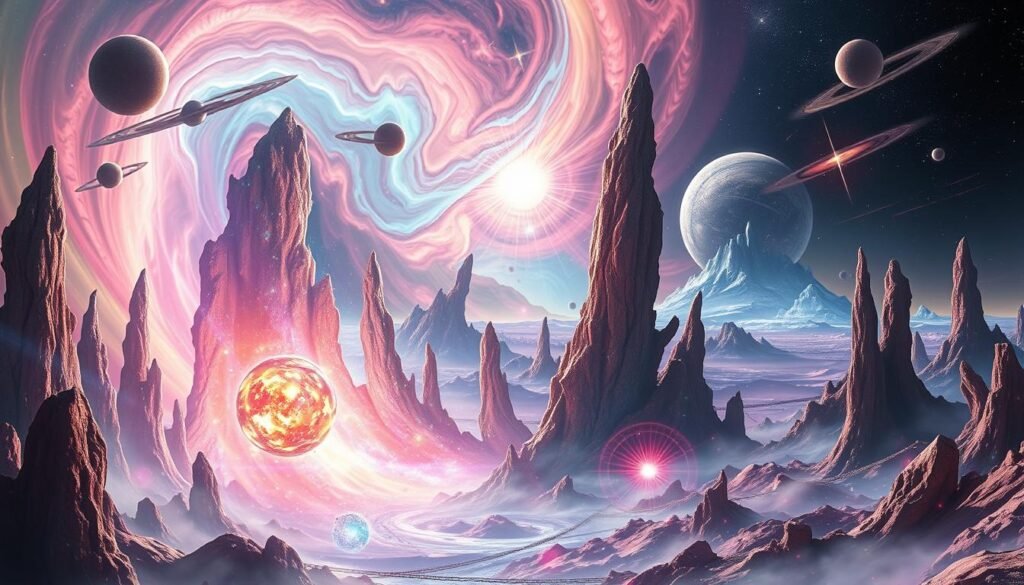
The Cosmic Latte and Other Colorful Discoveries
In 2002, astronomers made a surprising finding about the universe’s overall color. After analyzing light from countless galaxies spanning billions of light-years, they determined the average hue is a beige tone nicknamed “Cosmic latte.”
This discovery shows that the combined light from all stars creates a specific color palette. The finding emerged from careful wavelength analysis across the observable cosmos.
Exploring the Heliosphere and the Shape of Mars
Mars presents another astronomical surprise with its unusual shape. Unlike other rocky planets in our solar system, Mars isn’t spherical but resembles a rugby ball with three different axial dimensions.
Our solar system also has a boundary called the heliopause. This region marks where the sun’s solar wind can no longer push back against particles from distant stars.
Exotic planets like 55 Cancri e demonstrate cosmic extremes. Located 40 light-years away, this planet is approximately twice Earth’s size and composed primarily of diamond.
Meanwhile, Earth travels incredible distances daily. Our planet orbits the sun at 2.5 million kilometers per day while simultaneously moving 19 million kilometers relative to the Milky Way’s center.
The scale of microscopic life becomes astronomical when considering all Earth’s bacteria stacked together would stretch 10 billion light-years. This chain could wrap around the Milky Way over 20,000 times.
Mysterious Physics Phenomena
Physics reveals hidden dimensions of existence that remain invisible to our direct senses. These principles govern everything from cosmic scales to microscopic interactions.
Shifting Time, Gravity, and the Sound of the Sun
Earth’s rotation is gradually slowing down, adding about 1.8 seconds to each day every century. Six hundred million years ago, a complete rotation took only 21 hours.
The sun produces powerful pressure waves that create actual sound. However, these acoustic vibrations have wavelengths spanning hundreds of miles, making them inaudible to human ears.
Sound can reach negative decibel levels. Microsoft’s anechoic chamber in Washington achieves -20.6 decibels through specialized construction that blocks all external vibrations.
Even laser light beams exhibit slight curvature when examined closely. This demonstrates that perfect straightness exists only as mathematical theory rather than physical reality.
Different species experience time in unique ways. Smaller animals like salamanders process information faster, making their perception of time flow more slowly than larger creatures.
Temperature changes affect air density and sound propagation in unexpected ways. These relationships show how thermal conditions influence physical behaviors across different scales.
Curious Life and Natural World
Animal behaviors and physical adaptations reveal nature’s capacity for extraordinary evolutionary solutions. These biological marvels demonstrate how life forms develop unique strategies for survival in diverse environments across our planet.
Animal Oddities: From Lightning-Struck Giraffes to Headless Survival
Giraffes face remarkable lightning risks due to their height. Statistical analysis shows they experience fatal strikes thirty times more often than humans. Only five documented cases occurred between 1996 and 2010.
Mike the chicken survived eighteen months without a head in the 1940s. His intact jugular vein and brainstem maintained basic life functions. Most headless chickens perish within minutes.
Hippopotamuses cannot swim despite their aquatic lifestyle. Their dense bones make them barely buoyant. They instead perform slow gallops along riverbeds.

Nature’s Puzzles: From Regenerative Earthworms to Bizarre Insect Behaviors
Earthworms display incredible regenerative ability. They can regrow tails when cut properly. Planarian flatworms reconstruct entire bodies from tissue fragments.
Snails possess thousands of microscopic teeth on their tongues. These dental arrangements differ completely from vertebrate structures. They represent unique evolutionary adaptations.
Alpine bumblebees survive at extreme altitudes above earth’s surface. They maintain flight capability in conditions simulating 9-kilometer heights. Most insects cannot function at these levels.
Neon tetra fish form orderly queues during emergencies. This social organization prevents collisions in narrow spaces. It suggests advanced collective survival instincts.
Our planet contains more trees than stars in the solar system. Water can simultaneously boil and freeze under specific conditions. These phenomena challenge everyday understanding of natural processes.
Unusual Human and Biological Anomalies
Human biology contains remarkable contradictions that challenge our everyday assumptions about how bodies function. These discoveries reveal how our physical forms operate through processes that often seem counterintuitive.
Remarkable Body Functions and Mind-Boggling Processes
Your brain constantly engages in self-maintenance through phagocytosis. This process involves cells consuming debris to preserve neural tissue integrity.
Identical twins develop unique fingerprints despite sharing identical DNA. Environmental factors during gestation create these distinctive patterns.

The human stomach produces powerful acids with pH levels between 1-3. This corrosive environment can dissolve metal objects like razor blades within hours.
Surprising Insights into Genetics and Cellular Activity
Microbial cells outnumber human cells in your body by approximately 56 percent. However, by weight, people remain over 99.7 percent human due to bacteria’s microscopic size.
Human DNA contains approximately 145 genes inherited from other species. Studies in Genome Biology reveal genetic exchanges with bacteria and viruses.
Radioactive potassium-40 exists naturally in human bodies. Each person contains about 16mg, making people 280 times more radioactive than bananas.
Skin bacteria can trigger itching sensations. Staphylococcus aureus releases chemicals that activate nerve proteins, sending signals to the brain.
Diving into Weird Science Facts
Documented observations from multiple scientific fields demonstrate how reality often exceeds imaginative speculation. These verified findings span atmospheric phenomena, marine biology, and technological milestones.
Intriguing Listicle Highlights from Space to Cells
Cloud formations appear weightless but carry staggering mass. A typical cumulus cloud weighs approximately one million tonnes, floating due to minimal density differences.
Animal longevity records showcase remarkable exceptions. Bluey the Australian cattle dog reached 29.5 years, while Creme Puff the cat lived 38 years and three days.
Marine anatomy reveals precise terminology. Octopuses possess arms rather than tentacles, with suckers along their entire length. Starfish and other echinoderms represent entirely cephalic organisms.
Scientific Surprises That Blow Your Mind
Photosynthesis extends beyond plants to include algae, sea slugs, and pea aphids. These organisms independently evolved chlorophyll-based energy conversion.
Insect respiration demonstrates elegant solutions. Ants breathe through spiracles—microscopic openings that bypass lung systems entirely.
Human physiology can reach extreme conditions. A 2013 medical case involved 45 days of constipation requiring surgical intervention.
Technological progress compressed into 65.5 years separates the Wright Brothers’ 12-second flight from Apollo 11’s 8-day lunar mission. This timeline showcases exponential advancement.
Exploring Science’s Impact on Everyday Life
Scientific understanding transforms mundane activities into windows on universal principles. The air we breathe and the food we taste operate through complex systems that research has illuminated over time.
The Intersection of Innovation and Daily Phenomena
Marine ecosystems generate most of Earth’s oxygen. Oceanic plankton, algae, and bacteria produce 50-80% of the world’s breathable air through photosynthesis.
Flavor perception requires chemical dissolution in saliva. Without this process, taste receptors cannot detect food molecules. This demonstrates how basic experiences depend on biochemical interactions.
Workplace attire affects physiological function. A 2018 study found neckties reduce cerebral blood flow by 7.5%. This can cause dizziness and headaches during the work day.
Solar radiation travels 93 million miles in eight minutes. The sunlight reaching Earth today left the sun minutes earlier. This temporal delay highlights cosmic distances.
Space environments eliminate certain bodily functions. Astronauts cannot burp because microgravity prevents gas-liquid separation. Earth-based processes rely on gravitational influence.
Renewable energy presents ecological challenges. Wind turbines cause thousands of bird deaths each year in the UK. Painting one blade black reduces mortality by 70%.
Helium exhibits extraordinary properties at extreme temperatures. When cooled to -269°C, it becomes a superfluid that defies gravity. It can flow without friction and climb container walls.
These examples show how principles from various fields shape daily existence. Understanding these connections helps people appreciate the complexity underlying routine activities throughout the year.
Conclusion
The journey through these documented revelations concludes with a profound appreciation for empirical discovery. Each finding has the power to blow mind expectations about our universe.
These verified science facts demonstrate the incredible dedication of scientists. Their work over many years reveals truths from fleeting lightning strikes to the vast structure of the Milky Way.
This knowledge transforms our perception in a fundamental way. It gives us the ability to see the extraordinary processes behind ordinary events, challenging our brain to comprehend scales from minutes to millennia.
Ultimately, this collection is an invitation. It encourages continued curiosity about the world, reminding us that every answered question opens the door to new and deeper mysteries.