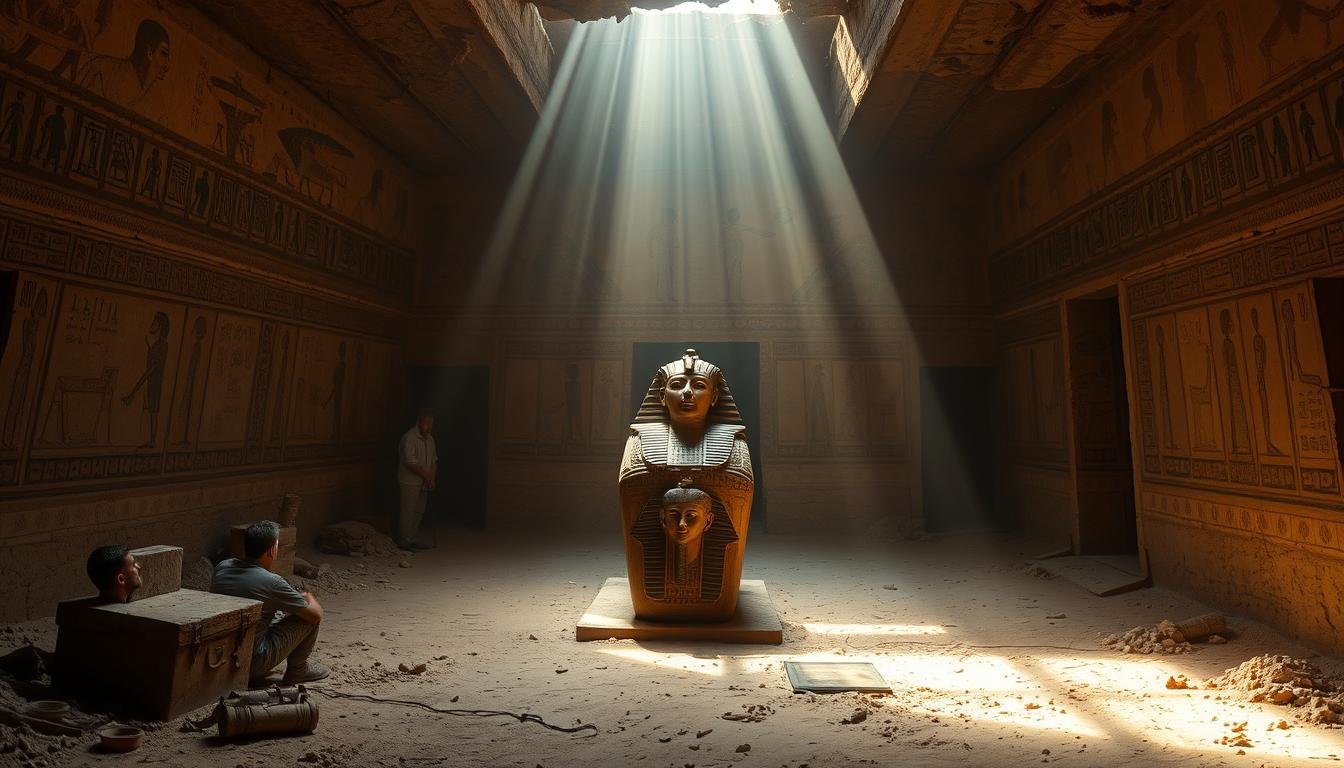
How did a teenage ruler who reigned for less than a decade become the most famous pharaoh in history? The answer lies in one of archaeology’s greatest discoveries.
Pharaoh Tutankhamun ruled during the Eighteenth Dynasty around 1332-1323 BC. He died at just 19 years old. His reign was brief and relatively unremarkable compared to powerful predecessors.
Yet this ancient Egyptian pharaoh captured global imagination when Howard Carter discovered his nearly intact tomb in 1922. The treasures inside had survived over three millennia undisturbed.
Today, the Grand Egyptian Museum near the Great Pyramid at Giza showcases his complete burial collection. For the first time since Carter’s discovery, all artifacts appear together. The museum houses approximately 100,000 pieces spanning seven thousand years.
This boy king’s legacy demonstrates a fascinating paradox. A minor ruler in his own time became the most recognized name from ancient times. His story continues to captivate millions worldwide.
The Dawn of Egypt’s 18th Dynasty and New Kingdom Era
When Tutankhamun ascended to power, he inherited a legacy built by generations of powerful rulers during Egypt’s golden age. The New Kingdom represented a transformative period that reshaped ancient Egypt into the Mediterranean world’s dominant force. This era witnessed remarkable achievements in architecture, military conquest, and cultural development that would define Egyptian civilization for centuries.
The 18th dynasty began around 1550 BC when pharaohs reunified Egypt after driving out foreign rulers. This reunification sparked an explosion of growth and ambition. The dynasty lasted until approximately 1292 BC, encompassing some of the most famous names in ancient history.
Understanding this historical context reveals why Tutankhamun’s tomb contained such extraordinary wealth. It also explains the complex political tensions that surrounded his brief reign.
Political and Military Power of the New Kingdom
The new kingdom egypt transformed from a regional power into an international empire through systematic military campaigns. Egyptian pharaohs launched expeditions south into Nubia and northeast into Syria and Palestine. These conquests brought unprecedented wealth flowing into Egyptian treasuries through tribute and trade.
Military innovations gave Egypt decisive advantages over neighboring kingdoms. Pharaohs adopted the horse-drawn chariot from their former occupiers, turning this technology against their enemies. Professional standing armies replaced the old militia system, creating a formidable fighting force loyal to the throne.
The expansion created a vast empire stretching from the Fourth Cataract of the Nile in Nubia to the Euphrates River in Syria. Egyptian governors administered these territories, ensuring regular tribute payments. Gold from Nubian mines and trade goods from Asia enriched the royal court beyond anything Egypt had previously known.

Control of trade routes became as important as military victories. Egypt dominated commerce between Africa, Asia, and the Mediterranean world. This strategic position generated enormous wealth that funded massive building projects and filled royal tombs with treasures.
The 18th Dynasty’s Golden Age
The 18th dynasty egypt produced a remarkable succession of powerful rulers who each contributed to Egypt’s glory. Ahmose I founded the dynasty by completing the expulsion of foreign rulers and reunifying the country. His military successes established the template for expansion that his successors would follow.
Queen Hatshepsut broke conventional boundaries by ruling as a full egyptian pharaoh rather than merely as regent. Her twenty-two-year reign brought peace and prosperity. She commissioned spectacular architectural projects, including her famous mortuary temple at Deir el-Bahari, and sponsored trading expeditions to distant lands.
Thutmose III, often called Egypt’s Napoleon, conducted seventeen military campaigns that expanded the empire to its greatest extent. His tactical brilliance at the Battle of Megiddo became legendary. Military records carved on temple walls documented his victories and the tribute he collected.
Amenhotep III, Tutankhamun’s grandfather, ruled during the dynasty’s wealthiest period. His reign saw massive building projects throughout Egypt. The wealth accumulated during his long peaceful rule created the resources that would fill royal tombs for generations.
These powerful predecessors established the traditions and expectations that young Tutankhamun would inherit. However, his father Akhenaten’s radical religious reforms had disrupted this stability, creating the crisis Tutankhamun would need to address.
Egypt’s Position in the Ancient World
The new kingdom egypt operated within a complex network of diplomatic relationships with other major powers. The Hittite Empire in Anatolia posed the greatest military threat, controlling territories that bordered Egyptian vassal states. Diplomatic correspondence known as the Amarna Letters reveals the delicate balance of power.
The kingdom of Mitanni in northern Mesopotamia alternated between rival and ally. Early in the 18th dynasty, these kingdoms competed for control of Syria. Later, they formed alliances through royal marriages when the Hittite threat grew.
Babylonia maintained generally friendly relations with Egypt, viewing the distant kingdom as a trading partner rather than a territorial threat. Royal correspondence shows Babylonian kings requesting Egyptian gold while sending lapis lazuli and other precious materials in return.
This geopolitical landscape required Egyptian pharaohs to balance military strength with diplomatic skill. Royal marriages sealed alliances, with foreign princesses entering the Egyptian court. Gift exchanges between rulers served both ceremonial and practical purposes, demonstrating wealth while cementing relationships.
The international prestige of Egyptian pharaohs rested on maintaining this delicate balance. When Akhenaten’s religious reforms distracted from foreign policy, Egypt’s international position weakened. Vassal states questioned Egyptian commitment, and rivals tested Egyptian resolve.
Tutankhamun inherited this unstable situation along with the throne. The young pharaoh’s advisors understood that restoring Egypt’s international standing required first stabilizing the domestic religious and political situation. The golden age his ancestors had built now demanded careful restoration rather than bold innovation.
Royal Lineage: The Son of Akhenaten and Nefertiti
DNA evidence has unveiled shocking truths about Tutankhamun’s royal bloodline and the family drama that preceded his rule. Modern scientific analysis revealed that King Tut was born into one of ancient Egypt’s most controversial royal families. His parents transformed the entire kingdom through radical religious changes that would haunt the boy king throughout his brief reign.
The family tree of ancient Egypt’s 18th Dynasty shows complex relationships and political marriages. Tutankhamun’s lineage connected him directly to the Amarna Period’s revolutionary changes. Understanding his parents helps explain the enormous challenges he faced as pharaoh.
Revolutionary Religious Transformation Under Akhenaten
Akhenaten launched the most dramatic religious upheaval in ancient Egyptian history. He abandoned the traditional worship of multiple deities and introduced a single god called the Aten. This sun disk deity replaced centuries of egyptian gods and beliefs that had defined Egyptian civilization.
The pharaoh built a new capital city called Akhetaten, known today as Amarna. He moved the entire royal court away from Thebes, disrupting the powerful priesthood of Amun. Temples dedicated to traditional gods were closed, and their wealth was redirected to Aten worship.
This monotheistic experiment created massive social disruption across Egypt. Priests lost their influence and income. Common people struggled to understand why their ancestral gods were suddenly forbidden.

Nefertiti’s Unprecedented Power and Influence
Nefertiti stood as one of ancient Egypt’s most powerful queens. She appeared in royal art with equal prominence to her husband, wearing the pharaoh’s crown. This level of visibility was extraordinary for an Egyptian queen.
Evidence suggests Akhenaten and Nefertiti ruled as partners in the religious revolution. Some scholars believe she may have served as co-regent, wielding actual governmental authority. Her name appears in religious texts alongside Akhenaten’s, indicating shared divine status.
Nefertiti’s famous bust, discovered in 1912, shows her striking beauty and regal bearing. Beyond physical appearance, she represented the new religious order’s power. Her role in shaping royal policy influenced the kingdom her son would inherit.
The Birth of Tutankhaten and Royal Heritage
Tutankhamun entered the world with the name Tutankhaten, meaning “Living Image of Aten.” His birth name reflected his parents’ devotion to the sun disk god. This name would later become a symbol of everything he needed to change.
DNA testing conducted in 2010 revealed startling information about his parentage. Scientists confirmed Akhenaten was his father, but his mother was one of Akhenaten’s sisters. This incestuous relationship was common among Egyptian royalty but created genetic problems for the boy king.
The genetic testing explained several of Tutankhamun’s health conditions. He suffered from a club foot, cleft palate, and other physical ailments. These issues stemmed directly from generations of royal intermarriage within his family line.
Born around 1341 BCE, Tutankhamun grew up during his father’s religious experiment. He witnessed the construction of Amarna and the worship of Aten. His early childhood experiences shaped his understanding of kingship and religious duty.
The boy who would become King Tut inherited more than just a throne. He received the responsibility of healing a fractured kingdom. His parents’ radical departure from egyptian gods and beliefs left Egypt politically weakened and spiritually confused.
When Akhenaten died, he left behind a nation divided by religious conflict. Young Tutankhaten faced an impossible choice between continuing his father’s vision or restoring the old ways. This family legacy would define every decision of his short reign as pharaoh.
Ascending the Throne: Egypt’s Boy King Takes Power
Egypt’s political landscape shifted dramatically when a nine-year-old prince took control of a civilization still reeling from religious upheaval. The year was approximately 1332 BC, and the death of his predecessor left a power vacuum that needed immediate filling. Tutankhamun of Egypt stepped into a role that would have challenged even the most experienced ruler, yet he was barely old enough to understand the weight of the double crown upon his head.
The young pharaoh inherited a kingdom fractured by his father’s radical religious experiment. Traditional priests had lost their authority, temples stood abandoned, and Egypt’s relationships with neighboring powers had weakened considerably. The new ruler would need to restore ma’at—the ancient Egyptian concept of cosmic order, truth, and justice—to a land that had strayed far from its cultural foundations.
Coronation at Age Nine
The coronation ceremony transformed a child into a living god in the eyes of his subjects. Ancient texts suggest that the ritual took place at the great temple of Karnak in Thebes, where priests performed sacred rites dating back centuries. The boy king mummy we know today once stood as a living child during this elaborate ceremony, receiving the symbols of royal authority.
During the coronation, Tutankhamun received the crook and flail—traditional symbols representing a pharaoh’s role as shepherd of his people. He was given his throne name, Nebkheperure, meaning “Lord of the Forms of Re.” The ceremony also involved the presentation of the double crown, combining the white crown of Upper Egypt with the red crown of Lower Egypt.
The young pharaoh faced enormous expectations despite his tender age. He was expected to lead military campaigns, make judicial decisions, and oversee massive construction projects. Most importantly, he needed to reverse the religious policies that had destabilized Egypt during the Amarna Period.

Ay and Horemheb: The Power Behind the Throne
While Tutankhamun held the official title of pharaoh, two powerful men actually controlled Egypt’s government. Ay served as the elderly courtier and likely relative of Queen Nefertiti who guided many of the kingdom’s administrative decisions. His experience in court politics made him invaluable to the young ruler, though his true motivations remain debated among scholars of egyptian archaeology.
Ay held the title of “God’s Father,” suggesting a close relationship with the royal family. Some historians believe he may have been Nefertiti’s father, making him Tutankhamun’s grandfather by marriage. His influence over the young pharaoh was substantial, and he would eventually succeed Tutankhamun of Egypt as ruler after the boy king’s untimely death.
Horemheb commanded Egypt’s military forces and represented the second pillar of power during Tutankhamun’s reign. As the army’s supreme commander, he controlled Egypt’s physical security and external relations. Horemheb had risen through military ranks during the previous reign and possessed both tactical expertise and political ambition.
These two advisors effectively served as regents, making critical decisions while allowing the young pharaoh to maintain his divine image before the public. They shaped foreign policy, directed temple reconstruction projects, and managed the complex process of returning Egypt to its traditional religious practices. The arrangement allowed the government to function smoothly despite having a child on the throne.
Historical records suggest tensions occasionally arose between Ay’s diplomatic approach and Horemheb’s military preferences. Yet both men recognized the necessity of presenting a united front to maintain stability. Their cooperation ensured that Egypt remained powerful during this transitional period, though each likely harbored ambitions to eventually claim the throne for himself.
Marriage to Ankhesenamun
Political necessity dictated that Tutankhamun marry his half-sister, Ankhesenamun, shortly after his coronation. She was the third daughter of Akhenaten and Nefertiti, making her royalty in her own right. This union served a crucial purpose—it legitimized Tutankhamun’s claim to the throne by connecting him directly to the powerful bloodline of the 18th Dynasty.
Royal sibling marriages were common in ancient Egypt, designed to keep power within the family and preserve the divine bloodline of the pharaohs. Ankhesenamun had been born during the height of the Amarna Period and originally carried the name Ankhesenpaaten, reflecting her father’s devotion to the god Aten. Like her husband, she changed her name to honor the traditional god Amun.
The young couple’s life together carried both public grandeur and private tragedy. Among the king tutankhamun treasures discovered in 1922, archaeologists found two small mummified fetuses carefully wrapped and placed in miniature coffins. DNA analysis later confirmed these were the stillborn daughters of Tutankhamun and Ankhesenamun.
These tragic losses highlight the personal suffering behind the golden splendor of pharaonic life. The boy king mummy and his young wife experienced the heartbreak of losing not one but two children. The deaths may have resulted from the genetic complications common in royal families due to generations of intermarriage.
The absence of a living heir would have profound political consequences. Without a son to inherit the throne, the succession remained uncertain throughout Tutankhamun’s brief reign. This vulnerability likely intensified the political maneuvering of advisors like Ay and Horemheb, each positioning himself as the potential next ruler of Egypt.
Ankhesenamun’s fate after her husband’s death remains one of ancient Egypt’s enduring mysteries. Some evidence suggests she may have written to the Hittite king requesting marriage to one of his sons, a desperate attempt to avoid being forced to marry an elderly courtier. This letter, if authentic, reveals the precarious position of royal women when political power shifted unexpectedly.
Religious Restoration and the Return to Traditional Egyptian Gods
Upon assuming power, Tutankhamun faced the monumental task of healing a nation spiritually fractured by his father’s controversial reforms. The religious upheaval caused by Akhenaten had left temples abandoned, priesthoods dismantled, and the Egyptian people disconnected from their ancestral worship practices. The young pharaoh’s advisors understood that restoring traditional beliefs would be essential for stabilizing the kingdom and regaining the support of powerful religious institutions.
This religious restoration became the defining achievement of Tutankhamun of Egypt’s brief reign. Through systematic reforms, the boy king reversed nearly two decades of religious experimentation and returned Egypt to the polytheistic traditions that had sustained the civilization for millennia.
Abandoning Atenism for the Cult of Amun
The first and most critical step in religious restoration involved abandoning the worship of Aten, the solar disk deity that Akhenaten had promoted as the sole god. Tutankhamun’s birth name had been Tutankhaten, meaning “living image of Aten,” but he changed it to Tutankhamun, meaning “living image of Amun.” This name change symbolized a complete rejection of his father’s religious legacy.
The return to Amun-Ra worship was both a religious necessity and a political strategy. The priesthood of Amun at Thebes had been Egypt’s most powerful religious institution before Akhenaten’s reforms. By restoring their prominence, Tutankhamun gained crucial support from influential priests who controlled vast temple estates and wielded significant political influence.
The young king’s advisors, particularly Ay and Horemheb, recognized that the Egyptian population had never fully embraced monotheism. Common people continued to worship traditional household gods in private, despite official prohibition. Restoring the old gods brought immediate popular support and helped legitimize Tutankhamun’s rule.
Reopening Temples and Restoring Priesthoods
The practical implementation of religious restoration required extensive reconstruction efforts throughout New Kingdom Egypt. Temples dedicated to traditional deities had fallen into disrepair during the Amarna Period. Many had been deliberately defaced or closed, their priesthoods disbanded, and their revenues redirected to support Aten worship.
Evidence of these restoration efforts comes from the famous Restoration Stele discovered at Karnak Temple. This monument describes how temples “had become nothing but mounds of ruins” and how the gods had “turned their backs on this land.” The inscription portrays Tutankhamun as a pious ruler who remedied divine abandonment through dedicated religious reforms.
The restoration included several key initiatives:
- Reopening major temple complexes at Thebes, Memphis, and throughout Egypt
- Reinstating traditional priesthoods with their hereditary positions and privileges
- Restoring temple lands, revenues, and economic resources to religious institutions
- Repairing damaged statuary, reliefs, and inscriptions that had been vandalized
- Resuming traditional religious festivals and ceremonial processions
These initiatives required substantial financial investment. The royal treasury allocated resources to repair sanctuary buildings, craft new cult statues, and provide offerings for daily temple rituals. Priests received back pay and compensation for losses suffered during the Amarna Period.
Egyptian Gods and Beliefs in the New Kingdom
Understanding the religious restoration requires knowledge of traditional egyptian gods and beliefs that Tutankhamun reestablished. The Egyptian pantheon was complex, with deities representing natural forces, abstract concepts, and regional traditions that had merged over centuries.

Amun-Ra stood at the apex of the divine hierarchy as the king of gods. This deity combined Amun, the hidden creator god of Thebes, with Ra, the ancient sun god. Egyptians believed Amun-Ra created the world and sustained cosmic order through his daily journey across the sky.
Other essential deities included:
- Osiris, god of the afterlife and resurrection, who judged the souls of the deceased
- Isis, goddess of magic and motherhood, protector of the vulnerable
- Anubis, jackal-headed god who guided souls and oversaw mummification
- Ptah, creator deity and patron of craftsmen, particularly important in Memphis
- Hathor, goddess of love, music, and joy who welcomed souls to the afterlife
New Kingdom Egypt religious beliefs centered on maintaining ma’at, the cosmic order and balance. Egyptians believed that proper worship, ethical behavior, and correct burial practices ensured both earthly prosperity and eternal life. These concepts would later be reflected in the ancient egypt treasures and religious texts discovered in Tutankhamun’s tomb.
The afterlife held central importance in Egyptian spirituality. People believed death was merely a transition to eternal existence, provided the deceased received proper burial rites and passed judgment in the Hall of Ma’at, where their heart was weighed against the feather of truth.
Relocating the Capital from Amarna
The final symbolic act of religious restoration involved abandoning Akhetaten, the purpose-built capital city that Akhenaten had constructed to honor Aten. This city, located in Middle Egypt at the site now called Amarna, represented everything Tutankhamun sought to reverse. Its very existence served as a monument to monotheistic worship and rejection of traditional values.
The decision to relocate the capital back to Thebes carried profound political and religious significance. Thebes had been Egypt’s religious heart for centuries, home to the great Karnak temple complex and the center of Amun worship. By returning the court to Thebes, Tutankhamun physically rejected his father’s legacy and reestablished connections with Egypt’s traditional power centers.
The move also had practical benefits. Thebes possessed established administrative infrastructure, experienced bureaucrats, and proximity to the Valley of the Kings where pharaohs had been buried for generations. Memphis, in Lower Egypt, served as an additional administrative center, allowing the government to manage both regions effectively.
Akhetaten was gradually abandoned after Tutankhamun’s relocation decree. Courtiers, officials, and craftsmen departed for Thebes and Memphis. The city’s temples were dismantled, and its buildings fell into ruin. This deliberate abandonment ensured that Akhenaten’s religious experiment would leave no lasting architectural legacy, though ironically, the city’s rapid abandonment would preserve remarkable archaeological evidence for modern researchers.
Through these comprehensive religious reforms, Tutankhamun of Egypt successfully restored traditional worship and healed the spiritual divisions that had threatened to destabilize the kingdom. His reign marked the definitive end of the Amarna Period and the return to religious practices that would continue for the remainder of ancient Egyptian civilization.
The Mysterious Death of Tutankhamun of Egypt
When Tutankhamun of Egypt died around 1323 BC, he left behind not only fabulous treasures but also a medical mystery that continues to intrigue researchers today. The young pharaoh’s sudden passing created immediate political turmoil and sparked questions that would remain unanswered for more than three thousand years. Modern science has finally begun to piece together the puzzle of what killed this famous ruler.
The circumstances surrounding his death represent one of Egyptology’s most debated topics. Scientists, historians, and medical experts have examined every available piece of evidence. Their findings paint a complex picture of a physically fragile young man facing multiple health challenges.
The Boy King’s Final Days
Tutankhamun died at approximately age 19, having ruled Egypt for only about nine years. Historical records suggest his death occurred suddenly, without obvious warning to the royal court. The exact date remains uncertain, though most experts place it in late 1323 BC or early 1322 BC.
His premature death created a serious political crisis. The pharaoh left no surviving heir to continue his bloodline. Ankhesenamun, his wife and half-sister, had given birth to two daughters, but both died in infancy or were stillborn.
The power vacuum threatened Egypt’s stability during a crucial period. Advisors Ay and Horemheb immediately began maneuvering for control. Within weeks of the pharaoh’s death, arrangements were made for a hasty burial, suggesting urgency in resolving the succession.

Revolutionary Medical Examinations
Modern technology has transformed our understanding of the ancient Egyptian mummy. In 2005, researchers conducted the first CT scan analysis of Tutankhamun’s remains. This non-invasive examination allowed scientists to peer inside the mummy without causing further damage.
The CT scans produced over 1,700 detailed images. These revealed bone structure, internal organs, and physical abnormalities previously hidden. Dr. Zahi Hawass led the team of Egyptian radiologists who analyzed the results.
Subsequent DNA testing in 2010 provided even more remarkable insights. Scientists extracted genetic material from the mummy of Tutankhamun and ten other royal mummies. The analysis confirmed family relationships and identified several genetic disorders.
This groundbreaking research established that the pharaoh’s parents were likely full siblings. The DNA evidence matched perfectly with mummies found in tomb KV55 and KV35, believed to be Akhenaten and a sister-wife. Such close inbreeding had serious health consequences for their son.
Scientific Theories About His Death
Medical evidence points to multiple contributing factors rather than a single cause. The egyptian mummy revealed a teenager burdened with several serious health problems. Each condition alone might have been manageable, but together they created a perfect storm.
Researchers discovered malaria parasites in Tutankhamun’s tissues during DNA analysis. Specifically, they found traces of Plasmodium falciparum, the most dangerous malaria strain. This mosquito-borne disease causes severe fever, organ damage, and potentially death without proper treatment.
Genetic disorders resulting from royal inbreeding significantly weakened his constitution. The CT scans revealed:
- Club foot affecting his left leg, requiring walking sticks for mobility
- A slight cleft palate that may have caused breathing difficulties
- Kohler’s disease, a bone disorder affecting his foot
- Spine curvature creating balance problems
Perhaps most significantly, the scans showed a fracture in his left leg occurring shortly before death. The break appeared to have happened just days before he died, with no signs of healing. The fracture showed evidence of becoming infected.
Dr. Hawass and his team proposed that this leg injury, combined with malaria and his weakened immune system, likely proved fatal. A healthy person might have survived the fracture. However, Tutankhamun’s compromised physical condition made recovery impossible.
Over 130 walking sticks were found in his tomb. This extraordinary number suggests he relied heavily on mobility aids. Such dependence indicates someone struggling with chronic pain and physical limitations throughout his short life.
Conspiracy Theories and Political Suspicions
The mysterious circumstances naturally spawned murder theories. Early examinations in 1968 detected bone fragments inside Tutankhamun’s skull. Researchers initially interpreted this as evidence of a fatal blow to the head, suggesting assassination.
However, the 2005 CT scans definitively disproved this theory. The bone fragments resulted from the mummification process, not trauma. Ancient embalmers likely dislodged them while inserting preservation materials through the nose.
Political intrigue theories remain popular despite lack of concrete evidence. Advisor Ay became pharaoh immediately after Tutankhamun’s death, marrying Ankhesenamun to legitimize his claim. General Horemheb succeeded Ay and systematically erased both men from historical records.
Some historians find these circumstances suspicious. Why would Horemheb work so hard to obliterate Tutankhamun’s memory? Could Ay or Horemheb have orchestrated the young pharaoh’s death to seize power?
Most Egyptologists now reject murder theories for several reasons. The medical evidence provides sufficient natural explanations. No contemporary documents suggest foul play. Ankhesenamun’s attempts to find a foreign husband after Tutankhamun’s death suggest she feared the advisors but didn’t accuse them of murder.
The scientific consensus favors a tragic accident made fatal by poor health. A simple fall while hunting or inspecting building projects could have caused the leg fracture. Combined with malaria and genetic disorders, this injury triggered a rapid decline ending in death.
The truth likely lies in understanding ancient Egypt’s harsh realities. Even pharaohs faced constant health threats from disease, poor medical knowledge, and limited treatment options. Tutankhamun’s death, while mysterious in timing, reflects the dangerous world he inhabited rather than sinister conspiracy.
Egyptian Burial Rituals and Mummification
When a pharaoh died, an intricate process began that would preserve not just the body but the very essence of the ruler for their journey through the underworld. Egyptian burial rituals represented the culmination of religious beliefs that viewed death as a transformation rather than an ending. These elaborate ceremonies ensured the deceased would live forever in the afterlife, surrounded by everything they needed for eternal comfort.
The practices used for Tutankhamun followed traditions established over centuries of royal burials. Every step carried deep spiritual meaning. From the moment of death to the final sealing of the tomb, specially trained priests performed sacred duties that connected the earthly realm with the divine.
The Sacred Mummification Process
The transformation of a pharaoh’s body into an ancient egyptian mummy required exactly seventy days. This period held religious significance, marking the time needed for complete purification and preparation. Specialized priests known as embalmers worked in dedicated workshops, following rituals passed down through generations.
The process began with the removal of internal organs through a small incision on the left side of the body. The brain was extracted through the nose using bronze hooks. However, the heart remained in place because ancient Egyptians believed it contained the person’s intelligence, personality, and soul.
After organ removal, the body was covered in natron salt. This natural substance drew out all moisture, preventing decay. The desiccation process took forty days, leaving the body completely dried and preserved.
Once dried, priests treated the body with precious oils, resins, and perfumes. These substances protected the skin and gave the mummy a lifelike appearance. The entire body was then wrapped in hundreds of yards of fine linen bandages.
The opening of the mouth ceremony restored the deceased’s senses, allowing them to eat, drink, and speak in the afterlife.
Between layers of linen, priests placed protective amulets. These magical objects guarded specific body parts and provided spiritual power for the afterlife journey. The wrapping process alone could take fifteen days to complete properly.
Canopic Jars and Preservation Techniques
The removed organs received their own careful preservation. Four organs were individually mummified: the liver, lungs, stomach, and intestines. Traditional Egyptian burial rituals called for storing these in canopic jars, each protected by a different deity.

Tutankhamun’s burial demonstrated extraordinary wealth and craftsmanship. Instead of standard canopic jars, his organs were placed in miniature coffins made of solid gold. These tiny coffins replicated the design of his full-sized burial coffins, complete with detailed hieroglyphic inscriptions.
The miniature coffins were housed in an alabaster canopic chest. This beautiful chest featured carved compartments for each organ. Four goddesses protected the chest: Isis, Nephthys, Neith, and Selket stood guard at each corner.
A gilded wooden shrine surrounded the canopic chest, providing an additional layer of protection. The shrine’s doors bore sacred texts and images meant to safeguard the organs throughout eternity. This elaborate system showed how seriously ancient Egyptians took preservation, revealing secrets of ancient civilization practices.
Funerary Goods for the Afterlife Journey
Ancient Egyptians packed tombs with everything the deceased might need in the afterlife. This wasn’t simply tradition—they believed the afterlife mirrored earthly existence. The pharaoh would need food, clothing, furniture, and entertainment for eternity.
Tutankhamun’s tomb contained over 5,000 objects despite its small size. Food offerings included bread, meat, fruits, and wine stored in sealed jars. Clothing ranged from simple linens to elaborate ceremonial robes embroidered with gold thread.
Furniture filled the chambers: beds, chairs, stools, and chests provided comfort. Golden chariots allowed the king to travel in style. Weapons and hunting equipment let him pursue his favorite activities.
Personal items included jewelry, cosmetics, perfumes, and games. Musical instruments, writing materials, and ritual objects served religious purposes. Even model boats were provided so the pharaoh could sail through the celestial waters with the sun god Ra.
The quality and quantity of funerary goods reflected the deceased’s status in life. Royal burials contained treasures that demonstrated the pharaoh’s divine nature and supreme power. Each object carried symbolic meaning related to rebirth and resurrection.
The Egyptian Sarcophagus and Coffin Design
The protection of egyptian mummies required multiple layers of containment. Tutankhamun’s burial arrangement exemplified the most elaborate system used in ancient Egypt. His mummified body rested within a series of nested containers, each more magnificent than the last.
The innermost coffin was made entirely of solid gold. Weighing 242 pounds, this masterpiece depicted the young king in the form of Osiris, god of the underworld. The coffin’s surface featured intricate decorations with colored glass and semiprecious stones.
This gold coffin fit inside a second coffin of gilded wood. A third outer coffin, also of gilded wood, enclosed both inner coffins. Each coffin bore hieroglyphic inscriptions containing prayers and spells from the Book of the Dead.
The three nested coffins were placed inside a quartzite egyptian sarcophagus. This massive stone container provided physical protection and spiritual significance. The sarcophagus lid depicted protective deities stretching their wings over the king.
Four gilded wooden shrines surrounded the sarcophagus. These shrine boxes fit one inside another like a puzzle. The outermost shrine nearly touched the burial chamber walls, filling almost the entire room. Golden panels covered every surface, inscribed with sacred texts and images of protective gods.
The symbolic meaning of this elaborate system extended beyond physical protection. Each layer represented a barrier between the living world and the realm of the dead. The decorations depicted the pharaoh’s transformation from a mortal king into a divine being, eternally united with the gods.
Valley of the Kings: The Lost Royal Necropolis
For nearly five centuries, Egypt’s New Kingdom pharaohs chose a hidden desert valley as their eternal burial ground. This remote location became the final resting place for over 60 rulers and nobles. The isolation and secrecy of this royal necropolis would ultimately preserve some of history’s most magnificent egyptian treasures.
The shift from monumental pyramids to concealed tombs marked a dramatic change in Egyptian burial practices. New Kingdom rulers sought protection for their mummies and treasures in ways their Old Kingdom ancestors never achieved. The valley of the kings represented both practical security and profound religious significance.
Location and Geography Near Luxor
The valley sits on the west bank of the Nile River, directly across from ancient Thebes, known today as Luxor. This location placed the royal necropolis in the symbolic land of the dead. Ancient Egyptians believed the western horizon represented the realm where the sun god Ra descended each night.
The geological features of the site offered natural advantages for tomb construction. Limestone cliffs rise dramatically from the desert floor, providing stable bedrock for excavation. The pyramid-shaped peak of al-Qurn towers above the valley, creating a natural pyramid that may have influenced the location’s selection.
Two main wadis, or dry riverbeds, form the valley’s structure. The eastern valley contains most royal tombs, including the tutankhamun tomb. The western valley holds fewer burials but demonstrates the necropolis extended across a larger area than initially visible.

Why Royal Tombs Were Built in the Valley
Security concerns drove the decision to abandon pyramid construction after thousands of years of tradition. Every pyramid built in Egypt had been robbed, despite massive stone blocks and complex internal passages. The visible monuments essentially advertised the location of vast wealth to potential thieves.
Beginning with Thutmose I of the 18th Dynasty, pharaohs opted for hidden tombs cut deep into bedrock. The isolated desert location made surveillance easier than urban pyramid complexes. Guards could monitor the limited access points to the valley of the kings more effectively than sprawling pyramid sites.
Religious symbolism reinforced the practical advantages. The western desert represented the domain of Osiris, god of the dead and resurrection. Burial in this direction aligned the deceased pharaoh with the sun’s daily journey through the underworld, preparing for rebirth at dawn.
Typical tomb design reflected beliefs about the afterlife journey. Long corridors descended at sharp angles into the bedrock, sometimes reaching depths of over 100 meters. Multiple chambers branched from these passages, each serving specific ritual purposes.
Walls throughout the tombs displayed religious texts and vivid scenes. The Book of the Dead, the Amduat, and other sacred writings guided the pharaoh through the twelve hours of night. These inscriptions transformed each tomb into a three-dimensional map of the underworld.
Tomb Robbers and Ancient Security Measures
Despite elaborate precautions, tomb robbery plagued ancient Egypt throughout its history. Professional thieves possessed detailed knowledge of tomb layouts and security systems. Many robbers had worked on tomb construction, giving them insider information about hidden chambers and treasure locations.
Ancient authorities implemented multiple security measures to protect royal burials. Workers sealed tomb entrances with rubble and plaster, attempting to disguise the doorways. Officials posted guards to patrol the necropolis continuously. Egyptian law prescribed severe punishments for tomb robbery, including execution.
These measures largely failed against determined criminals. Most tombs in the valley of the kings suffered extensive robbery in antiquity. Thieves stripped away gold, precious stones, and valuable oils, leaving behind damaged mummies and broken artifacts.
The tutankhamun tomb experienced an extraordinary fate that preserved it for modern discovery. Robbers broke into the tomb twice shortly after Tutankhamun’s burial around 1323 BCE. Officials detected both intrusions, restored the disturbed contents, and resealed the entrance.
Two centuries later, during construction of tombs for Ramesses V and Ramesses VI, workers dumped limestone chips and debris across the valley floor. This construction waste completely buried the entrance to Tutankhamun’s small tomb. The debris layer grew several meters deep, effectively hiding all traces of the burial beneath.
This accidental concealment protected the tomb through millennia of systematic robbery that devastated other royal burials. While thieves methodically plundered the grand tombs of Seti I, Ramesses II, and other powerful rulers, Tutankhamun’s modest burial remained forgotten beneath their feet. The debris layer proved more effective than any ancient security measure.
By the early 20th century, archaeologists believed the valley had been thoroughly explored. Most experts assumed all significant tombs had been discovered and emptied in antiquity. The luxor area had yielded remarkable finds, but few expected another intact royal burial to emerge from the valley’s depths.
Howard Carter’s Historic Excavation and Discovery
The story of the king tut discovery begins with an English archaeologist’s unwavering belief that one royal tomb remained hidden beneath the desert sands. While other experts had declared the Valley of the Kings completely explored, one man refused to give up. His persistence would lead to the most spectacular archaeological find of the twentieth century.
Howard Carter arrived in Egypt as a young artist in 1891, hired to copy tomb paintings and inscriptions. The work transformed him into a trained archaeologist with an intimate knowledge of Egyptian burial practices. By 1900, he had risen to become Inspector General of Monuments for Upper Egypt, overseeing excavations throughout the region.
The Search for King Tut’s Tomb
The howard carter excavation in the Valley of the Kings began with a theory that contradicted conventional wisdom. Theodore M. Davis, who held the excavation concession before Carter, had spent years digging in the valley. After discovering several minor tombs, Davis concluded in 1912 that the valley was exhausted and held no more secrets.
Howard Carter disagreed with this assessment completely. He had found scattered artifacts bearing Tutankhamun’s name during earlier work in the area. These fragments convinced him that the young pharaoh’s tomb lay somewhere beneath the tons of debris that filled the valley floor.
The howard carter discovery required a methodical approach that bordered on obsession. Carter planned to clear the entire valley down to bedrock, removing debris from previous excavations and centuries of natural accumulation. This systematic strategy would examine every square meter of ground that earlier archaeologists had dismissed as already explored.
Beginning in 1917, Howard Carter supervised crews of Egyptian workers who moved countless tons of limestone chips and sand. They worked through the scorching summer heat and cooler winter months. Year after year passed with nothing but broken pottery and minor artifacts to show for the exhausting labor.

Lord Carnarvon’s Financial Support
The entire operation depended on the financial backing of George Herbert, the fifth Earl of Carnarvon. The wealthy British aristocrat had first come to Egypt for health reasons in 1903. He developed a passion for Egyptology and began funding excavations throughout the country.
Lord Carnarvon hired Howard Carter as his archaeological expert in 1905. The partnership proved professionally successful, with several interesting discoveries over the years. However, none compared to the treasure both men hoped to find in the Valley of the Kings.
By 1922, Carnarvon’s patience and finances were wearing thin. Six years of digging in the valley had produced minimal results. The king tut’s tomb discovery seemed like an impossible dream, and the Earl decided to end his support for the project.
Howard Carter refused to accept defeat. He traveled to England and met with Carnarvon at Highclere Castle. Carter offered to fund the final season of excavation himself if Carnarvon would allow him to continue. The Earl, moved by Carter’s dedication, agreed to finance one last season of work.
November 4, 1922: Finding the First Step
The breakthrough came on November 4, 1922, just days after the excavation team resumed work for the new season. A water boy or workman clearing debris near the entrance to the tomb of Ramesses VI uncovered something unusual. His tool struck a flat stone surface cut into the bedrock beneath the sand.
Howard Carter rushed to the spot and immediately recognized what they had found. The workers had uncovered a step carved into the rock. As the crew cleared away more debris, a descending staircase emerged from the ancient rubble.
By the next morning, twelve steps had been revealed. At the bottom stood a sealed doorway plastered and stamped with ancient seal impressions. The seals bore the jackal and nine captives symbol of the royal necropolis. More importantly, Carter could make out the cartouche of Tutankhamun on the upper portion of the door.
Rather than proceed immediately, Howard Carter made a difficult decision. He ordered the staircase refilled with debris and cabled Lord Carnarvon in England: “At last have made wonderful discovery in Valley; a magnificent tomb with seals intact; re-covered same for your arrival; congratulations.”
November 26, 1922: Breaching the Sealed Door
Lord Carnarvon arrived in Luxor on November 23, accompanied by his daughter Lady Evelyn Herbert. Three days later, the excavation team reassembled at the site. Howard Carter, Carnarvon, Lady Evelyn, and Carter’s colleague Arthur Callender gathered at the sealed doorway.
The clearing of the staircase revealed troubling signs. The upper left corner of the doorway showed evidence of ancient intrusion and resealing. This suggested tomb robbers had entered shortly after the burial. The question remained whether they had stripped the tomb or been caught before removing everything.
Beyond the first door lay a rubble-filled corridor stretching thirty feet. The passage contained fragments of pottery, oils, and other materials. Workers cleared this debris to reveal a second sealed doorway at the end of the corridor.
Howard Carter carefully chiseled a small opening in the upper left corner of this inner door. The hot air from inside rushed out, causing the candle flame to flicker. As his eyes adjusted to the dim light, Carter peered into the darkness of the chamber beyond.
“Wonderful Things”: The First Glimpse Inside
The tension of the moment was almost unbearable for those waiting behind. Lord Carnarvon, unable to contain his anxiety, asked the famous question: “Can you see anything?” Howard Carter, overwhelmed by the glittering treasures his candle revealed, could only manage the understated reply: “Yes, wonderful things.”
What Carter saw through that small opening surpassed his wildest dreams. The candlelight reflected off golden surfaces in every direction. Strange animal statues, golden couches, and ornate chests filled the chamber in astonishing profusion. Everywhere he looked, more treasures emerged from the shadows.
The king tut discovery represented the first view of a nearly intact royal tomb in over three thousand years. Previous royal burials had all been stripped by ancient thieves. This tomb, despite evidence of two ancient robberies, still contained most of its original contents.
The antechamber alone held hundreds of objects piled in chaotic arrangement. Golden furniture stood against the walls. Life-sized guardian statues flanked a sealed doorway to another chamber. Ceremonial beds shaped like fantastic beasts rose above countless boxes and containers.
Howard Carter and his companions eventually widened the opening enough to enter the antechamber. They walked among the treasures in stunned silence, barely able to comprehend the magnitude of the discovery. Every surface held objects of incredible craftsmanship and beauty.
The king tut’s tomb discovery would take Carter and his team ten years to fully excavate, document, and preserve. That November night in 1922, however, marked the moment when Tutankhamun transformed from an obscure pharaoh into the most famous ancient Egyptian ruler in modern history. The boy king who had died forgotten would achieve immortality through Howard Carter’s determination and one spectacular discovery.
Ancient Egyptian Treasures and King Tutankhamun’s Tomb Contents
When the sealed doors opened, archaeologists encountered the most complete royal burial ever found in Egyptian history. The discovery revealed an astonishing collection that would take a full decade to document and preserve. Every object inside represented a window into the life and beliefs of ancient Egypt’s ruling class.

The tomb chambers overflowed with items ranging from massive golden shrines to tiny beads. Each artifact required careful photography before removal. The conservation process demanded patience and expertise that would set new standards for archaeological work worldwide.
Over 5,000 Artifacts Cataloged
Howard Carter and his team documented 5,398 individual objects from Tutankhamun’s burial. This staggering number made the tomb the richest archaeological find in Egyptian history. The king tutankhamun treasures included everything needed for eternal life in the afterworld.
The cataloging process stretched from 1922 to 1932. Carter photographed each item in its original position before moving it. The fragile state of many objects required immediate conservation work to prevent deterioration.
These egyptian treasures filled four chambers packed from floor to ceiling. The antechamber alone contained over 700 objects. Workers had to carefully navigate through piles of precious items without causing damage.
Golden Chariots and Military Equipment
Six dismantled chariots stood among the most impressive finds in the tomb. Craftsmen had covered these vehicles in gold leaf and decorated them with intricate designs. The engineering required to build such lightweight yet sturdy chariots demonstrated advanced ancient Egyptian technology.
The military collection included weapons that showed the pharaoh’s warrior status. Bows, arrows, and throwing sticks filled several containers. Swords and daggers revealed the metalworking skills of New Kingdom artisans.
One dagger possessed a truly extraordinary feature. Its blade came from meteoric iron, a material rarer than gold in ancient times. Scientists confirmed the extraterrestrial origin through modern chemical analysis, proving ancient Egyptians worked with materials from space.
The collection represents not merely treasure, but a complete snapshot of royal life frozen in time for over three millennia.
Jewelry, Amulets, and Personal Belongings
The jewelry collection showcased the pinnacle of ancient Egyptian craftsmanship. Gold pectorals featured elaborate designs with religious symbolism. Collars, bracelets, and rings combined precious metals with stunning gemstones.
Craftsmen imported lapis lazuli from Afghanistan, demonstrating extensive trade networks. Carnelian and turquoise added vibrant colors to the pieces. Each item served both decorative and protective magical purposes in Egyptian belief.
Personal items revealed intimate details about the young pharaoh’s daily life. The tomb contained over 100 walking sticks, likely necessary due to his mobility problems. Clothing, sandals, and gloves preserved textile techniques from 3,300 years ago.
Games provided entertainment for the afterlife journey. Several senet boards appeared among the king tut’s treasures. Cosmetics and oils filled ornate containers, maintaining the pharaoh’s appearance for eternity.
- Elaborate gold pectorals with protective deities
- Finger rings bearing royal cartouches
- Amulets shaped as sacred scarabs and gods
- Linen clothing with intricate weaving patterns
- Board games for eternal leisure
Hieroglyphics and Tomb Inscriptions
Sacred writings covered the surfaces throughout the burial chambers. Hieroglyphics and tomb inscriptions appeared on coffins, shrines, and walls. These texts served as guides and protection for the deceased pharaoh’s journey.
The inscriptions identified objects and their purposes. Royal names appeared in cartouches throughout the tomb. Prayers and invocations called upon gods to protect and assist Tutankhamun.
Artists painted some texts while carving others into stone and wood. The quality of the hieroglyphic work varied, suggesting the tomb’s hasty preparation. Some inscriptions showed signs of reuse from other royal burials.
Religious Texts and Spells for the Afterlife
The ancient egypt treasures included extensive excerpts from sacred funerary literature. Passages from the Book of the Dead provided spells for navigating the underworld. These texts guided the deceased through dangerous regions filled with demons and obstacles.
The Amduat, or “Book of What is in the Underworld,” described the sun god’s nightly journey. Tutankhamun would join this eternal cycle of death and rebirth. The spells offered protection and transformation for the pharaoh’s soul.
Religious formulas covered the golden shrines surrounding the sarcophagus. Each spell served a specific purpose in the resurrection process. The texts promised eternal life among the gods if performed correctly.
These hieroglyphics and tomb inscriptions represented the culmination of thousands of years of Egyptian religious thought. They transformed the tomb from a simple burial place into a magical engine for achieving immortality. The words themselves possessed power to make their promises reality in the Egyptian worldview.
The Golden Death Mask: Icon of Ancient Egypt
Crafted from precious metals and gemstones over 3,300 years ago, Tutankhamun’s golden mask represents the pinnacle of ancient Egyptian artistry. This stunning funerary treasure has transcended its original purpose to become the most recognized symbol of ancient civilization. The golden death mask captures both the physical likeness of the young King Tut and the eternal ideals of pharaonic power.
Discovery of this masterpiece in 1925 forever changed public perception of ancient Egypt. The mask’s beauty and perfection revealed the extraordinary sophistication of New Kingdom craftsmen. Today, it stands as the defining artifact of Egyptian archaeology.
Masterful Construction in Precious Metal
The mask weighs approximately 11 kilograms (about 24 pounds) of solid gold. Ancient Egyptian goldsmiths hammered two thick sheets of gold together to create this remarkable portrait. The finished piece stands 54 centimeters (21 inches) tall, covering the head and shoulders of the mummy.
Creating such a detailed and perfectly proportioned face required exceptional skill. Craftsmen worked the gold while it was still malleable, carefully shaping every contour. The process demanded countless hours of painstaking labor by master artisans.

The mask’s surface features intricate inlays of colored glass and semiprecious stones. Each element was precisely cut and fitted into channels carved in the gold. This technique, known as cloisonné, represented the height of New Kingdom goldsmithing technology.
Sacred Symbols of Royal Authority
The nemes headdress adorning the mask immediately identifies the wearer as pharaoh. This striped royal headcloth features alternating bands of blue glass and gold. The distinctive pattern was reserved exclusively for Egyptian royalty.
Two protective emblems rise from the forehead of the mask. The cobra, called the uraeus, represented Lower Egypt and the goddess Wadjet. The vulture symbolized Upper Egypt and the goddess Nekhbet. Together, these creatures proclaimed King Tut’s dominion over the unified kingdom.
A false beard extends from the chin, plaited in the style reserved for gods. This divine beard identified the deceased pharaoh with Osiris, lord of the afterlife. By wearing this sacred symbol, Tutankhamun claimed his place among the immortal gods.
Every element of the golden mask of tutankhamun served both aesthetic and religious purposes. The design followed strict conventions that had evolved over centuries. These symbols communicated the pharaoh’s divine right to rule in both life and death.
Exotic Materials From Distant Lands
Brilliant blue lapis lazuli forms the eyebrows and cosmetic lines around the eyes. This precious stone came from Afghanistan, over 2,000 miles from Egypt. Its deep blue color symbolized the heavens and divine protection.
The eyes themselves combine multiple materials for lifelike realism. White quartz forms the whites of the eyes, while polished obsidian creates the black pupils. These carefully shaped stones give the mask an eerily lifelike gaze that captivates viewers today.
Carnelian, a reddish-orange stone, appears in decorative patterns across the headdress. Other semiprecious stones include turquoise, amazonite, and colored glass paste. Each material was chosen for its symbolic meaning and visual impact.
The gold itself held profound religious significance. Ancient Egyptians believed gold was the flesh of the sun god Ra. Its imperishable nature made it the perfect material for ensuring eternal life. The massive quantity used demonstrated the wealth and power of the Egyptian state.
Modern Preservation and Public Display
The mask has required careful conservation over the past century. In 2014, museum workers accidentally knocked off the false beard while cleaning the display case. Staff members attempted a quick repair using epoxy glue, causing significant damage.
A team of specialists discovered the botched repair in 2015. They carefully removed the modern adhesive and properly reattached the beard using traditional beeswax. This restoration returned the mask to its authentic condition.
Previously housed at the Egyptian Museum in Cairo’s Tahrir Square, the golden death mask attracted millions of visitors. The old museum’s crowded conditions and aging infrastructure posed risks to the artifact. Security concerns and environmental control proved challenging in the historic building.
The Grand Egyptian Museum now provides a state-of-the-art home for cairo museum artifacts, including the mask. This massive new facility near the Giza Pyramids opened with climate-controlled galleries and advanced security systems. The complete Tutankhamun collection occupies dedicated exhibition halls designed specifically for these treasures.
Visitors can now view the golden mask of tutankhamun in optimal conditions. Specialized lighting reveals details impossible to see in the old museum. Temperature and humidity controls protect the artifact from environmental damage. These improvements ensure that future generations can continue appreciating this masterpiece of egyptian archaeology.
The Ancient Egyptian Mummy of Tutankhamun
Beyond the golden treasures and elaborate tomb decorations, the mummy of Tutankhamun itself has provided invaluable insights into ancient Egyptian life and royal health. The preserved remains of this young pharaoh have undergone examinations spanning nearly a century. Each investigation has revealed new information about his physical condition, family lineage, and the circumstances surrounding his early death.
The ancient egyptian mummy represents more than just archaeological curiosity. It offers tangible evidence of royal life in the 18th Dynasty. Modern scientific techniques have transformed our understanding of the boy king from legend into documented reality.
The 1925 Examination Process
Howard Carter began the careful unwrapping of the mummy of tutankhamun in November 1925, three years after discovering the tomb. The process took place in the presence of medical experts, including anatomist Douglas Derry from Cairo University. Carter’s team documented every step with detailed photographs and written notes.
The examination revealed immediate challenges. Excessive amounts of consecration resin had been poured over the body during burial rituals. These resins had hardened over millennia, essentially cementing the mummy to its solid gold coffin.
The preservation team discovered the body was in surprisingly poor condition. Unlike other royal egyptian mummies, Tutankhamun’s remains showed unusual deterioration. The combination of resin damage and the hot Egyptian climate had affected the preservation quality significantly.
Consequences of Early Archaeological Methods
The extraction process caused substantial damage to the mummy of tutankhamun by modern standards. Carter’s team faced an impossible choice: leave the body encased in hardened resin or remove it for study. They chose examination, which required chiseling the mummy free from the coffin.
Removing the famous golden death mask and jewelry required dismembering the body. The team separated the mummy into multiple sections to access artifacts underneath. This included severing the head, arms, and legs from the torso.

The egyptian mummy also underwent harsh chemical treatments considered standard practice in the 1920s. The remains were exposed to environmental conditions that would be unacceptable by today’s archaeological standards. However, these methods reflected the era’s limited understanding of preservation science.
Carter’s team cataloged their findings meticulously despite the invasive techniques. Their documentation has proven invaluable for later researchers. The photographs and notes provide baseline information for comparing changes over time.
Genetic Discoveries Through DNA Analysis
A comprehensive DNA study conducted between 2008 and 2010 finally resolved longstanding questions about Tutankhamun’s parentage. The research team analyzed genetic material from the boy king mummy and ten other royal mummies. Their findings confirmed relationships that historians had long debated.
The DNA evidence proved Tutankhamun was the son of Akhenaten, whose mummy was identified in tomb KV55. His mother was one of Akhenaten’s sisters, known as the “Younger Lady” from tomb KV35. This confirmed that the young pharaoh resulted from a union between siblings.
Royal incest was practiced in ancient Egypt to maintain bloodline purity. However, this genetic study revealed the serious health consequences of such practices. The ancient egyptian mummy carried genetic markers indicating inbreeding over multiple generations.
The DNA analysis also examined two mummified fetuses found in Tutankhamun’s tomb. These were identified as his stillborn daughters, likely with his wife Ankhesenamun. The genetic evidence suggested inherited health problems contributed to their deaths.
Medical Conditions and Physical Traits
Modern CT scans and medical imaging have revealed extensive information about the boy king mummy‘s physical condition. These examinations paint a picture vastly different from the powerful ruler many imagined. Tutankhamun suffered from multiple debilitating health issues throughout his short life.
The most significant finding was a severe club foot, likely caused by Köhler disease. This condition affects bone development in the foot, causing deformity and chronic pain. The pharaoh’s left foot showed pronounced bone fusion, resulting in a noticeable limp.
Additional physical characteristics discovered include:
- A slight cleft palate affecting the roof of his mouth
- A curved spine suggesting scoliosis or similar spinal condition
- An elongated skull shape, possibly hereditary from his father’s family line
- Evidence of multiple malaria infections in his bone marrow
- Partially fused vertebrae indicating potential mobility issues
These medical findings explain why tomb paintings often depict Tutankhamun seated or using walking sticks. Over 130 walking canes were discovered in his tomb, far more than ceremonial purposes would require. The pharaoh clearly needed these implements for daily mobility.
The combination of genetic disorders, bone disease, and malaria likely weakened his immune system significantly. Medical experts now believe this frailty made him vulnerable to complications from even minor injuries. These health issues inform current theories about what ultimately caused his death at approximately age 19.
Today, the egyptian mummy rests in a climate-controlled glass case within his original tomb in the Valley of the Kings. Visitors can view the actual pharaoh while his treasures are displayed at the Grand Egyptian Museum. This arrangement allows the mummy of tutankhamun to remain in its intended resting place while still being accessible to the public.
The preservation team monitors the body’s condition constantly. Modern conservation techniques protect it from further deterioration. Advanced environmental controls maintain optimal temperature and humidity levels to preserve this irreplaceable artifact for future generations.
The Curse of the Pharaohs: Separating Myth from Reality
The legend of the Tutankhamun curse remains one of archaeology’s most enduring mysteries, blending fact with fantasy. Despite no credible evidence supporting supernatural explanations, stories of ancient Egyptian vengeance captured public imagination worldwide. The narrative has persisted for over a century, influencing popular culture and shaping perceptions about ancient Egypt.
Understanding the curse of the pharaohs requires examining both the historical context and modern scientific explanations. What began as sensational newspaper stories transformed into a cultural phenomenon that continues today.
Origins of the Tutankhamun Curse Legend
No actual curse inscription existed in Tutankhamun’s tomb, contrary to popular belief. Howard Carter and his team found no warnings threatening death to intruders. This fact often surprises people who assume ancient curses were common.
Some Old and Middle Kingdom tombs did contain protective inscriptions warning against desecration. These warnings typically threatened judgment in the afterlife rather than immediate death. The distinction matters when examining the authenticity of the curse of the pharaoh legend.

The curse narrative tapped into Western anxieties about disturbing the dead and colonial practices. Many Europeans felt uneasy about removing artifacts from their original contexts. This cultural guilt provided fertile ground for supernatural explanations of misfortune.
Egyptian mythology and religion emphasized protection of the deceased in the afterlife. Western interpretations often misunderstood these beliefs, transforming spiritual concepts into vengeful curses. The king tut discovery occurred during a period of intense fascination with mysticism and spiritualism.
Lord Carnarvon’s Death and Media Sensationalism
Lord Carnarvon died in April 1923, just five months after the tomb’s opening. An infected mosquito bite led to blood poisoning and pneumonia. His death at age 57 provided the catalyst for curse of the pharaohs speculation.
Sensationalist newspapers in Britain and America seized upon his death immediately. Journalists created dramatic narratives claiming lights went out across Cairo at the moment of his passing. These stories were completely untrue but spread rapidly through international press.
Another fabrication claimed Carnarvon’s dog howled and died simultaneously in England. No evidence supports this tale, yet it became part of curse mythology. The media frenzy transformed a tragic but natural death into supernatural drama.
- Newspapers published daily updates about the “curse victims”
- Any death remotely connected to the excavation became attributed to ancient vengeance
- Sensational headlines increased newspaper sales dramatically
- Public fascination with Egypt and mysticism fueled ongoing coverage
The publicity surrounding the excavation intensified as more deaths were reported. Writers connected deaths of people only tangentially related to the discovery. This pattern of attribution created an illusion of widespread supernatural activity.
Scientific Explanations: Toxic Mold and Bacteria
Modern science provides rational explanations for illnesses associated with ancient tombs. Sealed environments create conditions where dangerous microorganisms thrive. Understanding these biological hazards demystifies the supposed curse.
Aspergillus and other toxic molds commonly grow in sealed tombs over thousands of years. These fungi release spores that can cause serious respiratory infections when disturbed. Early excavators worked without respiratory protection in confined spaces.
Potentially dangerous bacteria survive in mummified remains and burial goods. Bat droppings containing histoplasmosis-causing fungi accumulate in tomb chambers. Simple allergic reactions to millennia of accumulated dust also caused health problems.
- Excavators spent extended periods breathing contaminated air in poorly ventilated spaces
- Ancient organic materials decompose into harmful substances over time
- Disturbance of sealed environments releases concentrated biological hazards
- No protective equipment existed in the 1920s for archaeological work
Howard Carter himself worked in these conditions daily for nearly a decade. His survival until 1939, seventeen years after the king tut discovery, contradicts curse narratives. Modern excavators use respirators and protective gear to prevent exposure.
The Fates of Other Expedition Members
Examining the actual lifespans of expedition members reveals no supernatural pattern. Most people present at the tomb opening lived normal, healthy lives. Statistical analysis demonstrates their longevity matched expectations for their era and social class.
Photographer Harry Burton lived until 1940, dying at age 60 from natural causes. Lady Evelyn Herbert, Lord Carnarvon’s daughter who entered the tomb, lived until 1980. She died at age 78, having enjoyed a long and full life.
Key team members experienced no unusual health problems or premature deaths. The excavation staff included dozens of Egyptian workers who continued their careers successfully. Their survival rarely receives attention in curse discussions.
Debunking the Supernatural Claims
Howard Carter lived until 1939, dying at age 64 from lymphoma unrelated to his work. His seventeen-year survival after opening the tomb directly contradicts curse mythology. If supernatural vengeance existed, the expedition leader would logically be the primary target.
Statistical studies have compared expedition members’ lifespans with contemporary populations. Results show no significant difference in mortality rates or causes of death. People present at the tomb opening lived approximately as long as expected.
The curse makes entertaining storytelling but lacks credible evidence. No scientific, historical, or statistical data supports supernatural explanations. The legend reveals more about Western culture’s fascination with ancient Egypt than actual Egyptian beliefs.
The curse of Tutankhamun exists only in imagination and newspaper sales, not in archaeological or medical reality.
Modern Egyptologists recognize the curse narrative as cultural mythology rather than historical fact. While respecting ancient Egyptian spiritual beliefs, scholars distinguish between authentic religious concepts and fabricated curse stories. The tutankhamun curse endures as entertainment, but reality tells a different story entirely.
Preserving the Legacy: Cairo Museum Artifacts and Global Impact
Preserving and presenting Tutankhamun’s legacy has become one of Egypt’s most important cultural missions in modern times. The treasures from his tomb have traveled from the Valley of the Kings to museums in Cairo, captivating millions of visitors worldwide. Today, these artifacts serve as powerful ambassadors for ancient Egyptian civilization and continue to drive advances in egyptian archaeology.
The story of how Egypt has safeguarded and shared the boy king’s treasures reflects broader changes in museum practices and cultural heritage management. Over the past century, the approach to displaying and studying Tutankhamun of Egypt has evolved dramatically, incorporating new technologies and responding to changing international perspectives on cultural property.
The Historic Home of King Tut’s Treasures
The Egyptian Museum in Cairo’s Tahrir Square became the primary home for cairo museum artifacts from Tutankhamun’s tomb after their removal in the 1920s and 1930s. The neoclassical building, which opened its doors in 1902, was designed to house Egypt’s growing collection of ancient treasures. Its galleries dedicated to the boy king quickly became the museum’s most famous attraction.
For nearly a century, the museum’s Tutankhamun collection drew millions of visitors from around the world. The iconic golden death mask presided over crowded exhibition halls filled with chariots, jewelry, and funerary goods. However, the building’s age and limitations became increasingly apparent as conservation standards advanced and visitor numbers grew.
The cairo museum artifacts faced challenges related to climate control, security, and proper display space. Despite these constraints, the Egyptian Museum successfully preserved and presented the collection through decades of political change and modernization. Its role in making ancient Egypt accessible to global audiences cannot be overstated.
A New Era for Ancient Treasures
The Grand Egyptian Museum officially opened in 2024 near the pyramids at Giza, marking a transformative moment for egyptian archaeology and cultural preservation. This massive facility, which cost $1.2 billion to construct, spans 500,000 square meters and represents the world’s largest archaeological museum. The museum displays the complete collection of 5,398 artifacts from Tutankhamun’s tomb together for the first time.

Egyptian Egyptologists have celebrated the museum’s opening as a symbol of national pride. Dr. Zahi Hawass, Egypt’s most prominent archaeologist, expressed his enthusiasm for the project:
It was my dream. I’m really happy to see this museum is finally opened!
Dr. Tarek Tawfik, former director of the Grand Egyptian Museum, emphasized the significance of displaying the complete tomb collection. He noted that visitors can now experience “the complete experience, the way Howard Carter had it over a hundred years ago.” The museum’s state-of-the-art conservation laboratories and climate-controlled galleries ensure that these treasures will be preserved for future generations.
The facility is expected to attract 8 million visitors annually, making it a major driver of Egypt’s tourism economy. Beyond its economic impact, the Grand Egyptian Museum demonstrates Egypt’s capability to properly curate and conserve its heritage using 21st-century technology and international best practices.
The museum’s opening has strengthened Egyptian calls for repatriation of artifacts held in foreign institutions. Egypt has renewed requests for the return of the Rosetta Stone from the British Museum, the Dendera Zodiac from the Louvre, and the bust of Nefertiti from Berlin’s Neues Museum. These discussions reflect changing global attitudes about cultural property and colonial-era acquisition practices.
The Pharaoh Rests in His Ancient Tomb
While his treasures now reside at the Grand Egyptian Museum, Tutankhamun’s mummy remains displayed in the Valley of the Kings. The boy king rests in a climate-controlled glass case within his original tomb, designated KV62. This decision allows visitors to experience both the burial site and the pharaoh himself in their original context.
The mummy’s display in the valley of the kings provides a powerful connection to ancient Egyptian burial traditions. Tourists who visit Luxor can descend into the painted chambers where Howard Carter first discovered the sealed doorways. They can then view Tutankhamun’s wrapped remains, understanding the sacred space as ancient Egyptians conceived it.
Egyptian authorities installed advanced climate control and monitoring systems to protect the mummy from deterioration caused by humidity from visitors’ breath. These conservation measures balance public access with long-term preservation. The arrangement creates a unique museum experience split between ancient Thebes and modern Cairo.
Tutankhamun Tours the World
Traveling exhibitions have brought Tutankhamun’s treasures to audiences worldwide since the 1960s, spreading knowledge about ancient Egypt far beyond museum walls. These blockbuster shows have served both educational and diplomatic purposes while generating revenue for antiquities conservation. The exhibitions transformed public interest in Tutankhamun of Egypt into a global phenomenon.
The landmark “Treasures of Tutankhamun” exhibition toured the United States throughout the 1970s, creating unprecedented excitement. The show attracted over 8 million visitors across six American cities, with people waiting in lines for hours to glimpse the golden artifacts. This tour sparked renewed “Tutmania,” inspiring fashion, art, and popular culture.
Subsequent touring exhibitions continued throughout the following decades, visiting Europe, Asia, and Australia. Each presentation introduced new generations to ancient Egyptian civilization while showcasing Egypt’s archaeological riches. The exhibitions also fostered international cooperation in heritage preservation and scientific research.
These traveling displays carefully selected artifacts that could safely withstand transportation and environmental changes. The golden death mask, considered too fragile and precious, has never left Egypt. Instead, exhibitions featured jewelry, statues, ceremonial objects, and funerary equipment that illustrated the tomb’s incredible wealth and craftsmanship.
Advancing Scientific Knowledge Through Archaeological Research
Tutankhamun’s scientific importance to egyptian archaeology extends far beyond his fame as a cultural icon. His tomb provided the only complete example of royal burial goods ever discovered, offering unprecedented information about New Kingdom material culture. Researchers have studied every aspect of the burial assemblage to understand ancient Egyptian religious practices, artistic techniques, and daily life.
The luxor discoveries from KV62 established baseline knowledge that archaeologists use to interpret fragmentary evidence from other royal tombs. The intact burial demonstrated how various artifact types functioned together in funerary contexts. This complete picture proved invaluable for understanding the symbolism and purpose of objects found in disturbed burials throughout the Valley of the Kings.
Ongoing research continues to yield new insights through advanced technologies unavailable to Howard Carter’s team. Modern scientists employ the following methods to study Tutankhamun’s burial:
- DNA analysis revealing family relationships and genetic disorders affecting the 18th Dynasty royal family
- CT scanning providing detailed information about the mummy’s physical condition without unwrapping
- Materials science identifying the sources and manufacturing techniques for metals, glass, and stones
- Textile analysis reconstructing ancient weaving and garment construction methods
- Chemical analysis determining the composition of oils, resins, and pigments used in mummification and decoration
These scientific investigations have made Tutankhamun’s burial one of the most studied archaeological discoveries in history. Each new analysis adds depth to our understanding of ancient Egyptian civilization. The boy king continues to teach researchers about medicine, technology, trade networks, and social organization in the ancient world.
The integration of traditional egyptological methods with cutting-edge science exemplifies modern egyptian archaeology at its best. Tutankhamun serves as a cornerstone case study in archaeological curricula worldwide, inspiring new generations of researchers to explore ancient civilizations with both respect and scientific rigor.
Conclusion
The discovery of Tutankhamun of Egypt remains one of archaeology’s greatest achievements. Howard Carter’s 1922 find transformed a relatively minor ruler into the world’s most famous ancient Egyptian pharaoh. The intact tomb revealed treasures that continue to captivate millions across the globe.
King Tut ruled for just nine years and died at age 19. His reign accomplished the restoration of traditional religion after his father’s radical changes. Yet history barely remembered him until his golden mask emerged from the desert sands. This creates a fascinating paradox: a minor king in ancient times became an icon of modern culture.
The Grand Egyptian Museum now houses his complete collection in one location for the first time. Visitors can experience over 5,000 artifacts that tell the story of royal life, death, and beliefs about the afterlife. His mummy rests in his original Valley of the Kings tomb, allowing pilgrims to visit his final resting place.
This young Egyptian pharaoh achieved the ancient goal of eternal remembrance. Scientific research continues to unlock secrets about his health, family, and death. New technologies reveal details that Carter could never have imagined. Each generation discovers fresh insights into ancient Egyptian civilization through his legacy.
Tutankhamun of Egypt transcends golden treasures and archaeological significance. He represents humanity’s connection to the past and our universal questions about mortality and memory. His story will inspire curiosity and wonder for centuries to come.