
The date of July 20, 1969, marks the moment when humanity took its greatest leap. Neil Armstrong and Buzz Aldrin stepped onto the lunar surface while 500 million people watched from Earth. This cosmic journey represented more than just a technological triumph. The Apollo 11 mission turned science fiction into reality.
NASA launched the crew from Kennedy Space Center on July 16, 1969. The astronauts traveled nearly one million miles during their eight-day mission. Armstrong’s first moon walk lasted just two and a half hours, but it changed everything. His famous words echoed across television screens and radios around the globe.
The lunar landing did more than prove American engineering skills. It shifted how we see ourselves in the vast universe. Six successful Apollo missions brought twelve men to the Moon between 1969 and 1972. Each mission expanded our knowledge of space exploration and pushed the boundaries of what seemed possible.
After two million years of looking up at the night sky, humans finally reached it. The man on the moon became real, not just a nursery rhyme. This achievement sparked new technologies, inspired generations of scientists, and united people across political divides. The Apollo program proved that ambitious goals could drive extraordinary results.
The Dawn of the Space Race and Kennedy’s Bold Vision
The space race transformed from scientific curiosity into national priority when President John F. Kennedy made his legendary commitment. This pivotal moment in space exploration history set America on an unprecedented path that would culminate in the 1969 moon landing, forever changing humanity’s relationship with the cosmos.
President Kennedy’s Historic Congressional Address
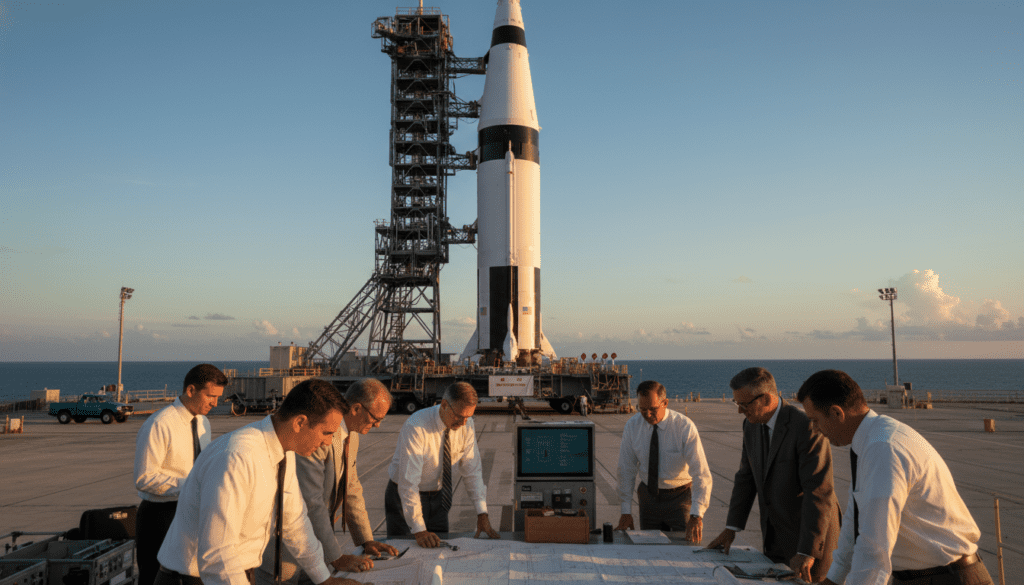
On May 25, 1961, President Kennedy stood before Congress and delivered words that would echo through history. He pledged that America would land astronauts on the Moon and return them safely before the decade ended. This declaration launched the Apollo program into overdrive, mobilizing over 400,000 Americans across the nation. Kennedy framed this ambitious goal as essential to American leadership, calling it a battle between freedom and tyranny in the midst of the cold war space race.
The Cold War Context and Technological Competition
The Soviet Union’s early victories in manned spaceflight intensified American determination. By 1965, the United States allocated over 4% of its federal budget to NASA space missions, while the USSR invested roughly half that amount. The Soviets initiated their lunar program in 1963 as a direct response to Apollo, though it never achieved its goals. Astronaut Frank Borman later described his December 1968 Apollo 8 mission as a battle in the Cold War, highlighting how deeply political tensions influenced the future of space travel.
Building the Foundation with Mercury Seven
Before Americans could dream of reaching the Moon, NASA needed to master basic orbital flight. The Mercury Seven astronauts became the pioneers of American manned spaceflight, testing equipment and procedures that would prove vital for the moon landing date of July 20, 1969. These early missions established crucial knowledge about human endurance in space and validated technologies that would carry astronauts nearly 240,000 miles from Earth.
Apollo 11: The Historic Lunar Landing Mission
The Apollo 11 mission stands as humanity’s greatest achievement in space exploration. On July 16, 1969, three NASA astronauts launched from Kennedy Space Center aboard a Saturn V rocket. Their destination was the lunar surface, where they would make history as the first humans to walk on another celestial body. This mission represented years of preparation and the pinnacle of moon landing technology developed during the 1960s.
The Crew: Neil Armstrong, Buzz Aldrin, and Michael Collins
Commander Neil Armstrong led the Apollo 11 mission crew with his exceptional piloting skills and calm demeanor. Buzz Aldrin served as Lunar Module Pilot, bringing his expertise in orbital mechanics to the mission. Michael Collins, the Command Module Pilot, played a crucial role maintaining the spacecraft in lunar orbit while his crewmates descended to the surface.
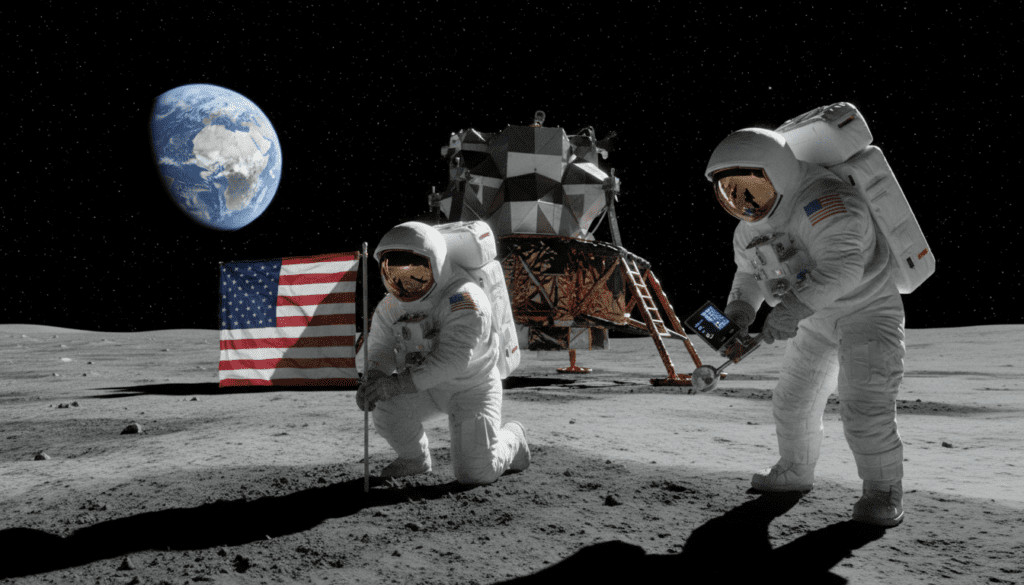
Each astronaut brought unique qualifications to this historic journey. Armstrong had previously flown on Gemini 8, while Buzz Aldrin held a doctorate in astronautics from MIT. Michael Collins had extensive test pilot experience and had completed a spacewalk during Gemini 10.
July 20, 1969: First Steps on the Lunar Surface
The Eagle lunar module separated from the command module and began its descent. Armstrong manually piloted the craft to a safe landing spot with just 25 seconds of fuel remaining. At 20:17 UTC, he radioed the famous words: “The Eagle has landed.”
Six hours later, Armstrong became the first man on the moon, stepping onto the lunar surface at 02:56 UTC on July 21. His immortal words echoed across Earth:
“That’s one small step for man, one giant leap for mankind.”
Buzz Aldrin joined him 19 minutes later, describing the lunar surface as “magnificent desolation.” Together, they spent 2.5 hours exploring outside the Eagle lunar module while Michael Collins orbited overhead in the command module Columbia.
Mission Achievements and Scientific Experiments
The NASA astronauts accomplished several critical objectives during their 21-hour stay on the moon:
- Collected 47.5 pounds of lunar rock and soil samples
- Deployed a solar wind composition experiment
- Installed a laser ranging retroreflector for measuring Earth-moon distance
- Set up seismic equipment to detect moonquakes
- Photographed the lunar surface extensively
- Planted an American flag and left a commemorative plaque
The plaque they left behind carries a message for future generations: “Here men from planet Earth first set foot upon the Moon July 1969 A.D. We came in peace for all mankind.” The crew left goodwill messages from 73 nations, demonstrating that this achievement belonged to all humanity.
Man on the Moon: Scientific Discoveries and Lunar Exploration
The Apollo missions timeline brought back 842 pounds of lunar samples that revolutionized our understanding of the solar system. These precious moon rocks revealed secrets about Earth’s companion that scientists continue studying today. Each mission after Apollo 11 expanded our scientific knowledge, with Apollo 15 through 17 focusing on detailed geological surveys that changed planetary science forever.
Geological Findings and Moon Rock Analysis
Scientists examining moon rocks discovered fascinating similarities and differences with Earth materials. The lunar samples showed the Moon formed 4.6 billion years ago through violent impacts and volcanic activity. Apollo 15’s famous Genesis Rock dated to 4 billion years old, providing crucial moon landing facts about our solar system’s early history.
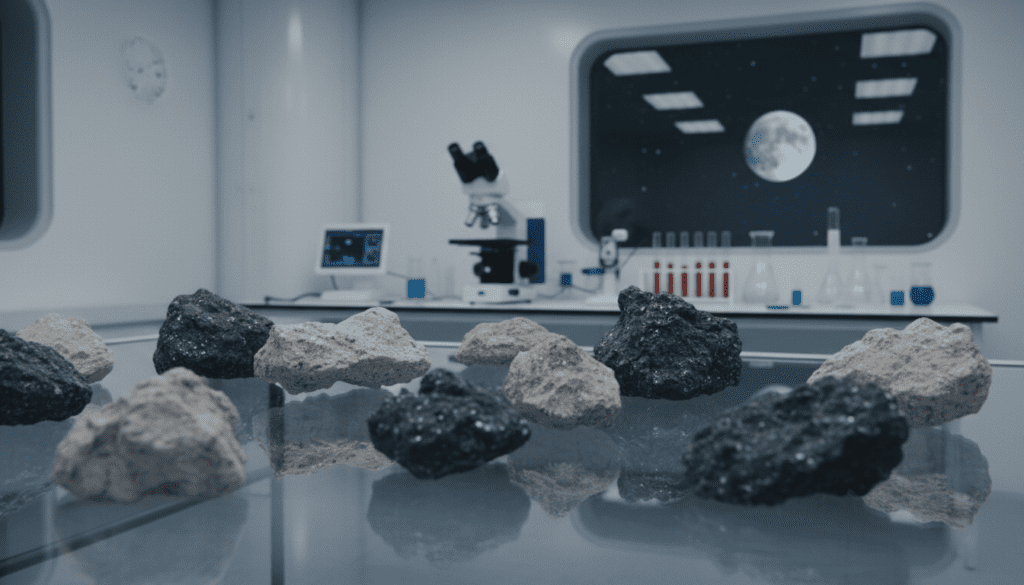
- Moon rocks contain similar minerals to Earth but lack iron and water
- Trapped solar radiation reveals ancient sun activity patterns
- Evidence of massive meteorite impacts from 3.2 to 3.6 billion years ago
- The Moon’s crust formed just 100 million years after Earth’s
Understanding Lunar Formation and Earth’s History
These space science breakthroughs confirmed the Giant Impact Theory – Earth collided with a Mars-sized object, creating the Moon from debris. The lunar module instruments and samples collected during lunar exploration showed the Moon’s far side has thicker crust than the Earth-facing side.
Technological Instruments Left on the Lunar Surface
Apollo astronauts placed laser reflectors that still work today. These mirrors show the Moon drifts away from Earth at 1.5 inches yearly. NASA distributes nearly 400 lunar samples annually to researchers worldwide, proving the lasting value of the Saturn V rocket missions that made collection possible.
The Geopolitical Impact of the Apollo Program
The Apollo program became far more than just a scientific endeavor—it transformed into a defining contest between two superpowers. The moon landing significance extended beyond space travel milestones to reshape global politics for decades. When American astronauts planted their flag on lunar soil, they secured a victory that resonated through diplomatic corridors worldwide.

This competition between the United States and Soviet Union represented what political analysts called “fighting a war without direct casualties.” The space age achievements of Apollo provided America with immense geopolitical prestige during difficult times. While the nation struggled with Vietnam War challenges, these historic space missions offered hope and national pride. The program’s success demonstrated American technological superiority in ways that military conflicts never could.
The moon landing impact influenced Cold War dynamics profoundly. By proving American capabilities in human space exploration, the Apollo program contributed to shifting global perceptions of superpower strength. Many historians argue that these space achievements played a role in the eventual Soviet collapse in 1991.
Political realities eventually caught up with lunar ambitions. President Nixon canceled the final three planned Apollo missions in 1972, prioritizing Vietnam War expenses and domestic concerns. Science fiction author Arthur C. Clarke captured this shift perfectly:
“The Solar System was lost, at least for a while, in the paddy fields of Vietnam.”
Despite this premature ending, Apollo’s geopolitical legacy shaped international relations from the 1970s through the 1990s, proving that extraterrestrial exploration could alter earthbound power structures.
Earthrise and Blue Marble: How NASA Changed Our Perspective of Earth
When astronauts on the moon turned their cameras back toward Earth, they gave humanity a gift beyond scientific data. The images they captured transformed how we see our planet and sparked a global environmental awakening that continues today.
The Birth of Environmental Consciousness
On Christmas Eve 1968, Apollo 8 astronaut Bill Anders snapped a photograph that would change everything. The Earthrise image showed our blue planet floating above the lunar horizon, fragile and alone in the cosmic darkness. Four years later, Apollo 17’s crew captured the Blue Marble photograph from 29,000 kilometers away, revealing Earth in stunning detail with Africa, Antarctica, and the Arabian Peninsula clearly visible.

These photographs became catalysts for environmental awareness. Stewart Brand featured Earth’s image on his Whole Earth Catalog cover in 1968, while David Brower founded Friends of the Earth the following year. The space mission timeline coincided perfectly with growing ecological concerns, turning abstract environmental ideas into visceral reality.
Inspiring Global Movements and Earth Day
John McConnell printed the Earthrise photograph on flags, which helped inspire the first Earth Day in 1970. Today, over 175 countries celebrate this event annually. NASA’s collection of Earth photographs documents this visual journey that began with early satellite images and culminated in these transformative Apollo missions.
The Philosophical Shift in Human Understanding
Bill Anders famously reflected: “We came all this way to explore the Moon and discovered the Earth.” Poet Archibald MacLeish captured this revelation, writing about humanity as “brothers who know now they are truly brothers… riders on Earth together.”
Technological Revolution: From Apollo to Modern Computing
The moon landing technology developed during the 1960s sparked a computing revolution that shapes our daily lives today. When NASA needed navigation computers small enough to fit inside spacecraft, they turned to MIT’s Instrumentation Laboratory. This partnership would transform not just space exploration but the entire electronics industry.
MIT’s Breakthrough in Computer Miniaturization
MIT engineers faced an unprecedented challenge: shrinking room-sized computers into briefcase-sized units for the Apollo missions timeline. Their solution involved using integrated circuits, a cutting-edge technology from Fairchild Semiconductor. NASA’s order of one million chips provided the financial boost this emerging industry desperately needed. This investment in space science breakthroughs created ripple effects across multiple sectors.
The Birth of Intel and the Microelectronics Industry
In 1969, the same year humans first walked on the moon, two Fairchild employees named Gordon Moore and Robert Noyce founded Intel Corporation. The moon landing legacy directly influenced their decision to start this company. NASA’s massive chip orders had proven that miniaturized electronics could be profitable at scale. Intel’s microprocessors would later power the personal computer revolution of the 1980s.
From Moon Walk to Smartphones: The Digital Legacy
The technological advances from space exploration accelerated computer development by 10 to 15 years. Apollo engineer Glynn Lunney observed that the program pushed industry forward by two decades. Today’s smartphones trace their technological lineage directly back to Apollo’s guidance computers. From pocket calculators in the 1970s to modern tablets and wireless devices, each innovation builds upon NASA’s original investment in miniaturized computing.
The Human Spirit and Space Exploration: Cultural Transformation
The Apollo program ignited a cultural revolution that reached far beyond the lunar surface. When astronauts took their first moon walk, they sparked dreams in millions of young minds worldwide. This cosmic journey transformed not just science but the very fabric of society itself.
Universities across America saw engineering and science PhD enrollments triple after the moon landing. Young students who watched the Apollo 11 mission on television rushed to become scientists and innovators. Professor Brian Cox credits those NASA space missions with inspiring his career in physics. Tim Berners-Lee, who later invented the World Wide Web, found his passion for technology while watching astronauts explore the extraterrestrial frontier.

Science fiction writer Arthur C. Clarke wept at the Apollo 11 launch, calling it “the last day of the old world.” His tears captured what millions felt—humanity had crossed into a new era. The moon walk represented more than technical achievement; it symbolized unlimited human potential.
Today’s space entrepreneurs trace their ambitions back to that cosmic journey. Richard Branson, Elon Musk, Paul Allen, and Jeff Bezos each describe experiencing an “Apollo effect” that shaped their destinies. Bezos even served as president of Students for Exploration and Development of Space before founding Amazon.
Rusty Schweickart’s extraterrestrial experience during his moon walk led him to see Earth without borders or divisions. This vision inspired him to establish the Association of Space Explorers in 1985, uniting 375 astronauts from 35 nations. The Apollo 11 mission didn’t just put footprints on lunar dust—it left permanent marks on human consciousness.
Future Missions: Artemis and Humanity’s Return to the Moon
After decades of waiting, future missions to the Moon are becoming reality. NASA astronauts will once again travel beyond Earth’s orbit as part of the Artemis program. This ambitious project marks a new chapter in space exploration history, building on the moon landing significance from Apollo while pushing toward permanent lunar presence.
The Lunar Orbital Platform-Gateway Initiative
The Gateway station will orbit the Moon and serve as a staging point for lunar exploration. Unlike Apollo’s direct missions, this space station allows NASA astronauts to prepare for surface operations while maintaining a permanent presence near the Moon. Canada, Japan, and European partners are contributing critical systems to this international effort.
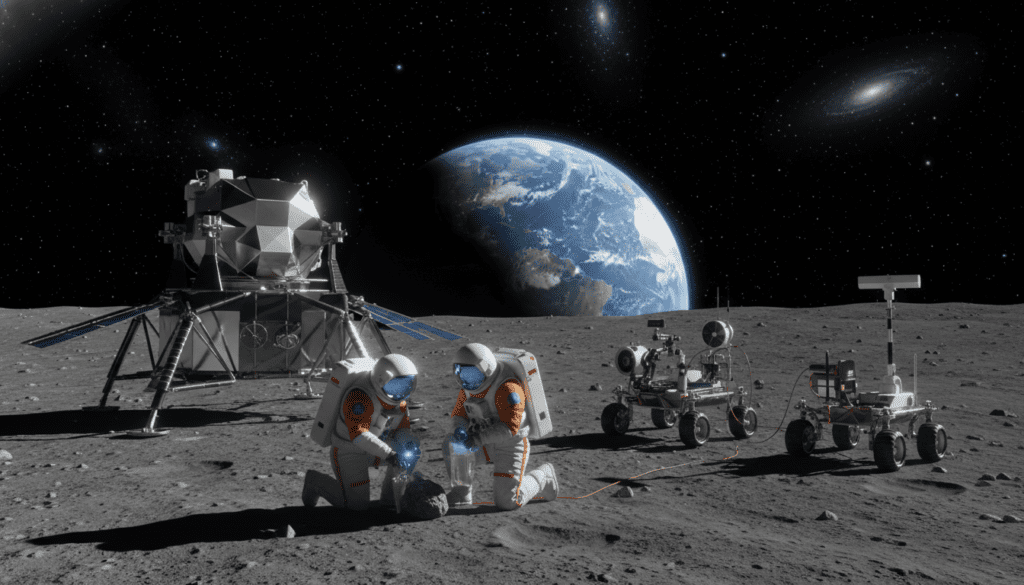
Artemis Program and Plans for Lunar Settlement
The Artemis program represents the next evolution of manned spaceflight. Artemis II will carry astronauts around the Moon’s far side without landing, testing systems for future missions. Artemis III aims to land the first woman and next man on the lunar surface. Water-ice discoveries at the Moon’s poles have sparked renewed interest in establishing permanent bases for human space exploration.
International Collaboration in Modern Space Exploration
Unlike the competitive race of the 1960s, today’s lunar exploration involves global partnerships. Space agencies worldwide recognize the moon landing significance extends beyond national achievement. Working together, nations share costs, technology, and expertise to ensure sustainable human presence on the Moon. This cooperation sets the foundation for deeper space missions to Mars and beyond.
Conclusion
The Apollo program stands as one of the greatest space travel milestones in human history. When Neil Armstrong and Buzz Aldrin walked on the lunar surface in 1969, they fulfilled President Kennedy’s ambitious vision and proved that human space exploration could overcome any challenge. This historic space mission cost approximately $160 billion in today’s dollars, yet its value extends far beyond monetary measures. The moon landing legacy continues to shape our world through countless technological innovations that touch every aspect of modern life.
The moon landing impact reaches beyond scientific achievements. The famous Earthrise photograph transformed how we see our planet, sparking environmental movements and a new global consciousness. The Apollo program pushed engineers to create smaller, faster computers that evolved into the smartphones and devices we use today. These space age achievements inspired generations of scientists, engineers, and entrepreneurs to push boundaries in fields ranging from medicine to telecommunications. The evidence of man on the moon remains visible through lunar samples, photographs, and equipment left behind on the lunar surface.
As we look toward future missions like Artemis, the lessons from Apollo guide our next steps in space exploration. The program proved that seemingly impossible goals become achievable when nations commit their resources and talent to a common purpose. Konstantin Tsiolkovsky once said that Earth is humanity’s cradle, but we cannot remain in the cradle forever. The Apollo missions represented humanity’s first steps beyond that cradle. Today’s international space partnerships and commercial space ventures build directly on the foundation Apollo created, ensuring that human space exploration will continue reaching new frontiers for generations to come.