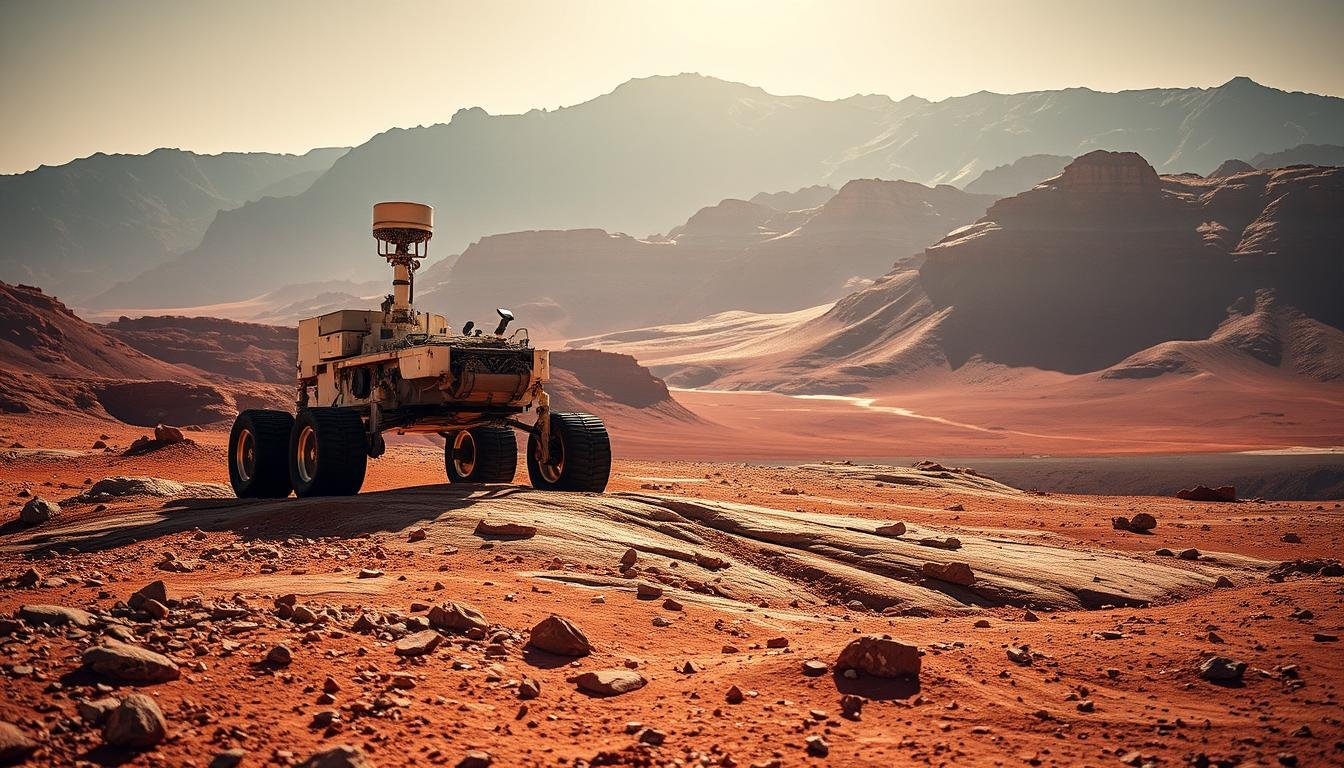
What if we are not alone in the cosmos? This profound question has driven exploration for generations. Now, a groundbreaking discovery on the Red Planet brings us closer than ever to an answer.
NASA’s Perseverance rover mission achieved a historic milestone. In the Jezero Crater, the rover collected a sample from a rock named “Cheyava Falls.” This sample, called “Sapphire Canyon,” contains potential biosignatures.
This finding represents a pivotal moment in the search for extraterrestrial life. It suggests that Mars may have once harbored conditions suitable for ancient microbial organisms. Scientists call this the closest we have ever come to a major discovery.
While the evidence is compelling, researchers emphasize caution. These are potential signs that require further study. This article explores the astonishing truth behind this revelation on the Red Planet and its implications for our place in the universe.
Introduction to Mars Exploration and Recent Discoveries
Decades of scientific inquiry have focused on understanding the geological history of our neighboring world. Researchers have long been captivated by evidence suggesting liquid water once flowed across the Martian surface.
Background on Mars Studies and Jezero Crater
The search for preserved signs of ancient microbial organisms led NASA to select Jezero Crater as the ideal landing site. This 45-kilometer-wide basin once contained a massive lake fed by an ancient river delta system.
Water is essential for life as we know it. The crater’s history makes it a prime target for discovering potential biosignatures in sedimentary rocks.
NASA’s Perseverance Mission Highlights
NASA’s Perseverance rover landed in February 2021 as the centerpiece of the Mars 2020 mission. The rover’s primary goal involves collecting carefully selected rock and soil samples.
In July 2024, the Perseverance rover discovered the Cheyava Falls rock formation while exploring Neretva Vallis. This ancient river valley once channeled water into the crater lake.

The mission represents decades of strategic planning. Perseverance carries advanced instruments designed to analyze rock chemistry and detect organic compounds.
To date, the rover has collected 27 rock cores for potential return to Earth. These samples may hold answers about the planet’s distant past when conditions were more hospitable.
Breaking Down the Latest Scientific Findings
Scientific breakthroughs often come from unexpected places, and the Bright Angel formation is proving to be one such source. This distinctive set of light-toned rocky outcrops has revealed surprising details about Mars’ ancient past.
Key Observations from Bright Angel and Neretva Vallis
While exploring Neretva Vallis, Perseverance encountered thick layers of fine-grained mudstones and muddy conglomerates. These rock types typically form in calm water environments where delicate biological signatures can be preserved.
The discovery was particularly surprising. Researchers found lake sediments within what was once a river valley. This suggests the valley itself flooded, creating an extensive lake that persisted for a significant period.
The Bright Angel rocks contain rich mineral compositions including clay, silica, and silt. On Earth, these materials excel at preserving fossilized microorganisms. The finding also revealed organic carbon, sulfur, oxidized iron, and phosphorus.

Significance of Rock Samples like Sapphire Canyon
The Sapphire Canyon sample represents a major scientific achievement. It was drilled from the arrowhead-shaped Cheyava Falls rock, measuring approximately 3.2 by 2 feet.
This sample stands out as one of the most valuable collected during the entire mission. Its unique mineral compositions and organic signatures make it exceptionally promising for study.
Imperial College London researchers provided essential geological context. Their analysis helped reconstruct the ancient lake environment from sedimentary evidence. This international collaboration underscores the global importance of this discovery.
The evidence suggests Mars could have been habitable later in its history than previously thought. These younger sedimentary rocks open new possibilities for understanding the planet’s potential to support life.
Understanding the Chemistry Behind Potential Biosignatures
The chemical patterns within the Cheyava Falls rock tell a story of potential ancient processes. Perseverance’s advanced instruments were the first to collect this crucial data.

These tools analyze rock chemistry at a microscopic scale. This allows scientists to detect organic compounds and specific mineral compositions.
Role of Instruments like PIXL and SHERLOC
The PIXL and SHERLOC instruments are vital for this study. They discovered colorful spots, nicknamed “leopard spots,” on the rock sample.
These spots are actually reaction fronts. They are points where chemical and physical reactions occurred over time.
Insights into Reaction Fronts and Mineral Pairings
The leopard spots revealed a distinct bullseye pattern. It featured rims of the mineral vivianite surrounding cores of greigite.
On Earth, this specific mineral pairing is often linked to microbial activity. Vivianite forms around decaying organic matter, while some microbes produce greigite.
The arrangement suggests a sequence of electron transfer reactions. These redox reactions involve organic carbon, iron, sulfur, and phosphorus.
The Importance of Organic Carbon and Mineral Evidence
The instruments mapped organic carbon in a distinct, repeating pattern with these minerals. This combination could represent a chemical fingerprint of ancient microbial metabolism.
Lead author Joel Hurowitz stated this mix of compounds could have been a rich energy source. This aligns with the recent potential biosignature discovery.
Scientists remain cautious, as abiotic processes can sometimes create similar signs. However, the evidence from Bright Angel strongly points toward a biological origin.
life on mars: Potential Evidence and Emerging Discoveries
In the meticulous field of astrobiology, a potential biosignature represents a cautious but thrilling first step. It describes a substance or pattern that could have a biological origin. Scientists require more data before confirming its source.

Interpreting the Leopard Spots and Mineral Signatures
The circular “leopard spots” found in the Bright Angel rocks are highly compelling. They show a specific pairing of the minerals vivianite and greigite.
On Earth, this exact combination often forms through microbial activity in low-oxygen sediments. The pattern strongly suggests a biological process.
Researchers must also consider non-biological, or abiotic, explanations. Extreme heat or acidic conditions can sometimes create similar mineral signatures.
However, the geological evidence at the Bright Angel site argues against these harsh abiotic scenarios. The rocks show no signs of the required extreme conditions.
“This very well could be the clearest sign of life that we’ve ever found on Mars,”
This discovery also suggests habitable conditions, with liquid water, may have lasted longer on the Red Planet than previously thought. The relatively young age of these rocks expands the potential window for ancient organisms.
The scientific community uses a careful framework called the CoLD scale. It outlines seven benchmarks for confidently confirming a biosignature.
Mission scientists emphasize this is a promising finding, not definitive proof. Extraordinary claims require extraordinary evidence, which future lab studies on Earth will provide.
Implications for Future Mars Missions and Sample Return
As the Sapphire Canyon sample awaits transport to Earth, scientists worldwide are preparing for what could be the most significant analysis in planetary science history. This discovery validates the strategic approach of collecting diverse geological samples rather than attempting all analysis robotically.
How Laboratory Analyses Could Confirm Biosignatures
The Mars Sample Return mission represents a critical next step. This joint NASA-ESA endeavor aims to retrieve cached samples in the 2030s.
Earth laboratories can perform analyses impossible on the Red Planet. Scientists will conduct precise isotope ratio measurements and high-resolution electron microscopy.
These advanced techniques can distinguish biological from non-biological carbon sources. Researchers will also test whether abiotic processes can reproduce the mineral patterns.

The Impact on Future Human and Robotic Exploration
Findings from the Sapphire Canyon sample will directly influence future mission planning. They will help identify geological settings most likely to preserve biosignatures.
Current exploration already supports future human presence. The Perseverance rover tests spacesuit materials and monitors environmental conditions.
Professor Sanjeev Gupta emphasized, “This is a very exciting discovery of a potential biosignature but it does not mean we have discovered life on Mars. We now need to analyze this rock sample on Earth to truly confirm if biological processes were involved or not.”
International collaboration continues with missions like the Rosalind Franklin rover. This European mission will drill deeper into the Martian subsurface.
Conclusion
Robotic exploration at Jezero Crater has delivered a scientific treasure that could reshape our cosmic perspective. The identification of a potential biosignature in the Bright Angel formation represents humanity’s closest approach to confirming ancient microbial activity beyond Earth.
As Acting NASA Administrator Sean Duffy stated, “This finding by Perseverance is the closest we have ever come to discovering life on Mars.” The international collaboration between NASA, Imperial College London, and other institutions demonstrates how complex planetary science requires global expertise.
While the mineral signatures and organic carbon patterns strongly suggest biological processes, scientists emphasize caution. Professor Sanjeev Gupta noted this discovery “is a huge step forward” but requires Earth laboratory analysis for definitive confirmation of the sample’s origin.
The cached Sapphire Canyon sample now awaits the Mars Sample Return mission. This next phase of study will determine if the Red Planet once hosted living organisms, answering one of humanity’s most profound questions about our place in the universe.