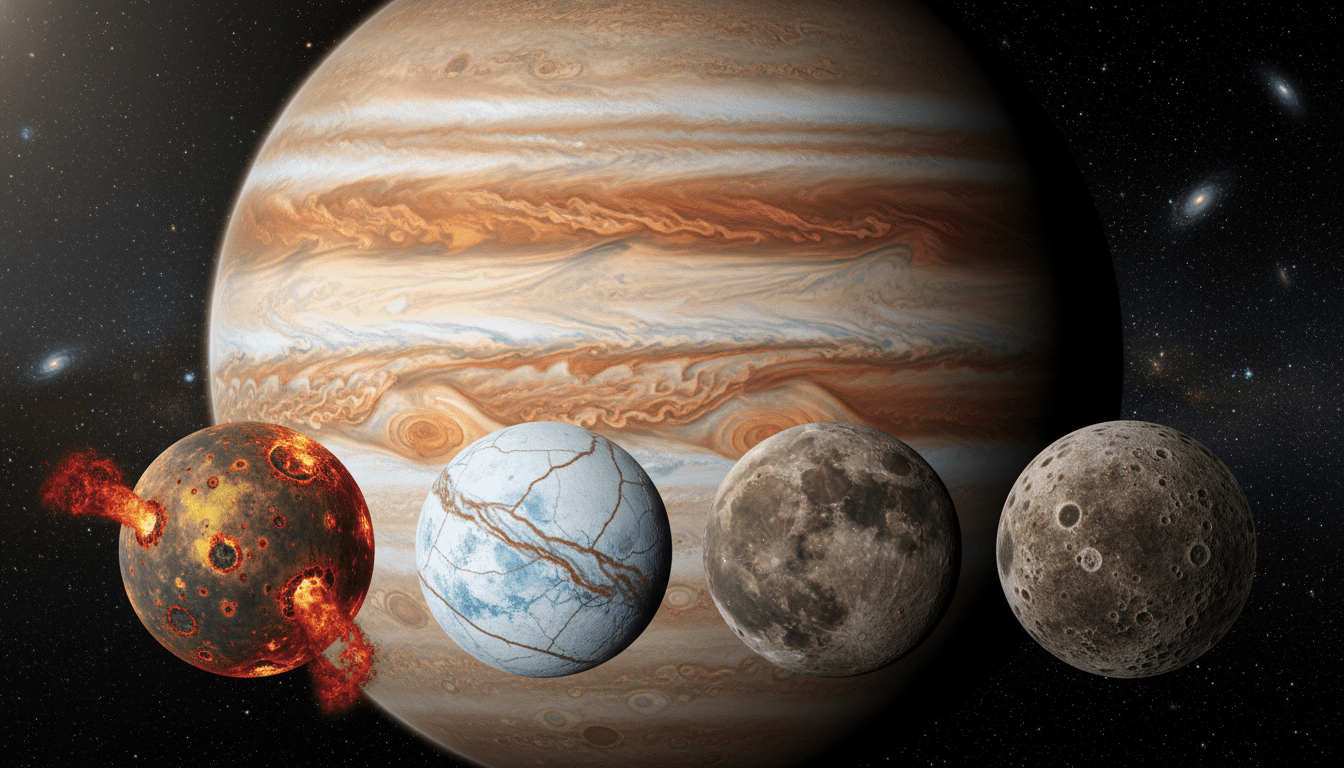
The giant planet Jupiter hosts an amazing collection of 95 moons that the International Astronomical Union has officially recognized. These astronomical bodies create one of the most complex satellite systems in our solar system. Each moon tells its own story about the formation and evolution of the Jovian system.
Scientists first spotted Jupiter moons on January 7, 1610, when Galileo Galilei turned his telescope toward the gas giant. His discovery of the four largest satellites changed how we understand our place in the universe. These were the first moons anyone had seen orbiting another planet.
The Jovian system contains thousands of small objects circling the planet. Rings, asteroids, and tiny moonlets fill the space around Jupiter. Modern telescopes have become so powerful that astronomers find new small moons regularly. The International Astronomical Union now gives mythological names only to moons that show special scientific value.
Jupiter’s moons range from tiny rocks just a few miles wide to massive worlds larger than the planet Mercury. Some have active volcanoes shooting lava hundreds of miles into space. Others hide vast oceans beneath icy surfaces. These astronomical bodies continue to surprise scientists with each new mission that visits them.
The Fascinating World of Jupiter Moons
Jupiter’s natural satellites create one of the most captivating systems in our solar neighborhood. These celestial bodies orbit the giant planet in a complex dance that has amazed astronomers for centuries. From tiny irregular rocks to massive worlds rivaling planets in size, the Jovian moons showcase incredible diversity in our cosmic backyard.
Discovery and Historical Significance
The first moon discoveries around Jupiter revolutionized our understanding of the universe. When Galileo Galilei spotted four bright points of light near Jupiter in 1610, he shattered the ancient belief that everything revolved around Earth. This groundbreaking observation proved that celestial objects could orbit other planets, supporting the revolutionary idea that Earth wasn’t the center of everything.
Current Moon Count and Classification
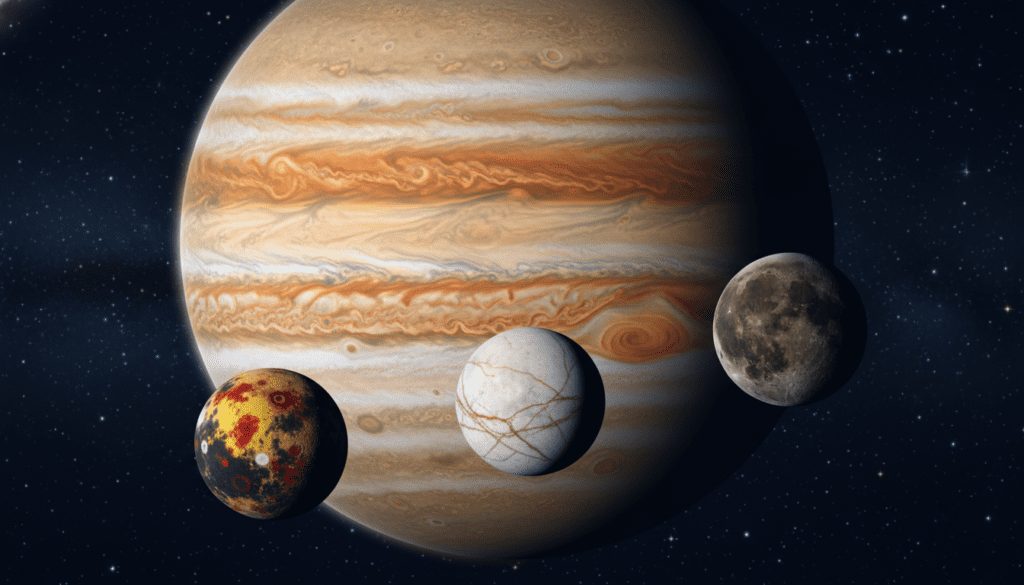
Scientists now recognize 95 confirmed moons orbiting Jupiter, though earlier counts listed Jupiter’s 79 moons before recent discoveries expanded the total. The Jovian moons fall into distinct groups:
- Four giant Galilean satellites visible through small telescopes
- Inner moons that help create Jupiter’s faint ring system
- Irregular outer satellites with tilted or backward orbits
- Captured asteroids that became permanent residents
The Jovian System’s Complexity
Jupiter’s natural satellites range from icy worlds hiding subsurface oceans to volcanic landscapes spewing sulfur hundreds of miles into space. Three moons likely contain liquid water beneath frozen surfaces, making them prime targets for astrobiology research. The largest Galilean satellites possess their own magnetospheres and show signs of ongoing geological activity rarely seen elsewhere in our solar system.
Galilean Satellites: The Four Giant Moons
The Galilean satellites represent one of astronomy’s most groundbreaking discoveries. These four celestial bodies – Io, Europa, Ganymede, Callisto – transformed our understanding of the universe and remain among the most studied objects in our solar system today.
Galileo’s Revolutionary Discovery in 1610
On January 7, 1610, Italian astronomer Galileo Galilei pointed his telescope at Jupiter and noticed something extraordinary. Four bright dots surrounded the giant planet, appearing like tiny stars through his primitive instrument. Night after night, he watched these dots change position, proving they orbited Jupiter rather than Earth. This observation shattered the belief that everything in the cosmos revolved around our planet.
Simon Marius and the Naming Convention
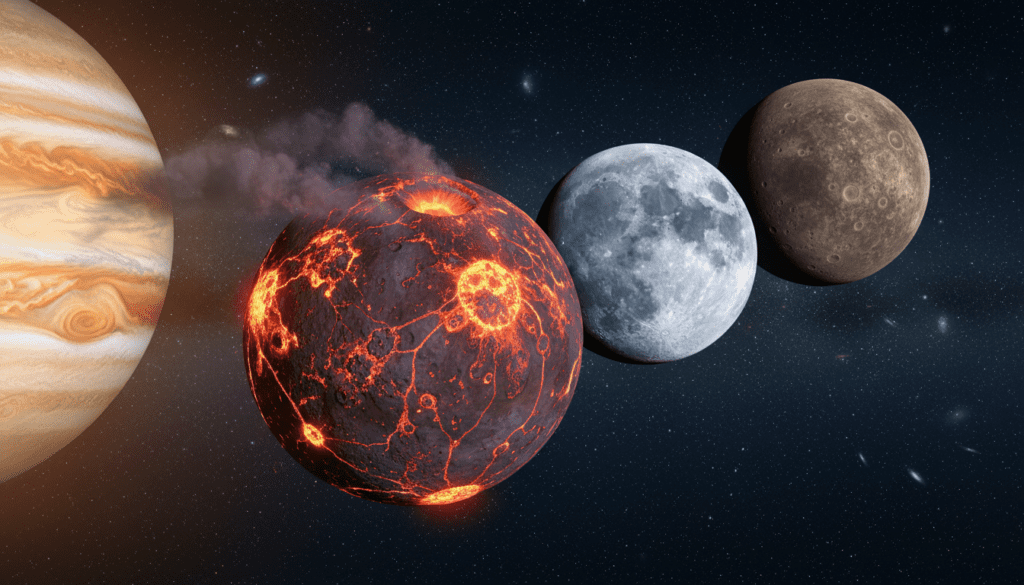
German astronomer Simon Marius observed the largest moons of Jupiter around the same time as Galileo but published his findings later. In 1614, Marius gave these satellites their mythological names, following a suggestion from Johannes Kepler. Each name – Ganymede, Callisto, Io, and Europa – represents a character from Greek mythology who had connections to Zeus, the Greek equivalent of Jupiter.
Size Comparison and Orbital Characteristics
Jupiter’s largest moons vary significantly in size and distance from their parent planet:
- Ganymede: Larger than Mercury, orbits at 665,000 miles
- Callisto: Nearly Mercury’s size, orbits at 1.17 million miles
- Io: Slightly bigger than Earth’s Moon, orbits at 262,000 miles
- Europa: Smallest of the four, orbits at 417,000 miles
These Galilean satellites remain visible through small telescopes and binoculars, making them accessible to amateur astronomers worldwide.
Ganymede: The Solar System’s Largest Moon
Among the spectacular sights in Jupiter’s lunar system stands Ganymede largest moon in our entire solar system. This remarkable world surpasses even the planet Mercury in size, measuring an impressive 3,273 miles (5,268 kilometers) in diameter. What makes this giant satellite truly special goes beyond its size—it holds the unique distinction of being the only moon with its own magnetic field.
The surface of this extraordinary member of the moon system of Jupiter tells a story billions of years old. A thick outer shell of ice, approximately 150 kilometers deep, preserves countless craters from ancient cosmic impacts. These scars reveal that Ganymede has remained geologically quiet for eons, with no tectonic activity to erase its history.
Beneath the frozen exterior lies an even more intriguing secret. Scientists believe Ganymede harbors multiple ocean layers sandwiched between sheets of ice—a unique arrangement in Jupiter’s lunar system. The deepest ocean layer sits directly against the moon’s rocky core, where hydrothermal vents might provide energy similar to those found in Earth’s deep seas.
“Ganymede may contain more water than all of Earth’s oceans combined, making it the most water-rich body in the Solar System.”
This layered ocean structure makes Ganymede particularly fascinating to researchers studying potentially habitable worlds. The combination of liquid water, rocky minerals, and possible energy sources creates conditions that could theoretically support primitive life forms deep within this frozen giant.
Europa’s Hidden Ice Ocean and Life Potential
Among Jupiter’s fascinating collection of icy moons, Europa stands out as one of the most intriguing worlds in our solar system. This moon holds secrets beneath its frozen exterior that have captivated scientists for decades. The icy moon Europa presents a unique combination of features that make it a prime candidate in the search for extraterrestrial life.
The Frozen Surface Mystery
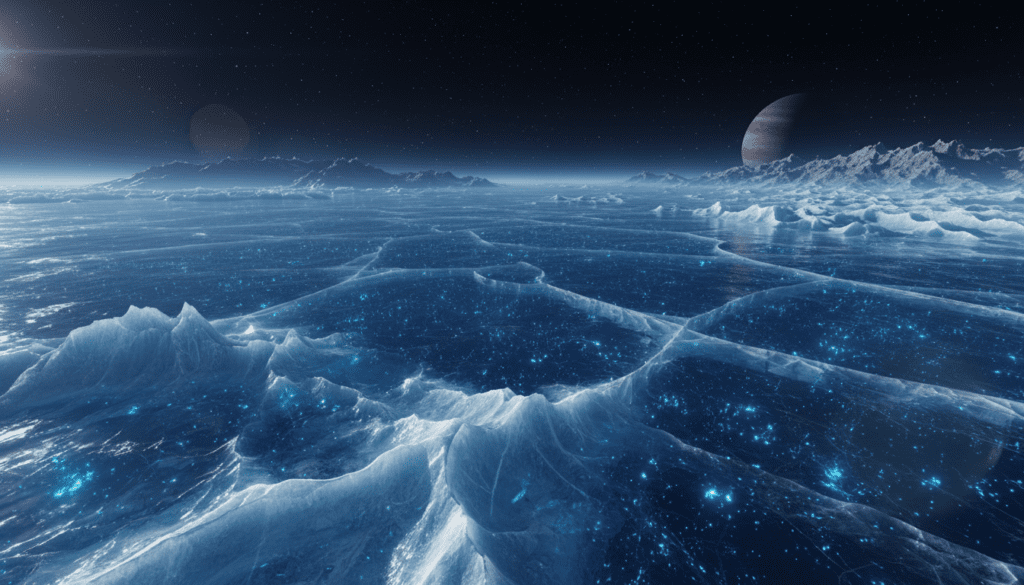
Europa displays the smoothest surface found anywhere in the solar system. Unlike other icy moons, Europa lacks towering mountains, deep craters, or vast canyons. Instead, its surface features distinctive stripe-like cracks crisscrossing the icy shell. These mysterious patterns suggest something remarkable lurks beneath.
Subsurface Ocean Discoveries
Beneath approximately 30 kilometers of ice, scientists have detected a vast Europa ice ocean stretching 70 to 100 kilometers deep. This hidden ocean contains twice the volume of water found in all Earth’s oceans combined. The salty waters appear to be in direct contact with the rocky seafloor below, creating conditions where hydrothermal vents might exist.
“The ocean of Europa is one of the most promising places to look for present-day life beyond Earth.” – NASA Astrobiologist
Astrobiological Significance
Europa possesses all the essential ingredients for life as we know it:
- Abundant liquid water in the subsurface ocean
- Organic compounds delivered by comets and asteroids
- Energy sources from potential hydrothermal vents
- Chemical interactions between ocean and rocky mantle
The constant surface regeneration observed on Europa indicates active geological processes linking the ocean to the surface, potentially cycling nutrients and energy throughout the moon’s interior.
Io’s Extreme Volcanic Activity
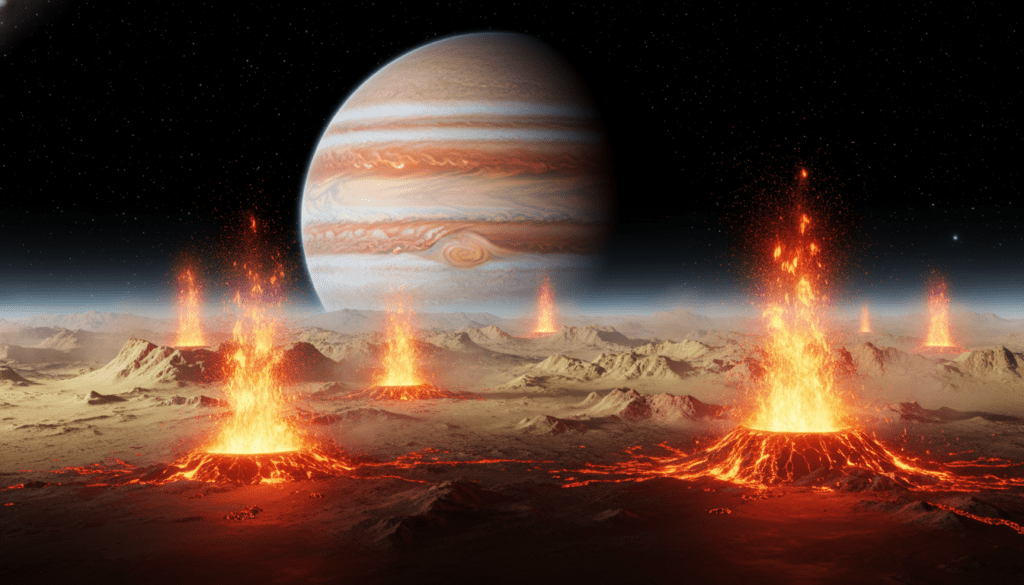
Among Jupiter’s many moons, Io stands out as the most geologically violent world in our Solar System. This remarkable moon transforms our understanding of planetary geology with its relentless volcanic eruptions that never cease. Scientists have identified over 400 active volcanoes on its surface, making io volcanic activity a phenomenon unlike anything else we’ve observed in space.
Most Volcanically Active World
The volcanic moon Io produces an astounding amount of lava—100 times more than all of Earth’s volcanoes combined. These eruptions reach scorching temperatures exceeding 1,000 degrees Celsius. NASA’s observations reveal that Io remains the only other rocky body besides Earth displaying large-scale volcanic activity of this magnitude.
Tidal Heating Phenomenon
Jupiter’s immense gravity creates a unique situation for Io. The moon’s rocky surface rises and falls by 100 meters with each tidal cycle. This gravitational squeeze generates internal friction that melts rock into magma. A vast magma layer lies 50 kilometers beneath the surface, possibly extending as deep as the rock layer above it.
Volcanic Eruptions Extending Hundreds of Kilometers
The io volcanic activity produces spectacular eruption plumes that shoot hundreds of kilometers into space. These massive volcanic fountains create an atmosphere around Io and contribute material to Jupiter’s magnetosphere. The gravitational dance between Io and its neighboring moons maintains an eccentric orbit that keeps the internal heat engine running continuously.
Callisto’s Ancient Craters and Mysteries
Among the four Galilean moons in the Jupiter satellite system, Callisto stands out as a frozen time capsule. This ancient world ranks as the third-largest moon in our Solar System, falling just 60 kilometers short of Mercury’s size. Its battered surface tells a story spanning billions of years.
Every square kilometer of Callisto bears witness to cosmic bombardment. Scientists have identified more impact sites here than on any other object in our Solar System. The surface is so saturated with craters that new space rocks can only strike existing ones. Each Callisto crater overlaps another, creating a complex pattern that resembles a heavily worn dartboard.
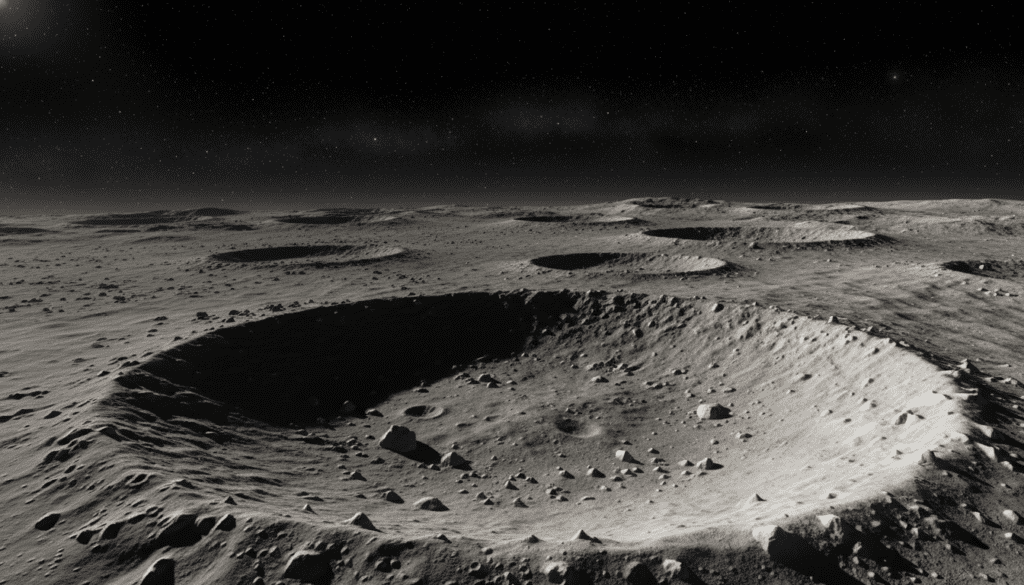
What makes this moon unique within the Jupiter satellite system is its complete lack of geological activity. Unlike its volcanic sibling Io or tectonically active Europa, Callisto remains perfectly still. The moon consists of an unusual blend—half rock and half water ice mixed throughout its interior. This composition creates a stable structure that resists change.
Deep beneath the cratered surface lies an intriguing secret. Scientists have detected signs of liquid water hiding far below the frozen crust. Yet this hidden ocean faces a critical limitation. The water never touches the rocky core below, preventing the formation of hydrothermal vents. Without these energy sources that might support life on Earth’s ocean floors, Callisto’s subsurface waters remain cold and isolated. This separation makes the moon less promising for astrobiology compared to Europa, despite both harboring hidden oceans.
Jupiter Satellite System Beyond the Big Four
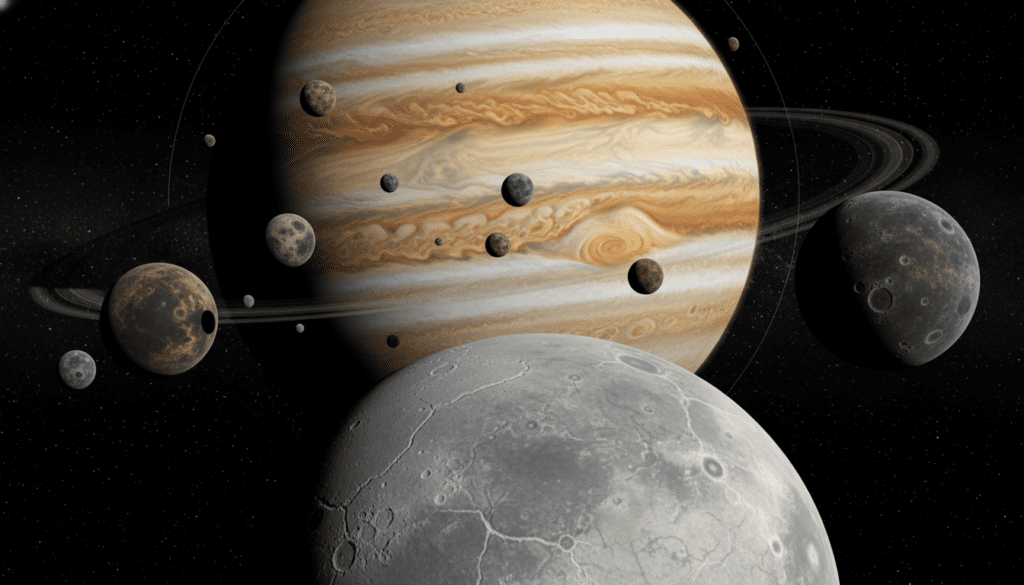
While the Galilean moons steal the spotlight, Jupiter’s natural satellites extend far beyond these four giants. The planet hosts an astonishing collection of 95 officially recognized moons, ranging from tiny captured asteroids to mysterious inner satellites that help shape the planet’s faint ring system.
Inner Moons and Ring Material
Four small moons orbit closer to Jupiter than Io does. These inner astronomical bodies—Metis, Adrastea, Amalthea, and Thebe—play a crucial role in maintaining Jupiter’s delicate ring system. As these moons travel through space, they shed dust particles that form the planet’s gossamer rings. Amalthea, the largest of this group, measures just 167 kilometers across and appears reddish due to sulfur compounds from Io’s volcanic eruptions.
Irregular Satellites and Recent Discoveries
Most moon discoveries in recent years involve irregular satellites—captured asteroids that wandered too close to Jupiter’s massive gravitational pull. These astronomical bodies follow tilted or backward orbits, suggesting they weren’t born alongside Jupiter but were caught later. Scientists discovered 12 new moons in 2018 alone, including Valetudo, a tiny moon just one kilometer wide that orbits in the opposite direction of its neighbors.
International Astronomical Union Recognition Process
The International Astronomical Union maintains strict standards for recognizing Jupiter’s natural satellites. New moon discoveries must complete multiple observations to confirm their orbits around Jupiter. Today’s advanced telescopes can spot objects as small as one kilometer across, but these tiny worlds don’t automatically receive mythological names. Only moons with significant scientific importance earn traditional names, while others receive numerical designations.
Pioneering Jupiter Moon Exploration Missions
The journey of jupiter moon exploration began decades ago with groundbreaking spacecraft that transformed our understanding of these distant worlds. Each mission built upon previous discoveries, revealing the incredible complexity of gas giant satellites that orbit the largest planet in our solar system.
Pioneer and Voyager Breakthroughs
NASA’s Pioneer 10 and Pioneer 11 spacecraft became the first to fly past Jupiter in the early 1970s. These missions paved the way for the Voyager program. In 1979, Voyager 1 and Voyager 2 captured stunning images that changed everything scientists knew about Jupiter’s moons. The spacecraft revealed Europa’s remarkably smooth, icy surface and provided the first hints of a possible ocean beneath its frozen shell.
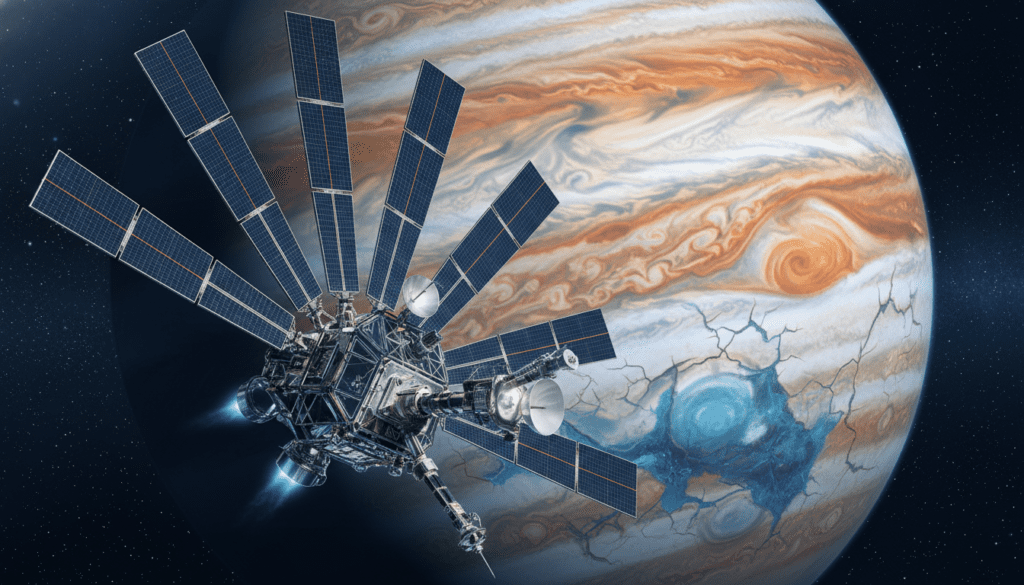
Galileo Orbiter’s Revolutionary Findings
NASA jupiter exploration reached new heights with the Galileo spacecraft, which orbited Jupiter from 1995 to 2003. This mission captured breathtaking global views of Io and documented active volcanic eruptions at Tvashtar Catena. During its tenth orbit, Galileo provided detailed observations of Io’s Pele Hemisphere, showing volcanic plumes shooting hundreds of miles into space.
Cassini-Huygens and New Horizons Flybys
While heading to Saturn, Cassini-Huygens flew past Jupiter in 2000, capturing valuable data about the gas giant satellites. The New Horizons spacecraft followed in 2007 on its way to Pluto, providing fresh perspectives on the volcanic activity of Io and studying the atmospheric dynamics of Jupiter’s largest moons.
NASA Juno Mission’s Current Discoveries
The NASA Juno mission continues to revolutionize our understanding of the Jovian system since entering Jupiter’s orbit in 2016. While its primary focus remains studying Jupiter’s atmosphere and interior, this spacecraft has become an invaluable tool for jupiter moon exploration, capturing breathtaking images and scientific data about the gas giant’s satellites.
Juno has photographed Ganymede, Io, and Europa from distances reaching 6.2 million kilometers. These views resemble what astronomers see through powerful telescopes on Earth, yet they provide unprecedented detail about these fascinating worlds. The spacecraft’s unique polar orbit allows it to observe these moons from angles never before possible.
One of Juno’s most significant contributions involves studying how these moons interact with their parent planet. The NASA Juno mission revealed that the Galilean moons’ gravity creates subtle changes in Jupiter’s shape. These gravitational tugs cause tiny distortions in the planet’s structure that scientists can now measure with precision instruments.
The spacecraft made history in 2021 when it conducted the closest flyby of Ganymede in over two decades. This encounter provided detailed images showing the moon’s icy surface features, including craters, grooves, and light and dark regions. Scientists use this data to better understand how the largest moon in our solar system formed and evolved.
The Jovian system’s magnetic environment proves equally fascinating. Juno discovered that Jupiter’s powerful magnetic field sweeps up particles ejected from the moons’ surfaces. These particles fill the planet’s magnetosphere, creating a complex web of interactions that affects everything from auroras to radiation belts.
Future Missions to Gas Giant Satellites
Scientists are preparing groundbreaking missions to explore Jupiter’s icy moons in the coming decade. These ambitious projects aim to unlock secrets hidden beneath frozen surfaces and search for signs of habitability on gas giant satellites. Two major spacecraft will revolutionize our understanding of Europa and Ganymede through advanced technology and carefully planned investigations.
Europa Clipper’s Upcoming Investigation
NASA’s Europa Clipper will launch in October 2024, beginning its journey to study one of the most promising icy moons in our solar system. The spacecraft will perform nearly 50 close flybys of Europa, using nine scientific instruments to investigate the moon’s ice shell and subsurface ocean. Scientists believe hydrothermal vents on Europa’s ocean floor could create conditions similar to those where life first appeared on Earth. The mission will measure ice thickness, analyze surface composition, and search for active geysers that might provide samples from the hidden ocean below.

ESA’s JUICE Mission Objectives
The European Space Agency launched its Jupiter Icy Moons Explorer (JUICE) in April 2023 aboard an Ariane 5 rocket. This sophisticated probe will reach Jupiter in July 2031 and become the first spacecraft to orbit Ganymede in December 2034. JUICE carries ten scientific instruments, including a 40-kilogram infrared spectrometer developed over 15 years. The mission will study three gas giant satellites:
- Ganymede’s unique magnetic field and internal structure
- Callisto’s ancient surface and possible subsurface ocean
- Europa’s chemical composition and ice shell dynamics
Search for Habitable Environments
Both missions focus on identifying conditions that could support life on these distant icy moons. Researchers will examine radiation protection mechanisms, chemical energy sources, and water-rock interactions within subsurface oceans. Ganymede’s stacked ocean layers and Europa’s potential chemical diversity represent fascinating targets for astrobiology research. These gas giant satellites might harbor more water than all Earth’s oceans combined, making them prime candidates in humanity’s search for life beyond our planet.
Scientific Breakthroughs and Auroral Phenomena
Jupiter’s polar regions display spectacular shimmering auroras that contain hidden signatures from its moons. These brilliant light shows differ from Earth’s northern lights in a remarkable way. Each of Jupiter’s moons leaves its own unique mark in the giant planet’s atmosphere, creating specific patterns that scientists can identify and study.
Jupiter’s Auroras and Moon Signatures
The auroras above Jupiter’s poles reveal fascinating connections between the planet and its galilean satellites. Scientists label these auroral marks with abbreviations: Io appears simply as “Io,” Europa shows up as “Eur,” Ganymede displays as “Gan,” and Callisto marks itself as “Cal.” Each signature tells researchers about the magnetic relationship between Jupiter and these astronomical bodies.
Magnetic Field Interactions
The magnetic connections between Jupiter and its moons create these auroral footprints through complex interactions. When charged particles from Jupiter’s moons travel along magnetic field lines, they crash into the planet’s upper atmosphere. This collision produces the glowing auroral signatures that make each moon’s contribution visible from space.
Callisto’s Elusive Auroral Footprint Discovery
Before NASA’s Juno spacecraft arrived at Jupiter, scientists had detected auroral signatures from only three galilean satellites: Io, Europa, and Ganymede. Callisto’s footprint remained missing from observations. Juno’s advanced instruments finally captured Callisto’s faint auroral signature, completing the set from all four major astronomical bodies orbiting Jupiter. This discovery represents a significant advancement in understanding how Jupiter’s moons interact with their parent planet’s powerful magnetic field.
Conclusion
Jupiter’s moons form one of the most captivating collections of worlds in our solar system. With 95 recognized satellites, the moon system of Jupiter ranges from the fiery volcanic landscape of Io to the frozen ice shell of Europa. Each world tells a unique story about planetary science and the forces that shape celestial bodies. The four Galilean satellites changed our understanding of the universe when Galileo Galilei first spotted them in 1610, proving that not everything orbited Earth.
The jovian moons continue to surprise scientists with each new discovery. Ganymede stands as the largest moon in our solar system, while Europa’s hidden ocean beneath its icy crust makes it a prime target in the search for life beyond Earth. Callisto bears the scars of billions of years of impacts, and Io erupts with sulfur volcanoes that shoot material hundreds of kilometers into space. These diverse worlds showcase how tidal forces, magnetic fields, and ancient impacts create dramatically different environments.
The exploration of Jupiter’s lunar system enters an exciting new chapter with upcoming missions. NASA’s Europa Clipper will investigate the moon’s subsurface ocean and potential hydrothermal vents when it arrives in the 2030s. The European Space Agency’s JUICE mission will study Ganymede, Callisto, and Europa to understand their potential as habitable worlds. The Juno spacecraft continues to reveal new details about how Jupiter’s moons interact with the planet’s powerful magnetic field and create stunning auroral displays.
The study of jupiter’s moons extends far beyond simple curiosity. These worlds help scientists understand how planets and moons form, how tidal heating can maintain liquid oceans beneath frozen surfaces, and where life might exist beyond Earth. Each mission to the jovian moons brings us closer to answering fundamental questions about our place in the universe and the possibility of life elsewhere in our solar system.