
The quest to uncover alien life in the Saturn system has taken scientists on an extraordinary journey of discovery. With 274 known moons orbiting this gas giant, researchers are increasingly focused on the tantalizing possibility of finding life beyond Earth.
Enceladus, a small moon just 310 miles wide, has emerged as a prime candidate in the search for is there life on Saturn’s moons. NASA’s Cassini mission revealed stunning evidence that challenges our understanding of potential habitats for alien life in the Saturn system.
Towering plumes of water vapor and ice erupting from Enceladus’s surface have captured the imagination of astrobiologists worldwide. These dramatic geological features suggest a complex subsurface environment that could potentially support microbial life.
The exploration of Saturn’s icy moons represents a groundbreaking frontier in scientific research. As technology advances, scientists continue to probe the mysteries hidden beneath frozen surfaces, bringing us closer to answering one of humanity’s most profound questions: are we alone in the universe?
Understanding Saturn’s Moons
Saturn stands as a celestial marvel in our solar system, boasting an impressive collection of 274 known moons that captivate scientists and space enthusiasts alike. This complex moon system represents a fascinating frontier for exploring Saturn moons habitability and understanding potential extraterrestrial environments.

The diversity of Saturn’s moons creates an extraordinary planetary laboratory for scientific investigation. These celestial bodies range dramatically in size, composition, and geological characteristics, offering unique insights into potential subsurface oceans Saturn moons might contain.
Exploring the Moon Population
Saturn’s moon collection presents remarkable variations:
- Tiny captured asteroids
- Massive geological worlds
- Moons with potential liquid water environments
- Geologically active and inactive celestial bodies
Titans of the Saturnian System
Two standout moons dominate the Saturnian landscape: Titan and Rhea. Titan distinguishes itself with a thick atmosphere and methane lakes, while Rhea provides critical gravitational and structural data from scientific missions.
Geological Diversity and Potential
The unique characteristics of Saturn’s moons demonstrate how tidal heating, internal composition, and orbital dynamics create vastly different environments. Some moons maintain liquid water beneath frozen surfaces, making them prime candidates for potential extraterrestrial life research.
The Search for Life on Titan
Saturn’s largest moon, Titan, has emerged as a captivating destination in the quest for extraterrestrial life. Scientists have discovered extraordinary characteristics that make this distant world a prime candidate for potential biological exploration.

The moon presents unique environmental conditions that challenge traditional understanding of habitable environments. Titan’s atmosphere differs dramatically from Earth’s, creating an intriguing landscape for potential methane-based life Titan researchers find fascinating.
Atmosphere Composition and Conditions
Titan boasts a thick, nitrogen-rich atmosphere that creates complex weather patterns and seasonal changes. Key atmospheric features include:
- Atmospheric pressure 50% greater than Earth’s sea level
- Extreme temperatures around -179°C (-290°F)
- Nitrogen-dominant chemical composition
Methane Lakes and Their Significance
One of the most remarkable discoveries about extraterrestrial life on Titan involves its stable liquid methane and ethane lakes. These hydrocarbon bodies represent a unique potential environment for alternative biochemistry.
- First moon with stable liquid surface bodies
- Liquid methane functions similar to water on Earth
- Potential solvent for hypothetical methane-based organisms
Titan’s combination of organic chemistry, liquid environments, and energy sources makes it a compelling target in humanity’s search for life beyond Earth.
While no definitive evidence of life exists, Titan continues to intrigue scientists with its extraordinary planetary characteristics and potential for harboring unconventional biological systems.
Enceladus: A Prime Candidate for Life
Deep within the solar system, Saturn’s moon Enceladus emerges as a tantalizing prospect for potential extraterrestrial life. Scientists have uncovered remarkable evidence suggesting this small, icy world might harbor conditions perfect for biological processes.

The moon’s most intriguing feature is its hidden global ocean. Beneath a thick ice shell, a vast liquid water reservoir spans the entire moon, maintained through fascinating planetary dynamics.
Underground Ocean Exploration
Researchers have discovered critical characteristics making Enceladus ocean life possibility increasingly plausible:
- Liquid water ocean extends across the entire moon
- Water depth estimated around 10 kilometers
- Active geological processes generate internal heat
Hydrothermal Vents: Potential Life Zones
Hydrothermal vents Enceladus represent extraordinary potential for biological activity. Similar to Earth’s deep-sea ecosystems, these underwater hot spots could support microbial life through chemical energy exchanges.
NASA’s Groundbreaking Discoveries
The Cassini spacecraft provided unprecedented insights into Enceladus’s mysterious environment. Key findings include:
- Detection of over 100 distinct water jets
- Identification of organic molecules in plume particles
- Evidence of chemical interactions between water and rocky core
Dr. Carly Howett from the University of Oxford suggests that the moon’s stable energy balance creates an environment conducive to potential life development.
These revelations position Enceladus as one of the most promising locations for discovering extraterrestrial life in our solar system.
Other Moons Worth Investigating
Saturn’s moon system continues to surprise scientists with its potential for subsurface oceans and possible habitability. Beyond the well-known moons of Enceladus and Titan, several other celestial bodies offer intriguing possibilities for scientific exploration.

The Unexpected Ocean World of Mimas
In a groundbreaking 2024 discovery, scientists uncovered evidence of a hidden subsurface ocean on Mimas, a moon previously thought to be geologically inactive. Nicknamed the “Death Star” due to its massive Herschel Crater, Mimas challenges previous assumptions about Saturn moons habitability.
- Massive crater resembling the Star Wars Death Star
- Unexpected detection of liquid water beneath its icy surface
- Potential for supporting microbial life
Tethys: A World of Intrigue
Tethys presents another fascinating candidate in the exploration of subsurface oceans Saturn moons. Its large surface cracks and relatively young geological features suggest potential internal activity that could support interesting scientific investigations.
Iapetus: A Moon of Unique Characteristics
The enigmatic Iapetus stands out with its distinctive two-toned coloration and dramatic equatorial ridge. While less likely to harbor life, this moon demonstrates the remarkable diversity of Saturn’s lunar system and continues to challenge our understanding of planetary formation.
The diversity of Saturn’s moons reminds us that potential habitats for life can exist in the most unexpected places.
As detection methods improve, scientists are increasingly optimistic about discovering more hidden oceans within Saturn’s moon system, expanding our understanding of potential extraterrestrial environments.
Conditions for Life Beyond Earth
The quest to understand potential life in the universe centers on identifying key ingredients that could support biological systems. Scientists exploring the astrobiological potential of Saturn’s moons have developed a comprehensive framework for assessing habitable environments beyond our planet.

Researchers have identified critical components necessary for life as we understand it. These fundamental requirements include:
- Liquid water as a universal solvent
- An energy source for metabolic processes
- Organic compounds as molecular building blocks
- Stable environmental conditions
What Creates a Habitable Environment?
The definition of a potential life-supporting environment goes beyond simple planetary characteristics. Sophisticated scientific investigations now examine complex interactions between chemical and physical systems that might nurture biological development.
“The most promising locations are those where multiple life-supporting conditions converge simultaneously” – Astrobiology Research Team
The Role of Water and Organic Compounds
Water and organic molecules play crucial roles in potential extraterrestrial life scenarios. Organic chemistry provides the foundational elements for biological processes, while water enables chemical interactions essential for molecular complexity.
The astrobiological potential of Saturn’s moons becomes increasingly compelling as we uncover more evidence of complex chemical environments capable of supporting primitive life forms. Each discovery brings us closer to understanding our place in the cosmic ecosystem.
The Technology Behind the Exploration
NASA Saturn moon missions have revolutionized our understanding of the distant planetary system through groundbreaking technological innovations. Space exploration requires exceptional engineering and scientific capabilities to overcome immense challenges of distance and harsh environments.
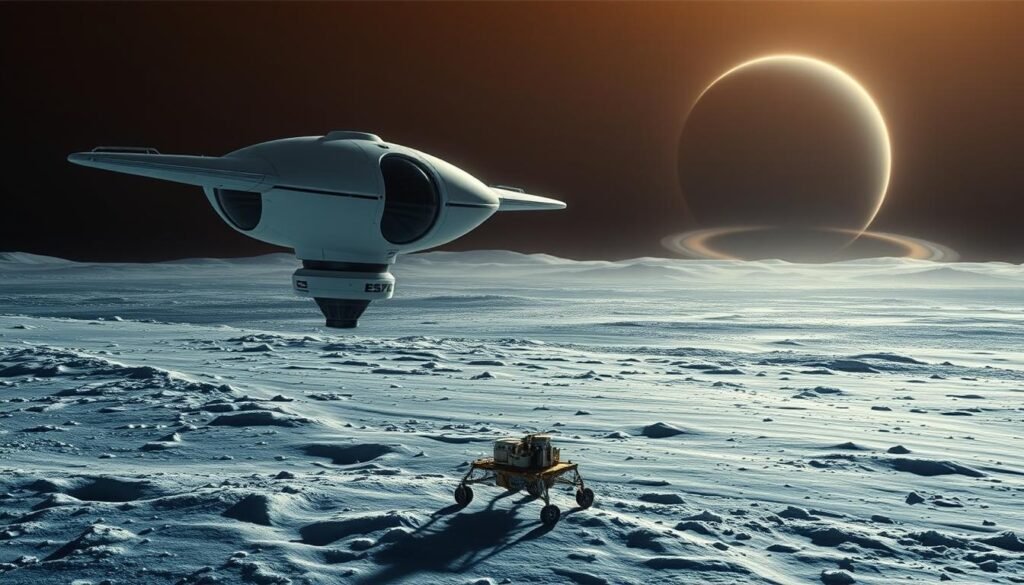
The technological achievements in exploring Saturn’s moons have been remarkable, demonstrating humanity’s capacity to investigate celestial bodies millions of miles from Earth.
Space Probes: Pioneering Missions
The Cassini spacecraft represents a pinnacle of NASA Saturn moon missions. Launched in 1997, this extraordinary probe spent:
- Seven years traveling to Saturn
- Six months studying Jupiter en route
- Thirteen years orbiting Saturn and its moons
Advanced Scientific Tools
Sophisticated instruments aboard space probes enable unprecedented exploration. Cassini carried 12 critical scientific instruments, including:
- Multispectral cameras
- Chemical composition spectrometers
- Magnetic field analyzers
- Cosmic dust collectors
These tools allowed scientists to collect intricate data without physical landing, revealing complex details about Saturn’s moon environments.
The innovation of flying through Saturn’s E-ring enabled direct sampling of Enceladus’s subsurface ocean, showcasing creative mission design.
Future NASA Saturn moon missions continue to push technological boundaries, promising even more exciting discoveries in planetary exploration.
The Role of Astrobiology
Astrobiology represents a cutting-edge scientific discipline exploring the potential for life beyond Earth. By studying extreme environments on our planet, researchers gain critical insights into the astrobiological potential Saturn’s moons might harbor.

Scientists have discovered remarkable organisms called extremophiles that challenge traditional understanding of life’s limitations. These unique creatures survive in environments once considered impossible for biological systems.
Exploring Extreme Life Forms
Extremophiles demonstrate remarkable adaptability in harsh conditions. They thrive in environments that would destroy most organisms:
- Boiling hot springs
- Frozen Antarctic lakes
- Deep underground caves
- Highly acidic water systems
Implications for Alien Life
The discovery of these resilient organisms expands our understanding of potential alien life Saturn system environments. Deep-sea hydrothermal vents provide fascinating models for potential extraterrestrial ecosystems.
Life doesn’t require sunlight or mild temperatures—it needs liquid water, chemical energy, and fundamental molecular building blocks.
Research suggests that subsurface oceans on Saturn’s moons like Enceladus could potentially support similar microbial communities. The presence of organic compounds and hydrothermal activity increases the likelihood of discovering unique life forms in these distant, icy worlds.
The Scientific Community’s Perspectives
The quest to understand is there life on Saturn’s moons has captivated researchers worldwide. Scientists are diving deep into the mysterious environments of these distant celestial bodies, exploring the potential for extraterrestrial life on Titan and other fascinating moons.

Current Research Initiatives
Research teams are pursuing multiple approaches to unravel the mysteries of Saturn’s moons. Key initiatives include:
- Analyzing Cassini mission data years after the spacecraft’s final journey
- Conducting laboratory experiments that simulate conditions on Enceladus and Titan
- Using advanced telescopes to gather additional observational evidence
- Planning future exploration missions to these intriguing celestial bodies
Theories on Life in Harsh Environments
Scientists propose various theories about potential life forms in these extreme conditions. Dr. Carly Howett from the University of Oxford highlights the stability of Enceladus’s subsurface environment, suggesting promising conditions for life development.
“We’ve completely rewritten the textbooks about Saturn,” says Andrew Coates from University College London, emphasizing the transformative discoveries about potential extraterrestrial life.
Researchers are particularly excited about two primary scenarios:
- Microbial life similar to Earth’s earliest organisms
- Potential methane-based life forms with unique biochemistry
While definitive proof remains elusive, the scientific community continues to push boundaries in understanding the remarkable potential for life beyond our planet.
Challenges in the Exploration of Saturn’s Moons
Exploring Saturn’s moons presents extraordinary challenges that test the limits of human space exploration. NASA Saturn moon missions face significant obstacles that make these scientific endeavors both complex and expensive. The extreme distance and harsh environmental conditions create unprecedented challenges for researchers seeking to uncover potential alien life in the Saturn system.

- Vast astronomical distances requiring years of travel
- Communication delays spanning over an hour
- Extreme temperature conditions
- Complex mission engineering requirements
Distance and Accessibility Hurdles
Reaching Saturn’s moons involves navigating approximately 886 million miles from Earth. Spacecraft must operate with extreme autonomy, carrying nuclear power sources to compensate for limited solar energy at such great distances. Missions to Enceladus require sophisticated technology capable of withstanding temperatures as low as -330°F.
Contamination Risks
The potential for biological contamination remains a critical concern in alien life Saturn system exploration. Planetary protection protocols demand rigorous sterilization of spacecraft to prevent introducing Earth-based microorganisms that could compromise scientific investigations. The Cassini mission demonstrated these precautions by intentionally destroying the spacecraft in Saturn’s atmosphere.
- Forward contamination risks: Preventing Earth microbes from affecting potential extraterrestrial environments
- Backward contamination concerns: Protecting Earth from potential alien organisms
These challenges underscore the complexity of exploring Saturn’s mysterious moons, requiring innovative technological solutions and meticulous scientific planning.
Future Research and Exploration Plans
The quest to uncover potential life on Saturn’s moons has entered an exciting phase of technological innovation and scientific planning. NASA Saturn moon missions are now focusing on advanced exploration strategies that could revolutionize our understanding of extraterrestrial environments.
Enceladus ocean life possibility remains a critical research priority for planetary scientists. Proposed mission concepts include sophisticated orbital probes designed to analyze the moon’s mysterious plumes with unprecedented precision. Researchers aim to detect complex organic molecules and potential biosignatures that could indicate the presence of microbial life beneath the icy surface.
Future exploration will likely involve developing specialized robotic missions capable of penetrating Enceladus’s thick ice shell. Nuclear-powered cryobots and advanced submersible technologies are being conceptualized to directly sample the subsurface ocean environment, potentially providing definitive evidence of biological activity.
Upcoming Scientific Expeditions
The scientific community is preparing for ambitious missions that build upon the groundbreaking discoveries of previous spacecraft like Cassini. Advanced instrumentation and innovative mission designs will enable researchers to conduct more comprehensive investigations into the potential habitability of Saturn’s most intriguing moons.
Long-Term Astronomical Goals
Astrobiology researchers are developing comprehensive strategies to explore the potential for life beyond Earth. The ultimate objective extends beyond simple detection – scientists seek to understand the biochemical mechanisms and potential origins of extraterrestrial life forms that might exist in these extreme planetary environments.