Deep in space, the most powerful cosmic explosion known to science rips through the darkness. A hypernova releases energy that dwarfs even the brightest supernovae. These rare events produce more energy in seconds than our sun will generate in its entire 10-billion-year lifetime.
When massive stars collapse, they create rotating black holes. These black holes launch twin jets of matter at near light speed. This astronomical phenomenon generates an extreme energy release exceeding 10^45 joules—ten times more powerful than regular supernovae.
The European Southern Observatory captured one of these stellar catastrophes in 1998. They observed SN 1998bw in the spiral galaxy ESO 184-G82.
Scientists first theorized about these cosmic explosions in the 1980s. They studied pair-instability supernovae. The concept evolved as telescopes improved and astronomers gathered more data. In 2023, the Zwicky Transient Facility detected AT2021lwx, a hypernova that released 1.5×10^46 joules of energy. Researchers nicknamed this extraordinary event “Scary Barbie” due to its unprecedented brightness and duration.
These stellar catastrophes shape galaxies and spread heavy elements throughout the universe. Each hypernova creates and disperses the building blocks needed for planets and life itself. Understanding these extreme events helps scientists piece together the violent processes that govern stellar evolution and cosmic change.
What Is a Hypernova and How Does It Differ from Regular Supernovae
A hypernova is a cosmic event that is incredibly violent. It is much brighter than the brightest supernova explosion. When a supermassive star explodes, it releases so much energy that it changes how we see stellar death.
These giant stars don’t just fade away. They actually tear apart spacetime with incredible force.
Defining the Extreme Energy Release of Hypernovae
A hypernova releases more than 10^45 joules of energy. This is ten times more than a typical massive star death. It produces gamma rays that can travel through galaxies.
It also ejects stellar material at almost the speed of light. The sheer scale defies comprehension. It’s like the Sun’s energy for its whole lifetime released in just seconds.
Comparing Luminosity: Hypernovae vs Standard Supernovae
Scientists classify these events by their incredible brightness. A hypernova is 100 times brighter than a standard Type Ib supernova. The SN 1998bw is a prime example of this extreme brightness.
Regular supernovae are much dimmer compared to these cosmic beacons.
The Role of Kinetic Energy in Classification
Kinetic energy is key in telling hypernovae apart from regular stellar deaths. Normal supernovae lose most of their energy as neutrinos. But hypernovae use their energy in jets driven by rotation.
This efficient energy use creates broad spectral lines. These lines show how fast the explosion is expanding. They help us understand physics in new ways.
The Discovery and History of Hypernova Observations
The study of the most powerful stellar explosions started in the late 1990s. Scientists noticed strange patterns in gamma-ray bursts from distant galaxies. These patterns hinted at a new kind of explosion, beyond what we knew of supernovae.
These discoveries changed how we see the end of massive stars. They exploded in ways we never imagined.
BeppoSAX Satellite and the First Confirmed Detection
In February 1997, the BeppoSAX satellite found GRB 970508. It was in a galaxy six billion light-years away. This event was a big step forward in understanding the universe.
The satellite’s X-ray eyes helped find the exact spot of these bursts. This was the first time we could locate them.
By 1998, Joshua Bloom and his team looked at GRB 970508’s data. They found that a hypernova was likely the cause. Bohdan Paczyński suggested that these hypernovae came from stars that spun very fast.
SN 1998bw: The Archetypal Hypernova Event
SN 1998bw was the first hypernova we saw. It was 100 times brighter than usual Type Ib supernovae. It sent out a huge shockwave, much more powerful than regular supernovae.
The spectrum showed no hydrogen and unclear helium. But it had strong silicon lines, like Type Ic supernovae. The lines were very broad.
The light curve showed it got very bright quickly. It reached the brightness of Type Ia supernovae by day 16. Scientists found it had about 10 solar masses of material, with 0.4 solar masses of nickel.
This helped us understand these events better. We now call them broad-lined Type Ic supernovae.
Evolution of Scientific Understanding Since the 1980s
Our understanding of these extreme events has grown a lot since the 1980s. Recent JWST observations have found supernovae from when the universe was just 730 million years old. This has pushed back our timeline of when these events happened.
Now, we have names like ASASSN-15lh for objects that challenge our old ideas. Scientists keep improving their models as they get more data from new telescopes. The link between hypernovae and black is a big area of research today.
Stellar Evolution Leading to Hypernova Formation
The path to a hypernova starts with stars that are incredibly massive. These stars go through a dramatic evolution that ends in a powerful cosmic event. Unlike regular stars, these giants burn their fuel at an incredible rate, leading to a catastrophic end.
Massive Star Requirements: The 30 Solar Mass Threshold
Stars must be at least 30 times heavier than our Sun to become hypernovas. These massive stars burn through their fuel quickly, living only a few million years. Their core must weigh about 15 solar masses to trigger the extreme collapse needed for this event.
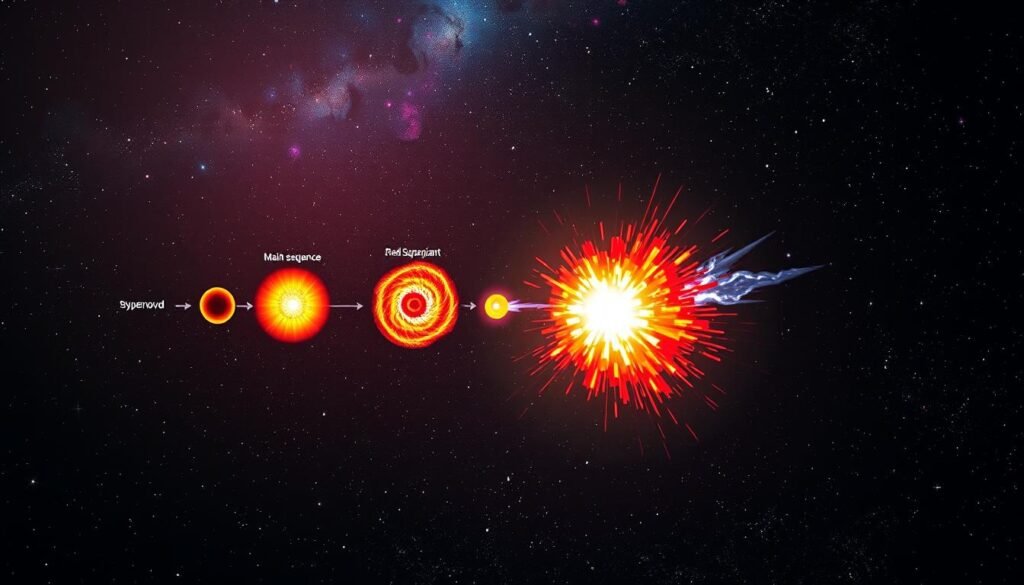
Core Collapse Dynamics in Supermassive Stars
As these giants age, they fuse heavier elements in their cores. Iron builds up until the core can no longer resist gravity. The star’s rotation speed is key to what happens next.
Fast-spinning cores can produce powerful jets that blast through the star’s outer layers. Slower rotation leads to a weaker explosion that might not be visible from Earth.
The Journey from Luminous Blue Variable to Catastrophic Explosion
Many hypernova candidates start as luminous blue variable stars, some of the brightest objects in the universe. These unstable giants shed massive amounts of material before their final collapse. When the end comes, the explosion can outshine an entire galaxy.
The blast expands to several light-years across within days, creating a spectacular light show.
Gamma-Ray Bursts and Their Connection to Hypernovae
Scientists have found a strong connection between hypernovae and the universe’s most powerful light flashes. These huge stellar explosions create gamma-ray bursts that can outshine entire galaxies for a short time. When massive stars collapse, they send jets of energy through space almost as fast as light.
Long-duration gamma-ray bursts can last from two seconds to over a minute. Every cosmic radiation event linked to these bursts shows signs of a hypernova, not just regular stellar explosions. The jets from these superluminous supernovae send high-energy particles and gamma rays into space, making the bright flashes astronomers see across vast distances.
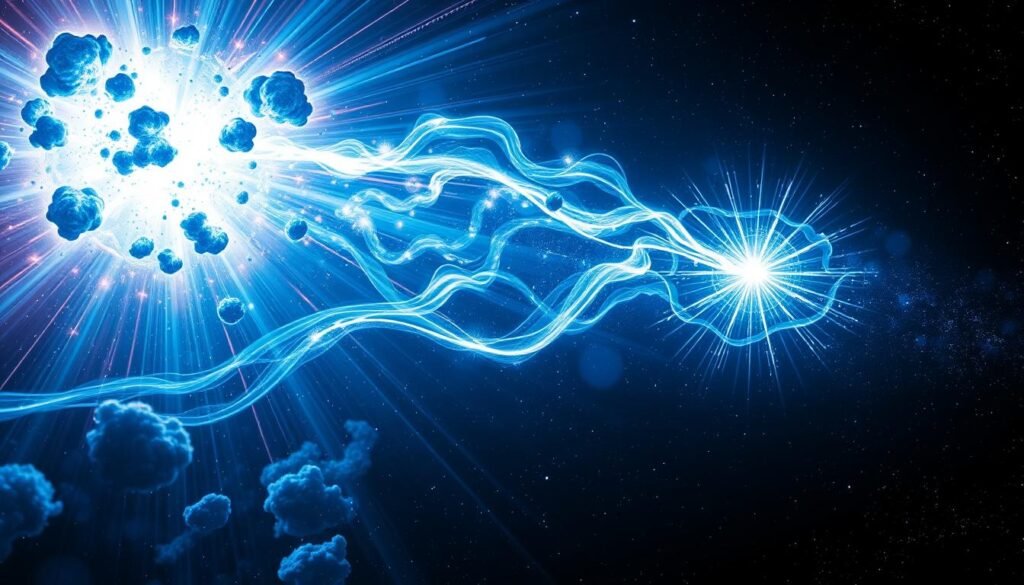
The collapsar model explains how these jets form during a luminous cosmic event. As the star’s core collapses into a black hole, powerful jets drill through the dying star’s outer layers. These jets create massive shock waves and blow off radioactive nickel-56 from the forming accretion disk. This violent process triggers the hypernova explosion we observe.
The decay of radioactive nickel-56 makes hypernovae shine much brighter than ordinary stellar deaths. In 1998, astronomers confirmed this connection by linking GRB 980425 with supernova SN 1998bw. This discovery proved that at least some gamma-ray burst sources come from these catastrophic stellar explosions. Each new observation helps scientists understand how these cosmic radiation event phenomena shape our universe.
The Collapsar Model: Black Hole Formation During Stellar Collapse
The collapsar model explains how massive stars end dramatically. Stars with cores over 15 solar masses collapse, leading to black hole formation. This happens when the star’s gravity is too strong, compressing matter into a single point.
Rotating Stellar Cores and Relativistic Jet Production
Fast-spinning stellar cores are key in this process. As the core collapses, its spin increases, like a figure skater. This spin prevents matter from falling directly into the black hole.
Instead, it creates powerful jets that shoot outward at nearly the speed of light.
Accretion Disk Formation and Energy Transfer
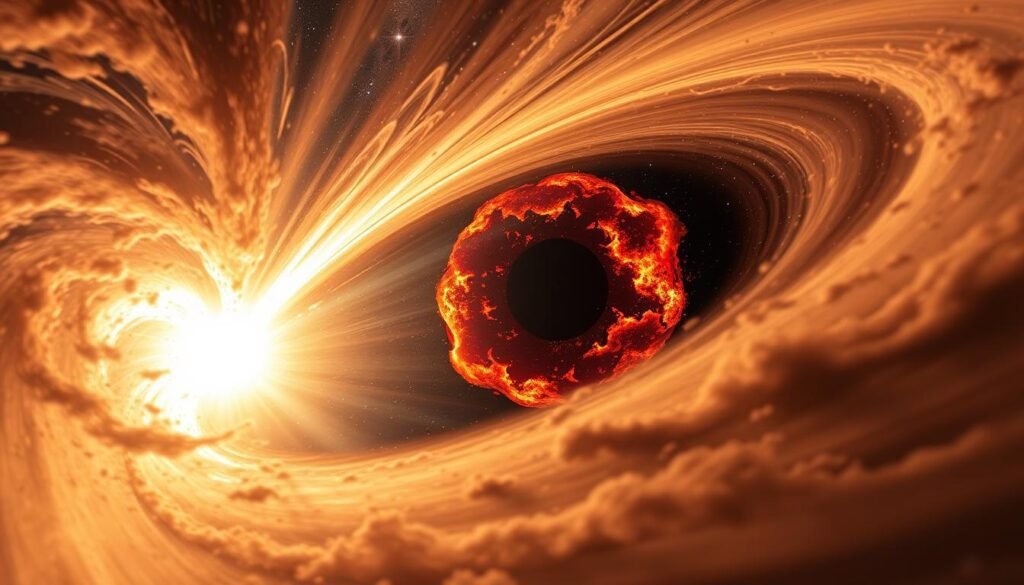
Material that doesn’t escape forms a swirling accretion disk. This disk produces intense cosmic radiation as matter spirals inward. Unlike regular supernovae, hypernovae convert more energy into visible light and motion.
Fallback Material and Explosion Mechanisms
Not all stellar material escapes in the initial explosion. Some falls back toward the black hole, feeding the disk. This creates powerful winds that blow material off the disk, causing the hypernova explosion we see from Earth.
Binary Star Systems as Hypernova Progenitors
Scientists now see binary star systems as key in creating the universe’s most powerful cosmic explosions. When two stars orbit each other closely, their gravitational dance can create the extreme conditions needed for a hypernova.
Binary interactions solve a major puzzle in stellar evolution research. For years, astronomers expected to find extremely evolved Wolf-Rayet stars before Type Ic supernovae occurred. These massive star death events should have left clear signatures. Yet, observations consistently failed to detect these predicted progenitors.
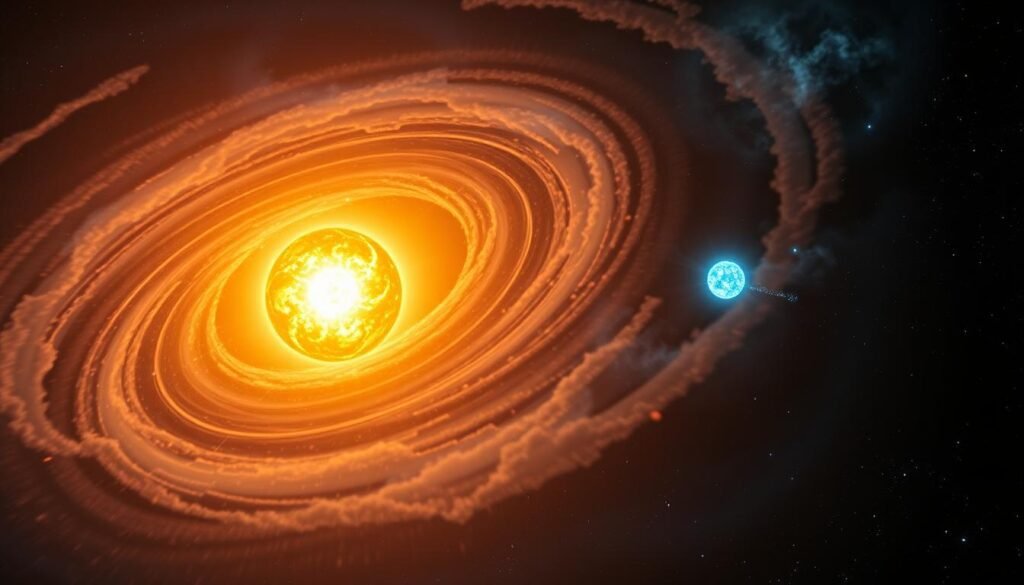
The answer lies in mass transfer between stellar companions. When a massive star shares its orbit with another star, it can lose its outer hydrogen and helium layers through gravitational stripping. This leaves behind a bare carbon-oxygen core – the perfect setup for this astrophysics phenomenon. Single stars simply cannot shed their envelopes efficiently enough through stellar winds alone.
Lower-mass helium giants have emerged as the likely candidates for these explosions. Binary companions strip away their outer layers more effectively than any solo stellar evolution process could achieve. The result transforms an ordinary star into a primed explosive waiting to unleash devastating energy.
“The gravitational interaction between binary stars creates conditions impossible for isolated stars to achieve, fundamentally changing our understanding of how the universe’s most energetic explosions occur.”
One fascinating mechanism involves induced gravitational collapse. A neutron star can be pushed past its limit when its companion undergoes core collapse nearby. This astronomical phenomenon forces the neutron star to become a black hole, launching powerful jets and creating the signature hypernova blast.
Observable Properties and Spectral Signatures of Hypernovae
Scientists spot hypernovae by their unique spectral patterns. These astrophysical phenomena have distinct signs that astronomers can spot from far away. The spectral analysis gives us key details about the explosion’s strength and the star’s final moments.
Type Ic Supernova Characteristics in Hypernova Events
Most hypernovae are Type Ic supernovae. They are special because they don’t have hydrogen or helium in their spectrum. SN 1998bw, a prototype hypernova, showed strong silicon lines but no hydrogen or helium.
This tells us that the star lost its outer layers before it exploded. This is a clue to the star’s final stages.
Broad Spectral Lines and Expansion Velocities
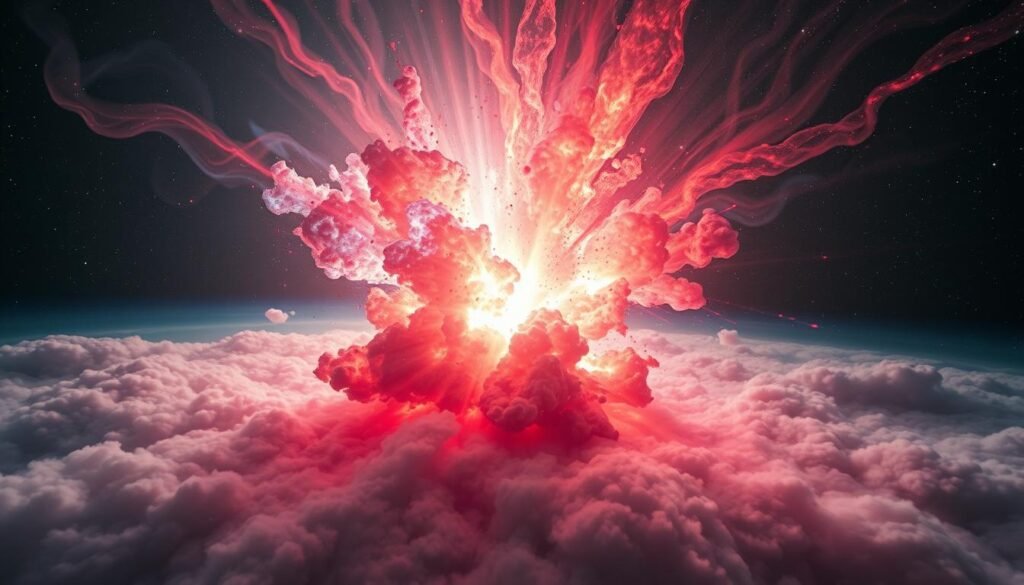
Hypernova spectra are known for their broad absorption lines. These luminous cosmic events move material at incredible speeds. Some parts reach up to 99% of the speed of light.
Regular supernovae rarely go over 10% of light speed. This makes the speed of hypernova material a key sign.
Radio Hypernovae: Unusually Bright Electromagnetic Emissions
Radio observations show another amazing trait of hypernovae. Radio hypernovae are incredibly bright in radio waves. They can stay bright for months after the explosion.
The stellar remnant keeps sending out strong radio waves. These waves travel through gas clouds. The peak brightness of these events is 10 to 100 times that of regular supernovae. This makes them some of the brightest radio sources in the universe.
Cosmic Impact: Mass Extinctions and Earth’s Vulnerability
Life on Earth has faced dangers from space as well as our own planet. Scientists think that distant stellar explosions might have caused some of Earth’s worst mass extinctions. These events have greatly influenced evolution, and we’re just starting to grasp their impact.
The Ordovician and Late Devonian Extinction Events
The Ordovician extinction happened 445 million years ago. It was one of Earth’s most severe biological disasters. This event killed 85% of all species, including 60% of marine life, when oceans were home to most life.
Scientists at Keele University believe a nearby superluminous event caused this disaster.
The Late Devonian extinction occurred 372 million years ago. It wiped out 70% of Earth’s species. Research shows a stellar explosion within 65 light-years of our solar system was likely responsible. The timing fits with the rate of supernovae near Earth throughout history.
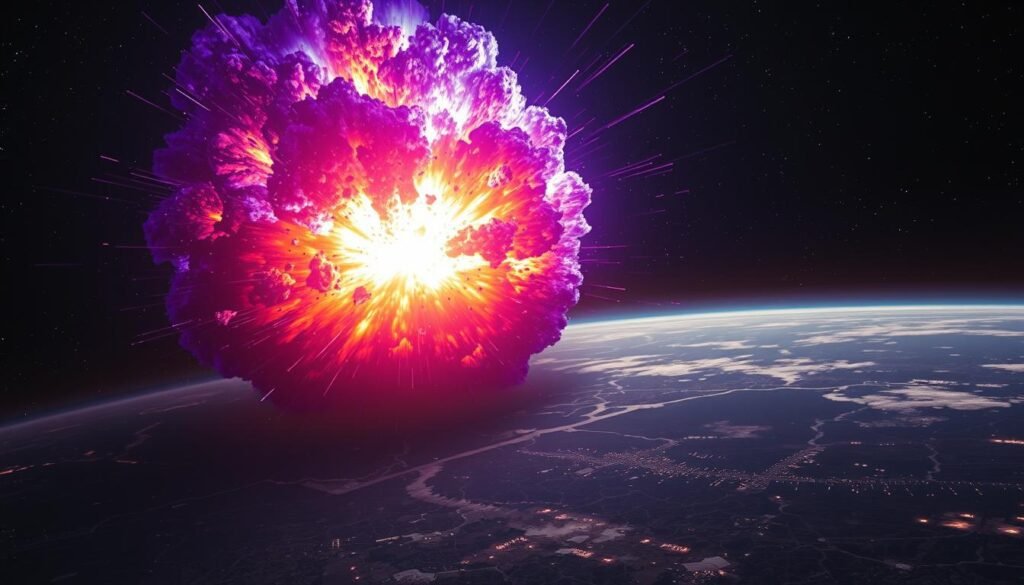
Ozone Layer Depletion from Nearby Stellar Explosions
When a cosmic event happens close to Earth, it can destroy our ozone layer. This leaves us vulnerable to harmful ultraviolet rays from the sun. The event also causes acid rain, harming ecosystems on land and in water.
Current Stellar Threats: Betelgeuse and Antares
Today, Betelgeuse and Antares are the closest stars that could cause a superluminous event. Both are red supergiants over 500 light-years away. Computer models show that explosions from these stars pose no danger to our planet’s life.
Modern Detection Methods and Scientific Breakthroughs
Space-based telescopes have changed how we study hypernovae. The Hubble Space Telescope leads in this field, giving us clear views of distant supernovae. It’s key for studying the universe far away, where Earth’s telescopes can’t see well.
Scientists use Type Ia supernovae as standard candles to measure distances. These events shine at the same brightness, helping us figure out how far away they are. The Hubble Space Telescope watched one in the NGC 2525 galaxy, 70 million light-years away, helping us learn about the universe’s growth.
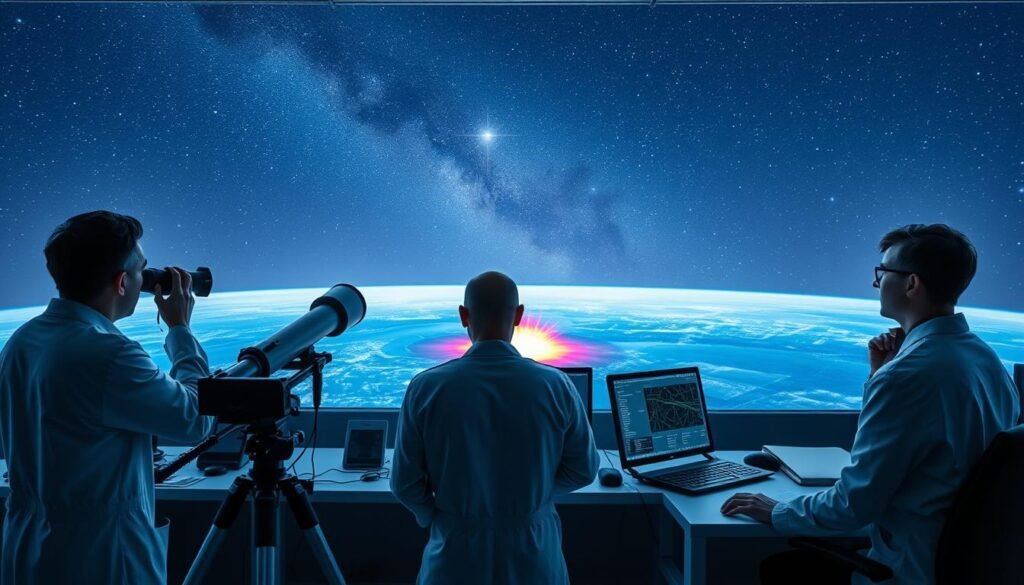
By watching Cepheid variable stars for eight years, scientists found something big. The universe is getting bigger faster. This shows dark energy started speeding up the universe’s growth when it was young.
Supernova 1987A in the Large Magellanic Cloud showed us how good we’ve gotten at observing. Hubble took amazing pictures of the explosion, 150,000 light-years away. Watching it for 30 years gave us a lot of information about hypernovae.
Conclusion
A hypernova is the biggest explosion in our universe. It happens when a huge star explodes, releasing more energy than we can imagine. These events are so powerful that they can be seen from billions of light-years away.
Stars that are 30 times bigger than our Sun can turn into hypernovas. When they do, they create a black hole and send out jets of energy at almost the speed of light. This explosion is much brighter than a normal supernova and can be seen from far away.
The study of hypernovas started with the BeppoSAX satellite. It found a link between gamma-ray bursts and star explosions. Scientists have learned that binary star systems help create hypernovas by removing outer layers and giving them the spin needed.
The stellar evolution sequence leading to hypernovas is fascinating. Stars build up heavier elements until they reach iron in the core. Then, in just one day, they collapse.
Hypernovas are important for life in the universe. They create the heavy elements needed for planets and life. But, they can also harm life by depleting the ozone layer.
Today, scientists watch for stars like Betelgeuse and Antares. But, they are too far away to harm us. Telescopes help us understand how these explosions shape galaxies and the universe.