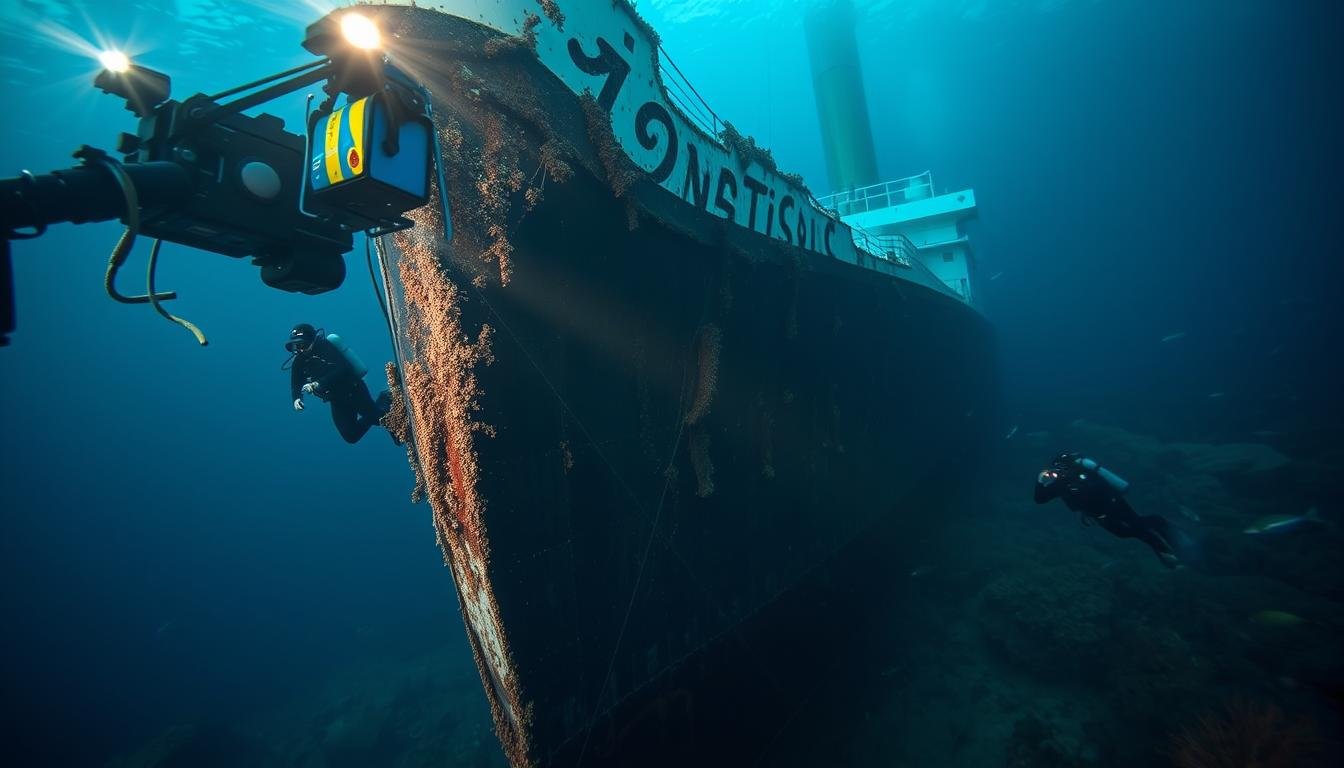
For 73 years, the RMS Titanic lay hidden in the North Atlantic’s dark depths. It sank on April 15, 1912, taking over 1,500 lives and many secrets. The ship’s exact location was a mystery until a breakthrough changed everything.
On September 1, 1985, at 12:48 AM, the impossible happened. A French-American team found the Titanic, shocking the world. Jean-Louis Michel from IFREMER and Robert Ballard from Woods Hole Oceanographic Institution led this historic mission.
The Robert Ballard expedition didn’t find the wreck by chance. They discovered the Titanic 12,500 feet below the surface, near Newfoundland’s coast. This mission used new technology and strategies, succeeding where others failed.
The story of finding the Titanic involves Cold War secrets and deep-sea robots. The team’s work on finding lost nuclear submarines helped fund and equip the Titanic search. This effort used advanced technology to locate the Titanic.
The coordinates 41°43′32″N 49°56′49″W now mark a famous location. What began as a dream became the 20th century’s greatest underwater discovery.
The Titanic’s Final Resting Place: A 73-Year Mystery
For 73 years, the Titanic’s exact location was a mystery. The north atlantic wreck site was huge and unexplored. Finding the Titanic needed patience, determination, and new technology.
The Night of April 15, 1912: When Disaster Struck
The Titanic hit an iceberg at 11:40 PM on April 14, 1912. It sank in just three hours. The ship broke into two parts, resting about 2,000 feet apart.
The bow section is surprisingly well-preserved. But the stern suffered severe damage during its fall.
Early Salvage Attempts and Their Failures
Soon after, families of victims tried to find the Titanic. They hired the Merritt and Chapman Derrick and Wrecking Company. But their titanic search mission was doomed.
The wreck was too deep for 1912 technology. Water pressure was over 6,000 pounds per square inch.
📚 Want to See How the Myth Was Created?

Charles Berlitz's 1974 bestseller is a masterclass in persuasive storytelling—even when the facts don't quite add up. While we now know the scientific truth, his book remains a fascinating study in how compelling narratives shape public perception.
Perfect for: Psychology students, writers, skeptics, and anyone interested in critical thinking and media literacy.
📖 Get on AmazonReading Berlitz's book after learning the real science makes it even more fascinating. You'll spot exactly where drama replaced data.
Why Finding the Wreck Proved So Challenging
Several factors made finding titanic shipwreck hard:
- Uncertain last coordinates from distress calls
- Titanic Canyon’s submarine valleys confused sonar readings
- Lack of deep-sea exploration technology to reach 12,500 feet
- A debris field spanning 5 by 3 miles across the ocean floor
Failed Expeditions and Wild Proposals: The Search Before 1985
Before Robert Ballard found the Titanic, many tried to locate it. Their efforts ranged from serious science to wild ideas. Each attempt taught us about the deep Atlantic’s challenges.
Jack Grimm’s Near-Miss Expeditions (1980-1983)
Texas oilman Jack Grimm almost found the Titanic. In July 1980, his team scanned 500 square nautical miles with Sea MARC sonar. They found 14 possible targets.
In June 1981 and July 1983, Grimm tried again. His underwater exploration technology missed the Titanic by just 1.5 nautical miles. These close calls helped later searches.

Bizarre Salvage Ideas: From Ping-Pong Balls to Vaseline
Some ideas for raising the Titanic were crazy:
- Charles Smith suggested using electromagnet submarines in 1914, with a price tag of $1.5 million
- Douglas Woolley wanted to inflate nylon balloons inside the ship
- Arthur Hickey proposed freezing the Titanic in an artificial iceberg using 500,000 tons of liquid nitrogen
- Others suggested filling the hull with 180,000 tons of molten wax or Vaseline
- Ping-pong balls were considered, though they would be crushed by deep-sea pressure
The Role of Sonar Technology in Early Search Attempts
Early searchers used sonar to scan the ocean floor. This underwater exploration technology sent sound waves down and measured their return. But, 1970s and early 1980s sonar couldn’t provide clear enough pictures.
These limitations taught future expeditions what equipment they needed for a successful search.
Robert Ballard’s Vision and the Secret Navy Mission
Robert Ballard’s dream of finding the Titanic started in 1973. But it took a secret Navy mission in 1985 to make it happen. Ballard had created a deep-sea robot called Argo in 1982, hoping to fund his Titanic search.
The Navy had other plans. They wanted Ballard to find two lost nuclear submarines, USS Thresher and USS Scorpion, in the North Atlantic. Ballard agreed to help the Navy first.
In 1984, Ballard’s team found both submarines at almost 10,000 feet deep. This mission taught Ballard a lot about ocean floor mapping. He learned that the submarines had exploded, leaving debris fields on the seafloor.

This discovery helped Ballard find Titanic. He followed debris to locate the main wreckage. The Finding Titanic exhibition shows how this Navy mission helped him.
After finding USS Scorpion in 1985, Ballard had only 12 days to find Titanic. The Navy’s support in developing sonar imaging Titanic technology was crucial for his dream.
How the Titanic Was Found: The Breakthrough Discovery
A team of American and French researchers made a groundbreaking find. They worked together in deep sea exploration to solve a long-standing mystery. Their partnership was key to uncovering the Titanic’s secrets.
The French-American Partnership: IFREMER and Woods Hole
In 1985, Woods Hole Oceanographic Institution teamed up with IFREMER. The U.S. Office of Naval Technology supported this effort. This partnership brought together top talents in oceanographic technology.
Bob Ballard from Woods Hole and Jean-Louis Michel from IFREMER led the teams. They focused on a 100-square-mile area for their search.

Following the Debris Trail: A New Search Strategy
The team changed how they searched for shipwrecks. Instead of looking for the main hull, they followed debris. This new approach was a game-changer.
When the R/V Knorr reached the search site on August 22, 1985, they had just 12 days. They scanned the ocean floor carefully. They knew that ocean currents had spread wreckage over vast areas.
September 1, 1985: The Moment of Discovery
At 12:48 AM on September 1, something appeared on the Knorr’s monitors. A team member saw a boiler that matched 1911 photos of the Titanic. It was a haunting coincidence, given the Titanic’s sinking 73 years prior.
The next day, cameras captured the first images of the Titanic’s main wreck. This ended years of speculation about where the ship lay.
Revolutionary Technology: Argo and Jason Systems
The discovery of the Titanic was made possible by advanced technology for underwater archaeology. A team used a system that changed ocean exploration. This gear could reach depths humans can’t survive, capturing clear images from the ocean floor.
Deep-Sea Imaging Capabilities and Remote Operation
The Argo submersible was a remote vehicle with strong cameras and sonar. It was towed behind a ship with a cable over two miles long. The robot Jason was attached to Argo, moving freely to take close-up photos of the ocean floor.
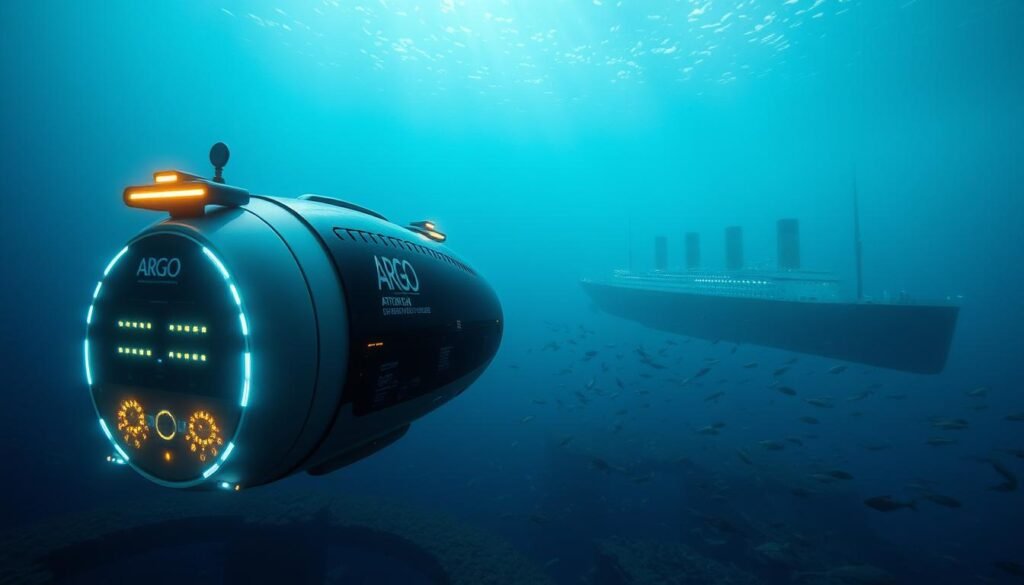
Video feeds from Argo were shown live in the ship’s control room. This allowed researchers to make quick decisions on where to search next. The system was tested at the East Pacific Rise, mapping 120 miles of seafloor in 20 days.
SAR Sonar System: Mapping the Ocean Floor
Sonar mapping was key in finding the North Atlantic shipwreck. Jean-Louis Michel created the SAR (System Acoustique Remorqué), a side-scanning sonar. It made detailed shadow images of the seafloor, clearer than other systems in 1985.
The ANGUS system also helped, taking thousands of photos. Together, these technologies gave a full view of the debris field, leading to finding Titanic’s hull.
The Wreck Site: What the Discovery Revealed
The Robert Ballard Titanic expedition found something unexpected. The ship was in two big pieces on the ocean floor, about a third of a mile apart. At 12,500 feet down, the site showed the ship’s last moments.
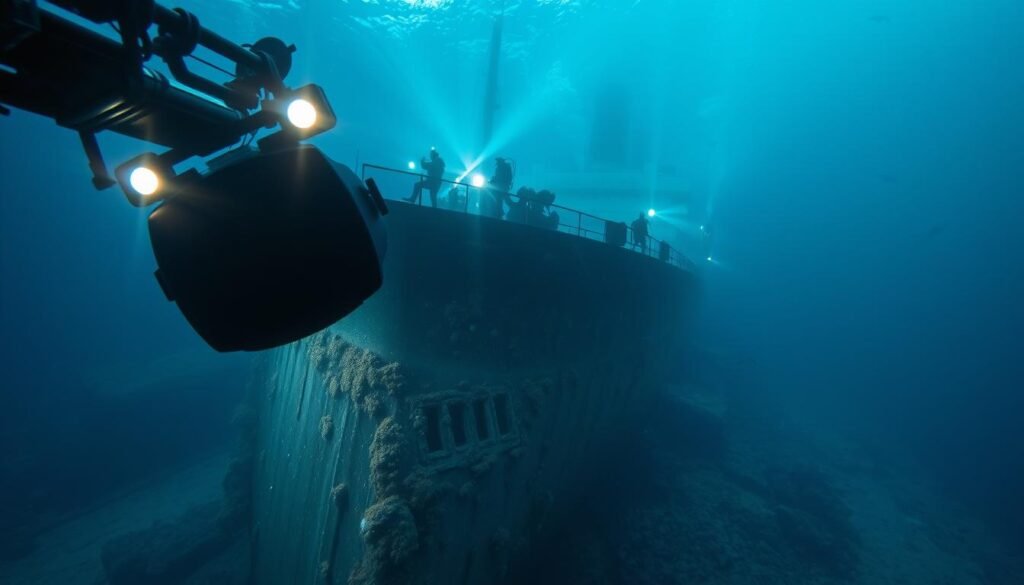
The bow section was surprisingly well-preserved. Windows still had their bronze frames. Most amazing, chandeliers still hung from the ceilings in some areas. Jason Jr., the remote vehicle, explored the Grand Staircase area, showing preserved wood and metalwork.

The stern section was badly damaged. It lay destroyed on the seabed. Between these sections was a huge debris field, covering about 15 square miles. This site had hundreds of thousands of objects from the ship’s break-up and sinking.
The sonar technology showed how items settled. Light things like papers and clothes went farthest. Heavier items fell straight down. Ocean currents arranged everything like a giant underwater museum.
Later expeditions found amazing artifacts:
- A two-ton reciprocating engine piece
- Steam whistles from the forward funnel
- A 20-ton hull section with its original portholes
- Lifeboat davits still in working condition
Jean-Louis Michel and the French Team’s Critical Contribution
The franco-american titanic expedition started with French scientists. They laid the groundwork for a major maritime discovery. Jean-Louis Michel led the French team from IFREMER, working with Woods Hole Oceanographic Institution. Together, they found the ship’s final resting place.
Le Suroit’s Five-Week Survey Mission
The French research vessel Le Suroit sailed on July 5, 1985. They searched for 31 days, facing tough seas and weather. Bernard Pillaud and Jean Jarry from IFREMER scanned the North Atlantic seabed.

“Mowing the Lawn”: Systematic Search Patterns
The French team used a method called “mowing the lawn.” This strategy involved:
- Sailing back and forth in overlapping strips
- Maintaining paths about 800 meters apart
- Covering a 150-square-nautical-mile target area
- Using sonar to scan the ocean floor systematically
During their first run, they unknowingly passed close to the Titanic’s location.
Eliminating 75% of the Search Area
By August 12, 1985, Le Suroit’s mission ended without finding the wreck. But their work was not wasted. They eliminated over 75% of the search area. This helped the Woods Hole Oceanographic Institution team focus their search.
Impact and Legacy of the Titanic Discovery
When R/V Knorr returned to Woods Hole on September 9, 1985, thousands gathered. Media from all over the world was there. The titanic wreckage discovery was a global news story, with press events in Washington, D.C., and Paris.
Woods Hole Oceanographic Institution Director John H. Steele said it showed our ability to explore the deep sea. The success showed the power of new underwater exploration technology from the three partners.

Later, the crew remembered the tragedy of their find. They held a brief memorial on Knorr’s fantail for the 1,500 who died in 1912.
The find marked a new era in ocean floor mapping and marine archaeology. Since 1985, many have visited the wreck site. Sadly, in June 2023, the submersible Titan exploded near the wreck, killing five on a tourist trip.
Now, the Titanic wreck is protected by UNESCO. It’s too fragile to raise after over 100 years. The site is a grave and a symbol of deep sea exploration progress.
Conclusion
The discovery of the Titanic is a major milestone in ocean exploration. On September 1, 1985, after 73 years of searching, Robert Ballard’s team found the wreck. It was 12,500 feet deep in the Atlantic Ocean.
This achievement was thanks to a partnership between Woods Hole Oceanographic Institution and IFREMER, a French institute. Their work showed that together, nations can solve big problems that one can’t alone.
The 1985 discovery was a game-changer because of new technology. The Argo imaging system, Jason robots, and SAR sonar were key. Ballard and Michel didn’t just look for the hull. They searched for the debris field across the ocean floor.
Their smart strategy, along with the French team’s careful work, made the impossible possible. They learned from submarine discoveries and uncovered secrets that had been hidden for decades.
The Titanic’s discovery changed ocean exploration forever. It showed humans can study the deepest parts of our planet. The technology used in the expedition now helps scientists explore underwater volcanoes, ancient shipwrecks, and marine ecosystems.
The story of finding the Titanic teaches us about the power of persistence, innovation, and teamwork. What seemed impossible in 1912 became real in 1985. It opened new doors for underwater discovery that keep expanding today.