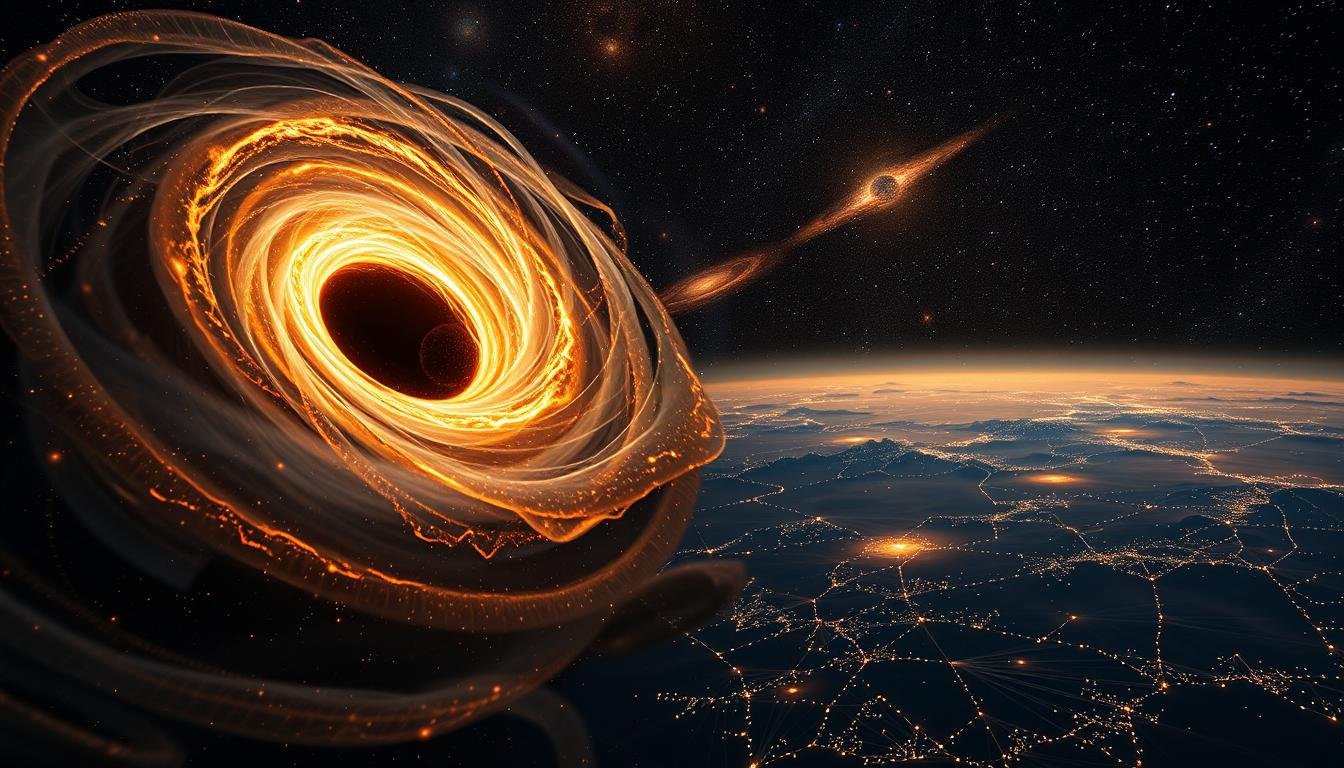
An unseen power governs everything from an apple’s fall to the dance of galaxies. This fundamental force of nature is essential to the cosmic structure we observe.
It keeps our feet on the ground and planets in their orbits. This invisible pull binds all matter together across the vast expanse of the universe.
This article explores centuries of scientific discovery about this phenomenon. We will journey from Isaac Newton’s classical ideas to Albert Einstein’s revolutionary insights on space itself.
Our exploration will cover the mathematical principles behind this force. We will also examine its dramatic cosmic effects and its practical role in our daily lives.
Fundamentals of Gravity and Newton’s Breakthrough
The story of Isaac Newton and the falling apple represents a pivotal moment in humanity’s quest to comprehend the forces shaping our universe. This legendary incident, whether fully factual or partly mythical, illustrates how careful observation of everyday events can lead to profound scientific discoveries.
The Apple Incident: Myth vs. Reality
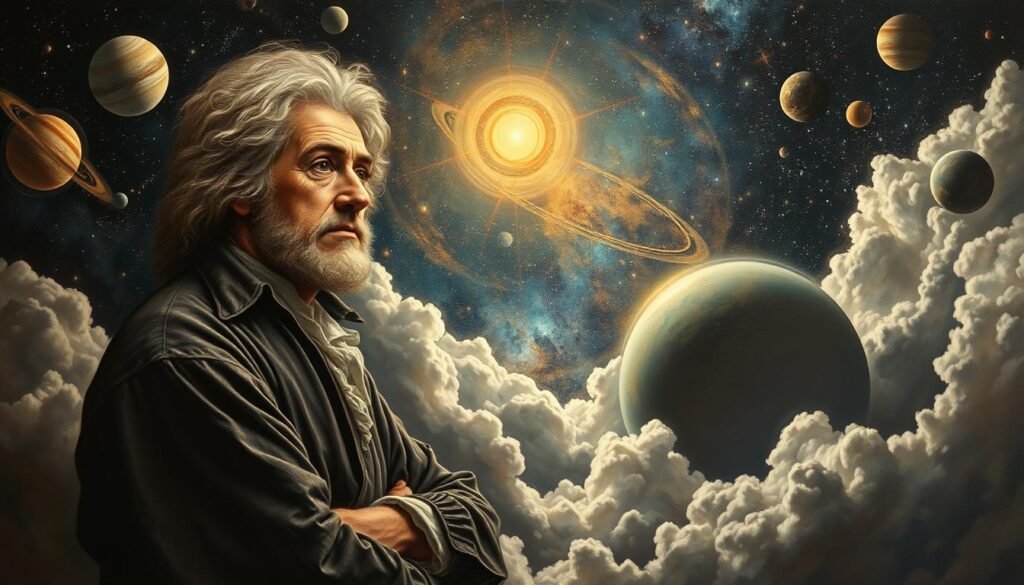
In the 1600s, Isaac Newton witnessed an apple falling from a tree. This simple observation sparked years of intense study about why objects are drawn toward Earth’s center. While the exact details may be embellished, the core truth remains: Newton recognized a universal pattern in this common occurrence.
His curiosity about the apple’s descent led to deeper questions about attraction between all matter. This moment of insight began a scientific journey that would transform our understanding of physical laws.
Understanding Universal Gravitation and Its Formula
After years of research, Newton published his Theory of Universal Gravitation in the 1680s. This revolutionary concept stated that every object in the universe attracts every other object. The strength of this gravitational force depends on two key factors: mass and distance.
The mathematical formula expresses this relationship precisely: Gravitational force = (G × m1 × m2) / d². Here, G represents the gravitational constant, while m1 and m2 are the masses of the two objects. The variable d signifies the distance between their centers.
This equation shows that the pull between objects increases with greater mass but decreases rapidly as distance grows. Newton’s law provided the first comprehensive framework for understanding gravity’s effects throughout the cosmos.
Exploring How Gravity Works in the Universe
The interplay between mass and distance governs gravitational interactions across interstellar space. This fundamental relationship shapes everything from planetary systems to galactic clusters.
The Role of Mass and Distance in Gravitational Pull
Every object with mass generates a gravitational field. The strength of this attraction depends directly on the amount of matter present.
Distance dramatically affects gravitational force. As separation increases, the pull between objects weakens rapidly. This principle explains why astronauts experience weightlessness far from Earth.
Gravity’s Influence on Planets, Stars, and Celestial Bodies
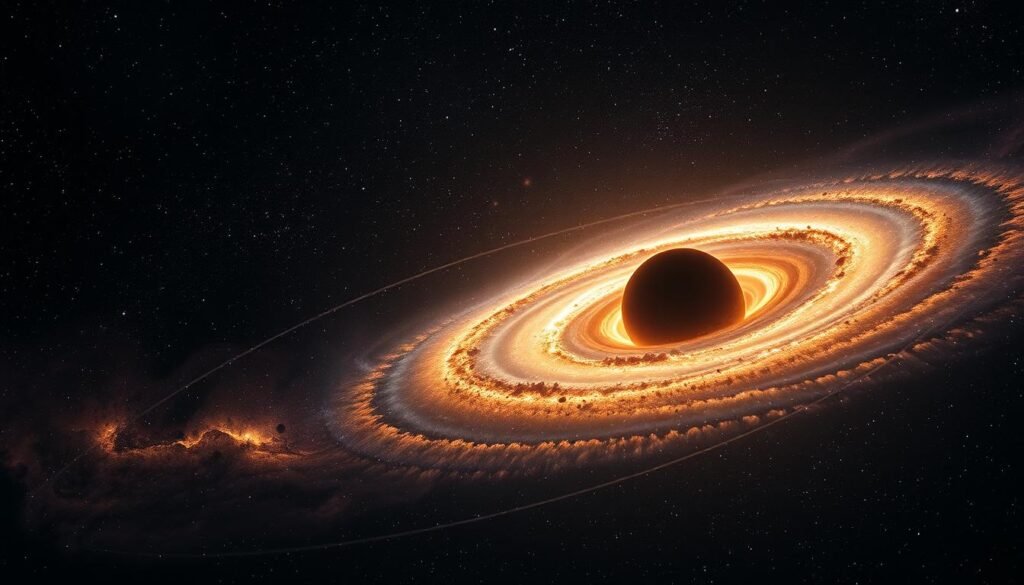
Planetary differences demonstrate mass’s crucial role. Jupiter’s immense size creates stronger gravity than smaller Mars. This affects surface conditions and atmospheric retention.
Stable orbits occur when gravitational pull balances orbital motion. This equilibrium prevents planets from drifting into space. The same principle applies to moons circling their parent planets.
Cosmic structure emerges from these gravitational relationships. Galaxies form as stars cluster under mutual attraction. The universe’s large-scale architecture reflects gravity’s organizing power.
Modern Perspectives: Einstein’s Theory and the Evolution of Gravitation
Albert Einstein’s revolutionary insights transformed centuries-old gravitational concepts. His work represented a fundamental shift in how scientists understood the cosmos.
Comparing General Relativity with Newton’s Laws
Einstein’s theory of general relativity reimagined gravity as curvature in spacetime rather than a simple force. Massive objects warp the fabric of space-time around them.
This perspective explains phenomena that Newton’s equations couldn’t fully address. While Newton’s laws work well for everyday situations, Einstein’s genius provided the framework for extreme cosmic conditions.
Gravitational Waves, Black Holes, and Cosmic Phenomena
The theory predicted gravitational waves—ripples in spacetime traveling at light speed. Scientists confirmed their existence in 2015, validating Einstein’s century-old predictions.
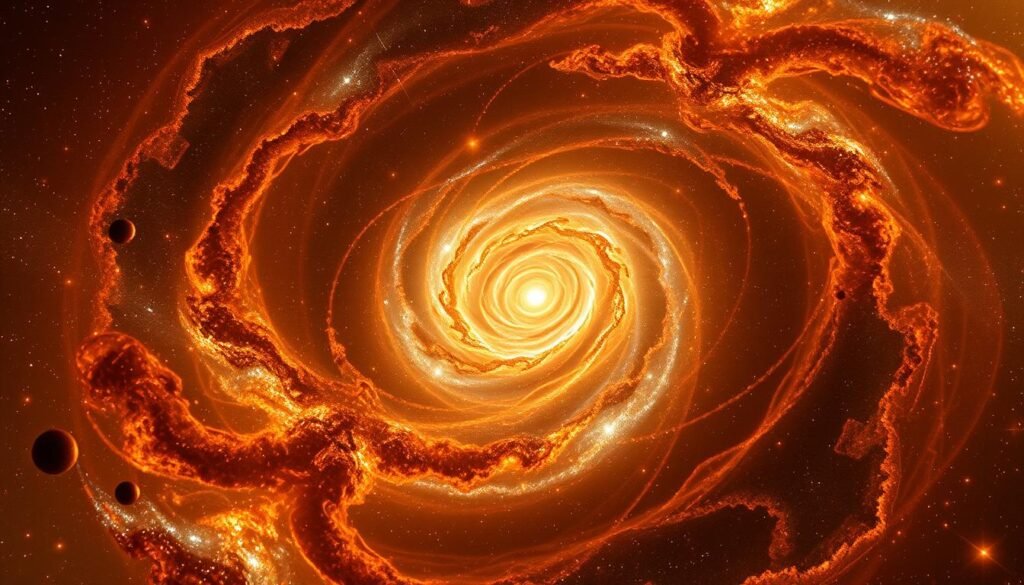
Black holes represent the most dramatic demonstration of general relativity’s power. These cosmic phenomena form when massive stars collapse, creating gravitational fields so strong that not even light can escape.
Modern physics continues to explore these extraordinary predictions. The detection of gravitational waves from colliding black holes opens new windows into understanding our universe’s most violent events.
Practical Approaches to Understanding and Calculating Gravity
Understanding gravitational calculations bridges theoretical concepts with observable phenomena. These mathematical tools transform abstract principles into measurable quantities we encounter daily.
Scientists developed precise formulas over many years of observation. These equations answer fundamental questions about attraction between masses.
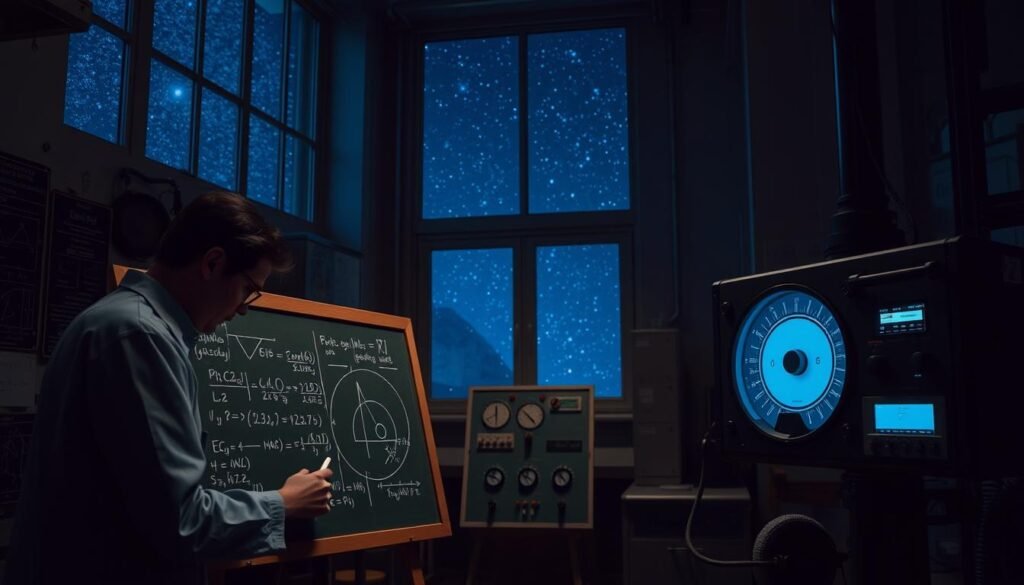
Step-by-Step How-To: Calculating Gravitational Force
The process begins with identifying the masses involved and their separation distance. Newton’s universal formula provides the framework for precise calculations.
For weight determination, use the simple equation: weight equals mass times gravitational acceleration. On Earth, this acceleration remains constant at 9.8 meters per second squared.
This explains why different objects fall at identical speed in vacuum conditions. Air resistance becomes the varying factor in real-world situations.
“Mathematics is the language with which God has written the universe.”
Real-World Applications: From Weight Measurement to Orbit Dynamics
Weight scales demonstrate the most common application of gravitational force. They measure the pull exerted on an object’s mass.
Orbital mechanics represent more complex implementations. Engineers calculate precise speed requirements to balance gravitational attraction with forward motion.
This delicate equilibrium creates stable paths for satellites in space. The structure of these orbits depends entirely on gravitational understanding.
Space missions succeed through advanced calculations of trajectory and fuel needs. Different theories provide frameworks for various precision requirements.
Conclusion
From ancient observations to modern laboratories, the study of universal pull has transformed our worldview. This article has traced the remarkable evolution of gravitational understanding across centuries.
The journey spans from Newton’s mathematical formulas to Einstein’s spacetime curvature. Each breakthrough built upon previous years of research and observation. Today’s physics continues to explore this fundamental force.
Gravity remains essential to the cosmic structure we observe throughout the universe. It connects everyday experiences with extraordinary cosmic phenomena. This invisible bond represents a fundamental force of nature.
Future discoveries will undoubtedly deepen our comprehension. The coming years may reveal how gravity interacts with other cosmic forces. Our understanding of the universe continues to evolve through ongoing scientific exploration.