
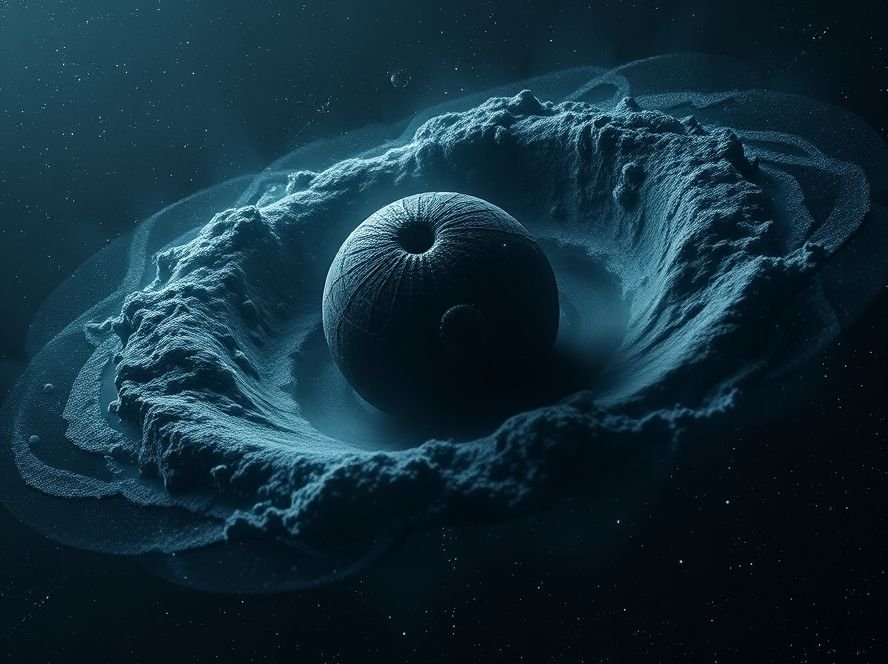
What is Dark Matter?
Dark matter is a mysterious and unseen form of matter that makes up about 27% of the universe. Unlike ordinary matter, which includes stars, planets, and galaxies, dark matter does not emit, absorb, or reflect light, making it invisible and detectable only through its gravitational effects. This elusive substance plays a crucial role in the structure and evolution of the cosmos.
The Importance of Dark Matter in Cosmology
Understanding dark matter is fundamental to cosmology—the study of the universe’s origin, evolution, and eventual fate. Dark matter influences the formation of galaxies and large-scale structures in the universe. Without it, the gravitational pull necessary to hold galaxies together would not exist, leading to a vastly different cosmic landscape. For instance, the rotation curves of galaxies—measurements of how fast stars orbit the center—reveal that visible matter cannot account for the speeds observed; dark matter must be present to explain the discrepancies.
How Do We Know Dark Matter Exists?
- Gravitational Lensing: This phenomenon occurs when light from distant galaxies is bent around massive objects, indicating the presence of unseen mass.
- Cosmic Microwave Background (CMB): Studies of the CMB provide insights into the early universe and support the existence of dark matter through its influence on cosmic structure.
- Galaxy Cluster Dynamics: Observations of galaxy clusters show that their mass exceeds the sum of their visible components, implying dark matter’s gravitational presence.
Characteristics of Dark Matter
Dark matter is hypothesized to be composed of particles that interact through gravity and possibly weak nuclear force, but not electromagnetic force, which is why it does not emit light. The leading candidates for dark matter particles include:
- WIMPs (Weakly Interacting Massive Particles): These are theoretical particles that could account for dark matter, expected to be heavy and interact via weak nuclear force.
- Axions: Hypothetical particles that are light and could solve various problems in particle physics.
- Sterile Neutrinos: These are a type of neutrino that does not interact via the weak force, suggesting they could be a dark matter candidate.
Applications of Dark Matter Research
Research on dark matter is not merely academic; it has practical implications:
- Advancements in Technology: The technologies developed for dark matter detection can lead to innovations in medical imaging and security systems.
- Understanding the Universe: Insights gained from dark matter research can help explain phenomena such as galaxy formation and the expansion of the universe.
- Interdisciplinary Collaboration: Dark matter studies encourage collaboration between physicists, astronomers, and computer scientists, fostering innovation across fields.
How Can You Learn More About Dark Matter?
For those curious about dark matter, there are numerous resources available:
- Visit local planetariums or science museums that offer exhibits on astrophysics.
- Engage with online courses or lectures from reputable institutions.
- Follow scientific publications and journals dedicated to astrophysics and cosmology.
Related Concepts
Dark matter is intricately linked to several other concepts in physics and cosmology:
- Dark Energy: A mysterious force driving the accelerated expansion of the universe, making up about 68% of the universe.
- Black Holes: Regions of space where gravitational forces are so strong that nothing, not even light, can escape.
- Gravity: The force that interacts with dark matter, shaping the structure of the universe.
Conclusion: The Mystery of Dark Matter
Dark matter remains one of the greatest mysteries in modern astrophysics. As researchers continue to investigate its properties and implications, our understanding of the universe will deepen. Whether through advanced experiments or theoretical models, the quest for knowledge about dark matter is vital for grasping the cosmos’ vast and intricate tapestry.
By delving into the mysteries of dark matter, we not only satisfy our curiosity about the universe but also push the boundaries of science and technology, paving the way for future discoveries.
Reflection
Consider how understanding dark matter might influence your view of the universe. Reflect on the interconnectedness of all things—how even what is unseen can shape our reality. Stay curious and keep exploring!