
What if the stories from one of the world’s oldest civilizations hold the key to understanding our own beliefs about life, death, and the universe?
For over three thousand years, the society of ancient Egypt was built upon a rich and complex spiritual foundation. This belief system shaped every facet of their culture, from grand temples to daily routines.
The pantheon of powerful gods and goddesses formed the core of this worldview. Understanding these deities is essential to grasping the depth of Egyptian mythology.
These sacred narratives were not just entertainment. They were a way for people to explain natural phenomena and the very essence of human existence.
This guide will journey through the origins, major figures, and lasting legacy of this fascinating tradition. We will explore how its concepts of cosmic order and the afterlife continue to resonate in our modern world.
Introduction to Egyptian Mythology and Its Cultural Legacy
At the heart of this remarkable society lay a comprehensive belief system that influenced everything from governance to daily rituals. These sacred stories formed the core of ancient Egyptian culture for over three millennia.
The traditions of this mythology served as both religion and cultural framework. People used divine narratives to explain natural events and human institutions. This provided meaning to their existence.
Evidence of these beliefs appears throughout their creative works. Sacred texts, temple art, and funeral inscriptions all reflect this pervasive influence. The system maintained core concepts while evolving over time.
Key aspects of this cultural heritage include:
- Explanations for cosmic order and human institutions
- Guidance for moral behavior and social structure
- Concepts of divine kingship and afterlife beliefs
This sophisticated approach to existential questions influenced later civilizations. Greek and Roman cultures adopted many concepts from this rich tradition. The history of these beliefs reflects one of humanity’s earliest major civilizations.
Origins and Creation Myths of Ancient Egypt
In the beginning, according to ancient beliefs, there was nothing but Nu – the primordial waters of chaos from which all would emerge. These creation myths describe how the universe transformed from formless waters into an ordered world. The stories vary across different regions but share the common theme of order emerging from chaos.
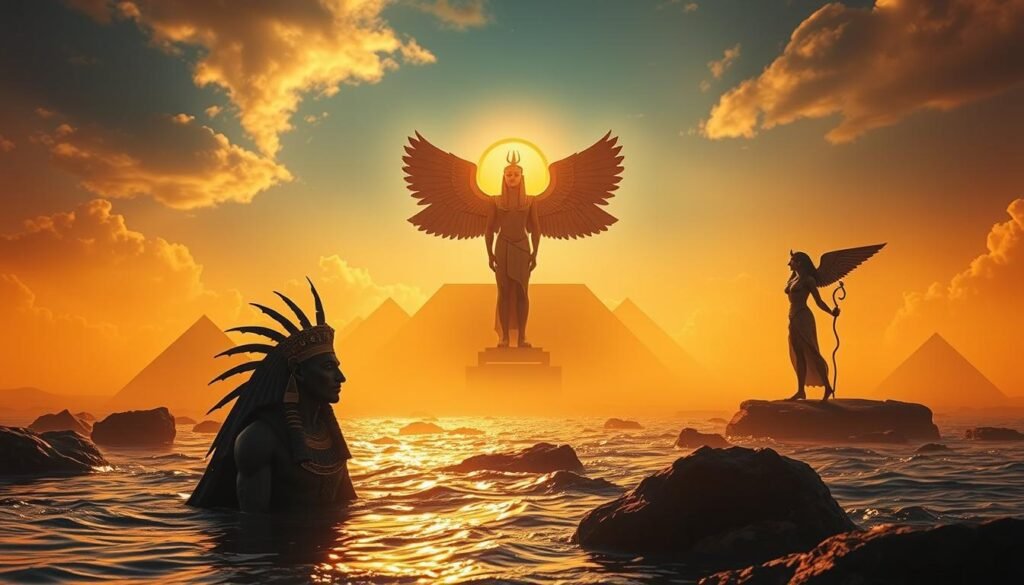
The Emergence of Order from Primordial Chaos
The creation world began with endless dark water without form or purpose. From this chaos arose the ben-ben, the primordial mound that became the first solid ground. This emergence of order became a central theme reflecting the civilization’s view of itself as an island of stability.
Atum, the creator god, stood upon this first land. Through the power of Heka (magic), he created the first divine pair. Shu brought the principles of life while Tefnut contributed order to the early world.
The Role of Nu, Atum, and the Ben-Ben
Nu represented the chaotic void before existence. Atum’s creative act began when he recognized his aloneness in the nothingness. He mated with his own shadow to produce Shu and Tefnut.
Humanity emerged from Atum’s tears falling upon the dark, fertile earth of the ben-ben. Shu and Tefnut then produced Geb (earth) and Nut (sky). Their separation created the space necessary for life and established the cosmic structure we know today.
The Role of Gods and Goddesses in Egyptian Mythology
From the sun’s daily journey to the Nile’s annual flood, every phenomenon had a divine explanation. The pantheon was vast, with deities representing both tangible elements and abstract ideas. These divine characters were integral to understanding the world.
Major Deities and Their Domains
Powerful figures like Ra, the sun god, and Osiris, ruler of the afterlife, held central roles. Isis, a prominent goddess of magic, and Horus, the sky god, were also key characters. Set, the god of chaos, provided a necessary counterbalance to order.
Groups like the Ennead of Heliopolis formed a divine family that created the world. Another group, the Ogdoad of Hermopolis, represented primordial concepts like water and infinity.
Lesser-Known Divine Figures
Many other deities played crucial but more specialized parts. Thoth was the god of wisdom and writing. Anubis oversaw mummification, while Hathor was the goddess of love and joy.
These gods and goddesses were not static. Their roles could merge or shift across different regions and times. This fluidity reflects the dynamic nature of the belief system itself.
The Primordial Concepts: Ma’at, Order, and Chaos
Central to the ancient worldview was a delicate balance between cosmic harmony and disruptive forces. This system of beliefs saw the world as a constant struggle between stability and disorder. The concept of Ma’at embodied this essential equilibrium.
Ma’at represented the fundamental principle of truth, justice, and cosmic order. It was the force that kept the universe functioning smoothly. People believed their society was an island of this order surrounded by threatening chaos.

The Significance of Ma’at in Daily Life
This principle was not abstract. It directly influenced personal conduct, legal systems, and royal duties. Every aspect of life was connected to maintaining this balance.
The pharaoh served as the primary maintainer of Ma’at on Earth. Through rituals and righteous rule, they renewed the cosmic patterns established in sacred stories. This action helped preserve harmony for everyone.
An underlying magical force called heka made Ma’at possible. This power existed before creation and enabled all aspects of existence. By repeating mythological patterns, humans participated in sustaining the world’s order against chaos.
The Journey of the Sun God Ra and Cyclical Time
Each sunrise represented more than just the beginning of a new day—it symbolized the eternal victory of order over chaos. The sun god Ra stood at the center of this cosmic drama, embodying creation, kingship, and the endless cycle of time.
This powerful deity’s daily passage formed the fundamental rhythm of existence. People saw in Ra’s journey a model for their own lives and the universe itself.
Ra’s Daily Voyage and Cosmic Battles
Every morning, the sun god began his east-to-west journey across the sky. He traveled in a magnificent solar barque, bringing light and life to the world. At sunset, his voyage continued through the dangerous Duat, the underworld.
During this nightly passage, Ra faced his greatest enemy. Apep, the serpent of chaos, attempted to stop the sun’s rebirth. This cosmic battle determined whether dawn would come.
The sky itself revealed the struggle’s intensity. A clear sunset meant easy passage. A blood-red horizon showed fierce combat between order and disorder.
This mythology reflected a profound understanding of time as cyclical. Each day repeated the pattern of birth, death, and resurrection. Ra’s victory at dawn renewed cosmic order, demonstrating that death was not an ending but part of an eternal cycle.
The Rich Tapestry of Egyptian Legends and Stories
The ancient Egyptians expressed their sacred stories through a fascinating blend of art and literature. These narratives were rarely presented as complete tales. Instead, they appeared as fragments and allusions across different mediums.
This approach allowed for great flexibility. Different regions and times could emphasize various symbolic meanings within the same core myth.
Mythic Episodes in Texts and Art
Scenes from these powerful stories decorated tombs, temples, and even protective amulets. In written form, they appeared in hymns, funerary texts, and ritual inscriptions.
Characters in these tales were not fully developed personalities. They served as symbolic representations of cosmic forces and natural phenomena.
Major episodes like Ra’s battles or the story of Osiris were well-known. Yet, sources often contain only portions of the larger narrative, inviting interpretation.
Symbolic Interpretations of Myth
The true realm of the gods was considered mysterious and inaccessible. Symbolism in these stories made divine events comprehensible to people.
In literature, myths were adapted for a wide range of purposes. They could provide humor, entertainment, or serious moral instruction.
This symbolic layer gave the stories enduring power. It allowed them to serve both decorative and profound spiritual functions across centuries.
Sources and Narratives: Exploring Ancient Writings
Unlike complete literary works, the mythological narratives of ancient Egypt survive primarily through ritual texts and temple inscriptions. These diverse sources provide fragments that scholars must carefully piece together.
The oldest religious texts in the world are the Pyramid Texts from the Old Kingdom. Later works like the Coffin Texts and Book of the Dead expanded these early sources. They detailed the afterlife journey and interactions with deities.
Important narrative sources include “The Contendings of Horus and Seth” and the “Great Hymn to the Aten.” Most people were illiterate, suggesting a rich oral tradition. Unfortunately, little evidence of this storytelling survives.
Modern researchers at Oxford University and other institutions continue studying these ancient writings. The sources reveal that myths served multiple purposes. They provided religious instruction, funerary protection, and even entertainment.
Rituals and Ceremonies in the Ancient Egyptian World
Through elaborate ceremonies, the people connected their mortal lives to the eternal cycles of the divine realm. These practices transformed sacred stories into tangible experiences that shaped daily existence.

Religious Practices Inspired by Myth
Ancient Egyptian religious practices were deeply intertwined with their sacred stories. Many ceremonies directly reenacted mythological events to maintain cosmic order. This connection between ritual and narrative formed the core of their spiritual traditions.
Major festivals celebrated key moments from their rich mythology. The Opet Festival honored the divine marriage of Amun and Mut. The Mysteries of Osiris dramatically reenacted his death and resurrection.
Private magical rituals showed especially close ties to mythological narratives. People incorporated sacred stories to achieve desired outcomes in daily life. These practices reflected their fundamental beliefs about the world’s structure.
The Beautiful Festival of the Valley involved processions where the gods visited the dead. This ceremony connected the living with ancestors through divine intervention. It demonstrated how mythology influenced all aspects of their spiritual life.
Daily temple rituals involved priests performing ceremonies that symbolically maintained order. The Sed festival renewed the pharaoh’s power through patterns of divine kingship. These ancient Egyptian traditions ensured mythological patterns were constantly repeated, thereby connecting human experience with eternal forces as detailed in comprehensive studies of their religious system.
The Osiris Myth: Death, Resurrection, and the Afterlife
The story of Osiris stands as one of the most profound narratives from the ancient world. This powerful myth explores deep themes of death, resurrection, and eternal justice. The characters in this drama represent fundamental forces that shaped spiritual beliefs.
Osiris began as a wise ruler who brought civilization to humanity. His brother Set grew jealous of this power and order. Set’s violent act of murder represented chaos triumphing over established structure.
The coffin trap became Set’s method for eliminating his brother. He threw the sealed container into the Nile, believing this would end Osiris’s influence. This act set in motion the myth’s central journey of loss and recovery.
The Role of Isis and Nephthys in Restoration
Isis demonstrated incredible devotion as she searched for her husband’s body. The goddess traveled extensively until discovering the coffin in distant Byblos. Her determination showed the power of love against destructive forces.
When Set dismembered the body, the two sisters began their sacred mission. Isis and Nephthys gathered each piece across the land. Wherever they buried a fragment, they established a religious shrine.
Using magical powers, Isis reassembled her husband and conceived their son Horus. Though restored to life, Osiris remained incomplete for earthly return. He instead became the righteous judge of the departed, offering hope for life beyond death.
Kingship and Divine Right in Egyptian Traditions
The concept of kingship was not a human invention but a divine gift passed down from the celestial realm. According to sacred traditions, the first rulers were the gods themselves. This divine institution later passed to human pharaohs.
The unification of the land around 3100 BCE made the king the central figure in religion. Kingship ideology became a crucial part of the nation’s mythology. The pharaoh was seen as the primary maintainer of order on earth.

Pharaohs were considered living gods, specifically manifestations of Horus and sons of Ra. They acted as essential intermediaries between the divine and mortal worlds. Their sacred duty was to ensure harmony and justice for all people.
Royal ceremonies, especially coronations, reenacted key mythological events. They symbolized the eternal triumph of order over chaos. This reinforced the pharaoh’s absolute divine right, a concept explored in depth regarding divine kingship.
The pharaoh’s commands were considered the will of the gods. This belief profoundly shaped how people viewed authority in ancient Egypt. The ruler was essential for the universe’s very survival.
Environmental Influences on Mythic Narratives
Ancient storytellers looked to their immediate surroundings to give form to cosmic principles. The physical features of their world became powerful symbols in their sacred stories.
This connection between nature and narrative shaped how people understood their place in the universe. The regular patterns they observed directly influenced their spiritual beliefs.
The Lifegiving Nile and Natural Cycles
The Nile River’s annual flooding created a rhythm that sustained all life in the region. Each year, the waters rose and receded, renewing the fertility of the earth.
This predictable cycle became a powerful metaphor for death and rebirth. The emergence of fertile land from receding waters mirrored creation stories.
The daily journey of the sun across the sky provided another fundamental pattern. Its reliable rising and setting inspired stories of cyclical time and eternal renewal.
The Harsh Deserts and the Symbolism of Chaos
Beyond the fertile river valley lay vast, unforgiving deserts. These barren landscapes represented the opposite of the ordered, life-giving Nile region.
People saw their cultivated land as an island of stability in a threatening world. The surrounding wilderness embodied chaos and disorder.
This environmental contrast shaped how the mythology portrayed fundamental struggles. The battle between order and disorder reflected the real geography of their world.
Natural disruptions like droughts or unusual floods were interpreted as cosmic imbalances. These events required divine intervention to restore harmony to the earth.
Adaptation, Syncretism, and the Evolution of Belief
Political and cultural changes throughout Egyptian history prompted fascinating adaptations within their mythological framework. Over thousands of years, the sacred stories evolved while maintaining core concepts about cosmic order.
Rather than replacing old gods with new ones, Egyptians practiced syncretism. This process combined deities into composite forms like Ra-Atum. Local gods gained national importance while preserving regional traditions.

Dominant cities promoted their patron gods to supreme positions during different periods. The flexibility of this belief system allowed absorption of new ideas without abandoning fundamentals.
During the New Kingdom period, foreign deities like Anat and Yam entered the pantheon through cultural contact. Different regions maintained distinct traditions centered on their patron gods.
Despite these adaptations over time, core themes remained constant throughout history. The struggle between order and chaos, death and rebirth, and divine justice persisted as central elements.
Comparative Perspectives: Egyptian Mythology Among Ancient Cultures
Across the Mediterranean world, Egyptian religious concepts traveled through trade routes and cultural exchange. The spiritual traditions of this civilization profoundly shaped neighboring societies.
Egyptian beliefs about eternal life represented a revolutionary idea. This concept transformed how ancient peoples viewed mortality. The notion of benevolent deities also spread widely.
Trade networks carried these spiritual ideas to distant lands. The port city of Alexandria became a major center for cultural exchange. After 130 BCE, the Silk Road further expanded this influence.
Influences on Greek, Roman, and Near Eastern Myths
Greek philosophers like Pythagoras and Plato reportedly studied Egyptian beliefs. Concepts of reincarnation and the immortal soul particularly interested them. These ideas entered Greek philosophical traditions.
Roman culture extensively borrowed from Egyptian spiritual practices. They incorporated deities like Isis and Serapis into their pantheon. Roman religious ceremonies adopted Egyptian elements.
Despite Greek and Roman political control from 332 BCE to 641 CE, Egyptian religious traditions remained distinctive. The core mythology resisted significant Greco-Roman influence.
Comparative study reveals both unique Egyptian elements and shared themes with other ancient world mythologies. Concepts like creation from chaos and dying-and-rising gods appear across cultures.
Interpreting the Complexity of Egyptian Myth Narratives
Ancient Egyptian religious thought embraced multiple perspectives on divine truths through varied mythological expressions. The same sacred stories often appear in different versions across temple inscriptions and papyrus texts. These apparent contradictions actually reveal a sophisticated approach to understanding cosmic principles.
Rather than literal accounts, these narratives functioned as metaphorical frameworks. They translated complex divine behaviors into comprehensible human terms. Each variant represented a unique symbolic perspective on the same cosmic phenomenon.
The fragmentary form of surviving sources means scholars must reconstruct complete stories from scattered references. Multiple regional versions existed simultaneously, each emphasizing different aspects of divine characters. This multiplicity of approaches allowed for rich theological exploration.
Mythological figures were not fixed personalities but fluid representations. They could merge, separate, or transform to express different concepts. This interpretive flexibility helped the tradition remain meaningful across millennia of cultural change.
Modern understanding requires appreciating the symbolic nature of these ancient stories. Not every detail carries deep meaning—some elements served as dramatic embellishments. The true value lies in the conceptual richness rather than narrative consistency.
egyptian mythology: Key Themes and Enduring Beliefs
Throughout thousands of years, certain core concepts remained central to how ancient Egyptians understood their place in the cosmos. These recurring patterns in their sacred stories reveal a sophisticated worldview that addressed fundamental human concerns.
The eternal struggle between order and chaos formed a primary theme. This conflict played out through divine characters who represented cosmic forces. Death and rebirth cycles mirrored natural patterns like the Nile’s annual flooding.
Divine kingship served as another essential concept. Pharaohs acted as bridges between the world of deities and humanity. Their role maintained balance across all existence.
Magic represented a fundamental power that enabled both gods and people to influence reality. The promise of an afterlife gave ancient Egyptians remarkable confidence in life’s continuity.
Justice and moral behavior were emphasized through judgment after death. These enduring beliefs provided not just religious doctrine but a comprehensive worldview. They shaped every aspect of culture and daily life in the ancient world.
Conclusion
As we reflect on the journey through Egypt’s mythological landscape, the lasting impact of these beliefs becomes clear. This ancient system provided answers to life’s biggest questions.
The stories of powerful gods and cosmic order shaped a remarkable culture for over three thousand years. They offered hope through themes of justice and eternal life.
The legacy of this mythology extends far beyond the ancient world. It influenced Greek and Roman thought about the afterlife.
Modern fascination with pyramids and pharaohs shows how these narratives still resonate. They reveal the intellectual depth of a great civilization.
By studying this rich tradition, we gain insight into how people found meaning in their lives. The life-affirming message continues to inspire us today.