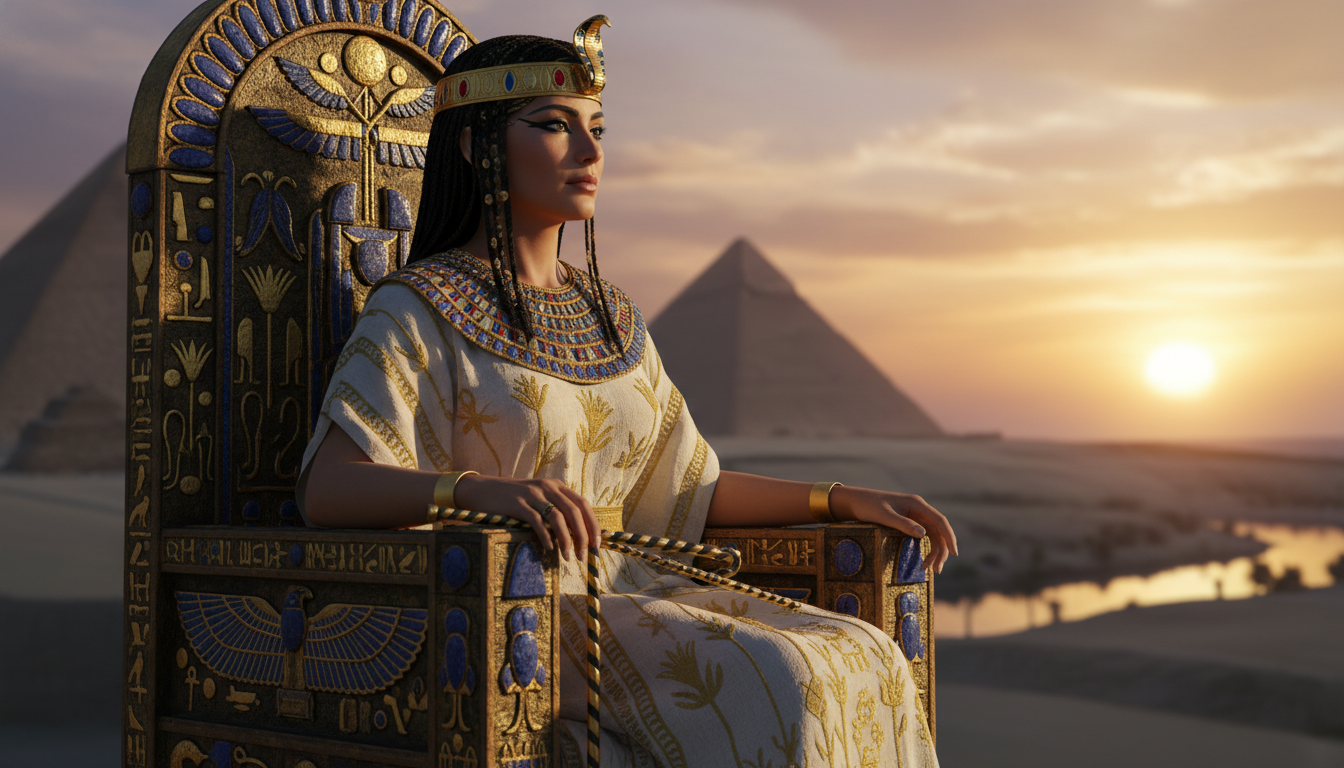
Cleopatra VII stands as one of the most fascinating rulers in ancient Egypt. She was born in Alexandria around 69 BC and became the last pharaoh to rule this great civilization. Her story captivates people even today, thousands of years after her death in 30 BC.
This egyptian queen came from the Ptolemaic dynasty, a Greek-Macedonian family that ruled Egypt for nearly 300 years. Her ancestor Ptolemy I served as a general under Alexander the Great. When Alexander died, Ptolemy took control of Egypt and started a new royal line. Cleopatra inherited this rich cultural mix of Greek and Egyptian traditions.
The hellenistic period saw many powerful rulers, but none matched Cleopatra’s influence. She spoke nine languages and received an excellent education in mathematics, rhetoric, and philosophy. Her father, Ptolemy XII Auletes, recognized her intelligence and named her as his successor before his death in 51 BC.
When Cleopatra became queen, she faced immediate challenges. The Roman Empire was growing stronger, and Egypt’s independence hung in the balance. She used her wit, charm, and political skills to protect her kingdom. Her relationships with Julius Caesar and Mark Antony became legendary, though they were strategic alliances as much as romantic ones.
The end of Cleopatra’s reign marked a turning point in history. After her death, the hellenistic period ended, and Egypt became a Roman province. No native ruler would sit on Egypt’s throne again. Her story reminds us of ancient mysteries that still intrigue scholars, including the location of her final resting place.
Today, this last pharaoh of the Ptolemaic dynasty remains a symbol of power, intelligence, and determination. Her legacy lives on in art, literature, and popular culture, making her one of the most recognized figures from ancient Egypt.
The Rise of Cleopatra in the Ptolemaic Dynasty
The story of this ancient Egyptian queen begins in the magnificent city of Alexandria, where Greek culture merged with Egyptian tradition. The Ptolemaic dynasty ruled over Hellenistic Egypt for nearly three centuries, creating a unique blend of cultures that would shape the destiny of their most famous descendant.
Born into Power: Early Life in Alexandria
Cleopatra entered the world in early 69 BC as the daughter of Ptolemy XII. She grew up in Alexandria’s royal palace, surrounded by the splendor of Egyptian royalty. The city itself was a marvel of the ancient world, founded by Alexander the Great and transformed into a center of learning and commerce.
The Greek-Egyptian Heritage of the Ptolemaic Kingdom
The Ptolemaic pharaohs lived between two worlds. They received their crowns from Egyptian priests in Memphis but governed from Alexandria as Greek monarchs. This dual identity defined life in Hellenistic Egypt. The royal court spoke Greek, yet they embraced Egyptian religious traditions and even used hieroglyphics in their official inscriptions.
Education and Languages: The Making of a Polyglot Queen
Under the guidance of her tutor Philostratos, young Cleopatra mastered Greek rhetoric and philosophy. She studied at the famous Library of Alexandria, absorbing knowledge from the greatest minds of her time. Unlike previous Ptolemy rulers, she learned to read hieroglyphics and speak Egyptian fluently. Her linguistic talents extended to at least nine languages, including Hebrew, Arabic, Syrian, and Latin.
Political Turmoil and the Path to the Throne
The road to becoming queen of Egypt was never simple for Cleopatra. Her father’s troubled reign set the stage for the complex ancient Egypt politics she would later navigate. When Rome annexed Cyprus in 58 BC, it triggered a series of events that would shape young Cleopatra’s understanding of power and survival in the Mediterranean world.
The Exile and Return of Ptolemy XII Auletes
Ptolemy XII faced a devastating blow when his own people forced him from Egypt. The pharaoh fled to Rhodes and Athens before seeking help at Pompey’s villa near Rome. During this exile, 11-year-old Cleopatra accompanied her father, witnessing firsthand how a ruler could lose everything. In 55 BC, Roman general Aulus Gabinius invaded Egypt to restore Ptolemy XII to his throne. A young Mark Antony served as cavalry officer during this campaign, marking his first connection to Egyptian affairs.

Co-Regency with Ptolemy XIII: A Kingdom Divided
When Ptolemy XII died in 51 BC, the question of pharaoh succession created immediate tension. Cleopatra began ruling alongside her 10-year-old brother Ptolemy XIII, whom she likely married according to Ptolemaic tradition. By August 29, 51 BC, official documents showed Cleopatra as sole ruler, signaling her determination to control Egypt’s destiny. Her brother retained powerful supporters including:
- Potheinos, the influential eunuch
- Achillas, the military commander
- Theodotus of Chios, the royal tutor
The Gabiniani Crisis and Early Challenges to Authority
The Gabiniani garrison, Roman soldiers left behind to protect Egypt, became a source of instability for the future last ruler of Egypt. These troops had grown comfortable in Alexandria and resisted outside control. Their presence reminded everyone that Egyptian pharaohs now depended on Roman military support. Cleopatra needed to balance their demands while asserting her own authority as the rightful queen of Egypt.
Julius Caesar and the Roman Alliance
The meeting between Cleopatra and Julius Caesar marked a turning point in both Egyptian and Roman history. After defeating Pompey in the Roman civil war at Pharsalus, Caesar pursued his rival to Egypt. Pompey sought refuge with young Ptolemy XIII but met a brutal end on September 28, 48 BC. The Egyptian court had him assassinated, hoping to gain favor with Caesar.
When Julius Caesar arrived in Alexandria that October, he expressed genuine sorrow at Pompey’s death. Despite their rivalry during the Roman civil war, Caesar had respected his former ally from the days of the Roman Republic. He took control of Alexandria and demanded that both Cleopatra and her brother Ptolemy XIII dissolve their armies and settle their differences peacefully.

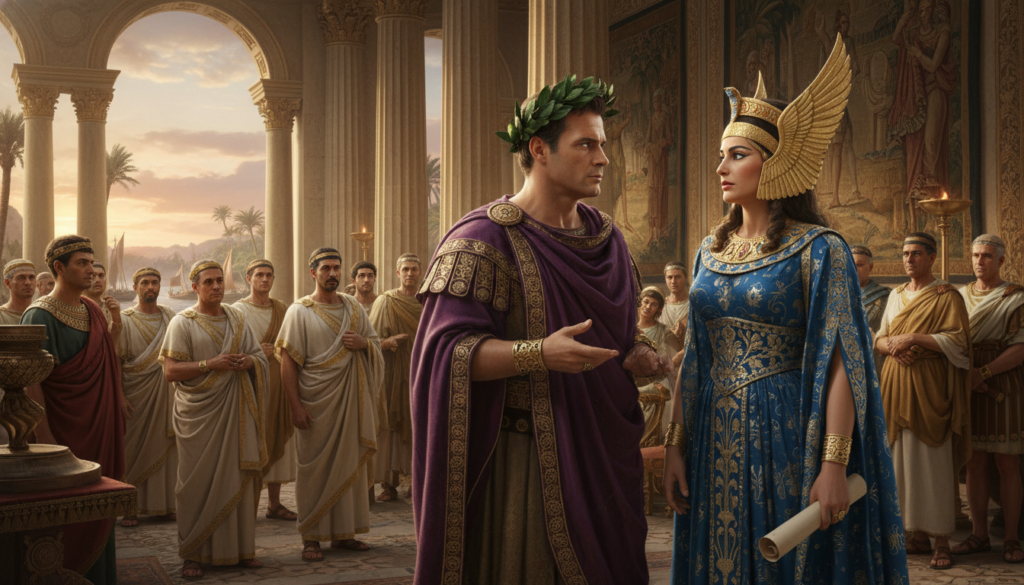
What began as political mediation soon transformed into one of history’s most famous political alliances. Caesar and Cleopatra became lovers, and their partnership served both their interests. Caesar gained access to Egypt’s vast wealth to pay off debts from his campaigns, while Cleopatra secured the backing of the Roman Empire’s most powerful leader. In 47 BC, she gave birth to Caesarion, whom she claimed was Caesar’s son.
Cleopatra visited Rome between 46 and 45 BC, residing in Caesar’s villa with her son and co-ruler Ptolemy XIV. This bold move demonstrated the strength of their political alliances to both Egyptian and Roman citizens. After Caesar’s assassination in March 44 BC shook the foundations of the Roman Republic, Cleopatra quickly returned to Egypt, understanding that her position in Rome had become dangerously vulnerable.
The Siege of Alexandria and Consolidation of Power
The winter of 48-47 BC marked a turning point for the young Egyptian pharaoh as she fought for control of her kingdom. Caesar’s small force found themselves trapped in Alexandria’s royal palace while Ptolemy XIII’s army surrounded them. For four long months, the Roman general and Cleopatra held their ground against overwhelming odds in one of the ancient Mediterranean world’s most dramatic sieges.
The Battle of the Nile and Death of Ptolemy XIII
Roman reinforcements changed everything when they arrived in spring 47 BC. Caesar’s strengthened army broke through the siege lines and pursued Ptolemy XIII’s forces across the delta region. The decisive confrontation came near the banks of the Nile River, where the young king’s army suffered a crushing defeat.

Ptolemy XIII attempted to escape by boat but never reached safety. Ancient historians record that the 15-year-old ruler drowned when his vessel capsized in the Nile River during his desperate flight. His golden armor pulled him beneath the muddy waters, ending the civil war that had torn Egypt apart.
Installation of Ptolemy XIV as Co-Ruler
Caesar restored order by placing Cleopatra back on the throne alongside her younger brother, Ptolemy XIV. The 13-year-old boy posed no real threat to his sister’s authority. This arrangement satisfied Egyptian tradition requiring an Egyptian pharaoh to have a male co-ruler while giving Cleopatra true control.
Ptolemy XIV’s reign lasted only three years before his mysterious death in 44 BC cleared the path for Cleopatra’s son Caesarion to become co-ruler. These political maneuvers set the stage for future conflicts that would culminate in the Battle of Actium decades later.
Queen of the Nile: Governing Ancient Egypt
Cleopatra’s reign as the queen of the Nile marked a remarkable period of recovery for ancient Egypt. Despite facing natural disasters like unpredictable Nile floods that threatened crops, this skilled female pharaoh transformed a nation torn by civil war into a prosperous kingdom. Her governance style blended practical economic policies with deep respect for Egyptian culture and religion.
Economic Prosperity Under Her Reign
Cleopatra inherited a bankrupt nation but quickly stabilized Egypt’s economy through smart trade policies. She controlled grain exports to Rome, making Egypt indispensable to the Mediterranean world. The queen of the Nile reorganized tax collection and expanded trade routes to India and Arabia. These reforms brought wealth back to ancient Egypt after years of decline.
Religious Authority and the Cult of Isis
The female pharaoh strengthened her legitimacy by identifying herself as the “New Isis.” This connection to the beloved goddess resonated deeply with Egyptian culture and religion. People saw her as the living embodiment of Isis, the divine mother and protector. This religious authority helped unite Upper and Lower Egypt under her rule.
Architectural Projects and Cultural Renaissance
Cleopatra’s building programs revived ancient Egypt‘s architectural glory. She completed the magnificent Temple of Edfu and commissioned a new temple at Dendera dedicated to Hathor. These projects employed thousands of workers and demonstrated the restored power of the female pharaoh. Her patronage of arts and sciences attracted scholars to Alexandria, reinforcing Egypt’s reputation as a center of learning.
Mark Antony and the Eastern Empire
The meeting between Mark Antony and Cleopatra in 41 BC marked a turning point for both leaders and the Roman Empire itself. After his victory at Philippi against Caesar’s assassins, Antony summoned Egypt’s queen to Tarsus to answer accusations of supporting his enemies. What began as a political meeting transformed into one of history’s most famous partnerships.
Cleopatra arrived in spectacular fashion, sailing up the river Cydnus in a golden ship with purple sails. Dressed as the goddess Isis, she created an unforgettable impression on the Roman general, who saw himself as the god Dionysus. This theatrical display wasn’t just romance—it was calculated statecraft by one of the most powerful women in history.
Their political alliances reshaped the eastern Mediterranean. During the winter of 41-40 BC in Alexandria, they formed a drinking society called “The Inimitable Livers” while planning their shared future. Cleopatra bore Antony three children: twins Alexander Helios and Cleopatra Selene in 40 BC, and Ptolemy Philadelphos in 36 BC.
The partnership proved mutually beneficial. In 37 BC, Mark Antony needed funds for his Parthian campaign. Cleopatra provided financial support, and in return, Antony restored much of Egypt’s former empire. Cyprus, Crete, parts of Syria and Lebanon, and valuable territories in Judea returned to Egyptian control. This expansion made Egypt a dominant force in the eastern Roman Empire, challenging the traditional power structure in Rome.
The Donations of Alexandria and Roman Opposition
In 34 BC, Mark Antony staged a grand public ceremony in Alexandria that would spark outrage across the Roman Republic. This lavish event became a turning point in the power struggle between East and West, setting the stage for the final chapter of ancient Egypt’s independence.
Caesarion as Heir to Julius Caesar
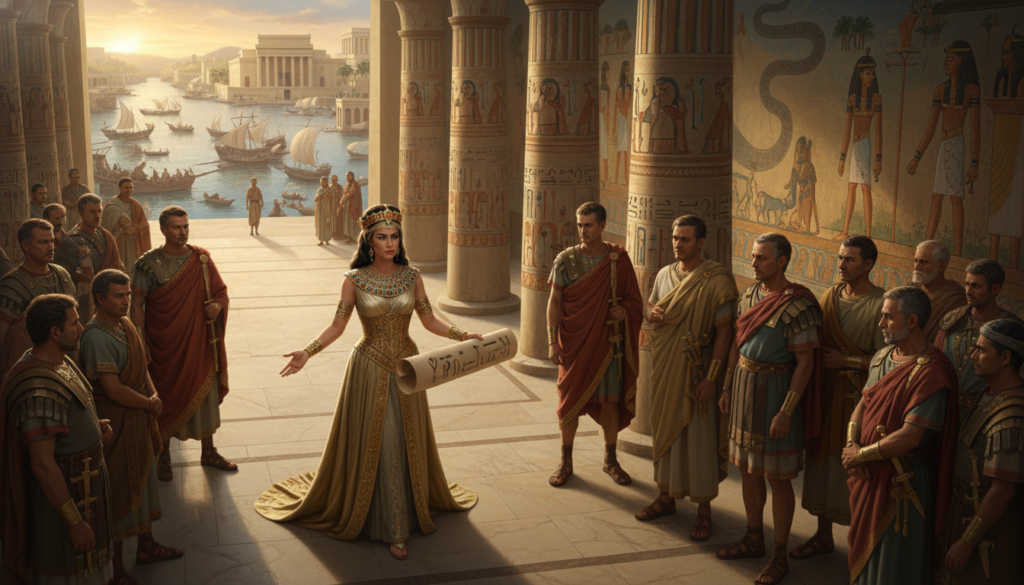
During the spectacular ceremony, Antony made a shocking declaration. He proclaimed that Caesarion, Cleopatra’s eldest son, was Julius Caesar’s legitimate heir. This directly challenged Octavian, who had been adopted by Caesar and considered himself the rightful successor. The announcement sent shockwaves through Rome’s political circles.
Division of Eastern Territories
Antony didn’t stop with naming Caesarion. He distributed vast territories among his children with Cleopatra:
- Alexander Helios received Armenia and Media
- Cleopatra Selene got Cyrenaica and Libya
- Ptolemy Philadelphus was given Syria and Cilicia
These grand gestures appeared to Roman citizens as if Antony was giving away lands that belonged to the Roman Republic.
Octavian’s Propaganda War
Octavian seized this opportunity to launch a fierce royal propaganda campaign. He painted Antony as a man bewitched by Cleopatra, claiming the Roman general planned to move the capital from Rome to Alexandria. By late 32 BC, the Senate stripped Antony of his titles. Octavian cleverly declared war on Cleopatra rather than Antony, avoiding the appearance of civil war while accelerating ancient Egypt decline.
The Battle of Actium: Downfall of an Egyptian Pharaoh
The fate of the last pharaoh of ancient Egypt was sealed on September 2, 31 BC, when naval forces clashed in the waters off Greece’s western coast. The Battle of Actium became the decisive moment that ended both the Roman civil war and Cleopatra’s reign over the ancient Mediterranean world.

Cleopatra and Mark Antony assembled a massive fleet of 500 warships to face Octavian’s naval commander, Marcus Agrippa. The Egyptian queen commanded 60 ships in the rear guard while Antony led the main attack force. Their combined strength seemed formidable on paper.
The battle turned disastrous when Cleopatra’s squadron suddenly broke through the enemy line and sailed toward Egypt. Some historians believe she fled in panic; others argue it was a planned escape with the treasury ships. Mark Antony abandoned his fleet to follow her, leaving his forces leaderless and demoralized.
“Antony’s soldiers watched in disbelief as their general’s purple sails disappeared toward the horizon, chasing after the Egyptian queen’s golden-prowed flagship.”
Octavian’s victory at the Battle of Actium gave him control over the Roman civil war’s outcome. He pursued the lovers to Alexandria, where he arrived in 30 BC with overwhelming force. The last pharaoh’s allies deserted her one by one. Mark Antony fell on his sword after hearing false reports of Cleopatra’s death, dying in her arms. The ancient Mediterranean world now belonged to Octavian alone.
The Asp Suicide: Death and Immortal Legend
The death of Cleopatra remains one of history’s most fascinating mysteries. On August 10, 30 BCE, the last ancient Egyptian queen chose death rather than face humiliation at the hands of Octavian. Her dramatic end came just days after Mark Antony took his own life, leaving her isolated in a world that had turned against her.
Final Days in the Royal Palace
Cleopatra spent her final days in Alexandria’s royal palace, surrounded by loyal servants. The asp suicide story tells us she dressed in her finest royal robes and laid upon a golden couch. According to historical accounts, she ordered an Egyptian cobra, known as an asp, to be brought to her hidden in a basket of figs. The bite of this sacred serpent held deep meaning for Egyptians, who believed it symbolized divine royalty and could grant immortality.

Ancient Sources on Her Death
The Cleopatra suicide myth has multiple versions. While the asp story became legendary, ancient historians disagreed about what really happened. Plutarch himself admitted that “the truth of the matter no one knows.” Some sources suggest she used a poisonous ointment or drank from a vial of poison. These conflicting accounts have fueled centuries of debate about how this powerful ancient Egyptian queen actually died.
The Mystery of the Lost Tomb
Cleopatra’s burial location remains unknown to this day. Ancient writers claim Octavian allowed her to be buried alongside Mark Antony, but the tomb has never been found. Archaeologists continue searching throughout Egypt for this legendary resting place. Her death marked the end of the Ptolemaic dynasty after 275 years of rule, and Egypt became a Roman province.
Cultural Impact Through the Ages
The legacy of Cleopatra extends far beyond her lifetime, transforming from political reality into cultural phenomenon. This Egyptian queen became one of the most recognizable powerful women in history, her image and story constantly reinvented across centuries. From ancient Roman writings to modern Netflix productions, Cleopatra has inspired countless artistic interpretations, each era projecting its own values onto her legendary persona.
Roman Historiography and Medieval Interpretations
Roman writers like Plutarch praised Cleopatra’s irresistible charm and linguistic abilities—she reportedly spoke twelve languages. Yet Roman propaganda painted her as a dangerous seductress who threatened Rome’s stability. Medieval scholars inherited these biased accounts, viewing the Egyptian queen through a moral lens that emphasized her romantic entanglements over her political achievements in ancient Egypt.

Renaissance Art and Baroque Representations
Renaissance artists rediscovered Cleopatra as a subject worthy of grand artistic expression. Painters, sculptors, and composers created operas and theatrical dramas celebrating her dramatic life. Baroque artists particularly emphasized her tragic death scene, cementing her place among powerful women in history through emotional, theatrical portrayals.
Modern Pop Culture and Egyptomania
Victorian Egyptomania sparked renewed fascination with ancient Egypt’s mysteries. Today’s Cleopatra appears everywhere:
- Hollywood blockbusters and television series
- Fashion and cosmetics branding
- Video games and graphic novels
- Museum exhibitions and documentaries
Each generation reimagines this Egyptian queen, proving her story remains eternally relevant to contemporary audiences worldwide.
Conclusion
Cleopatra stands as the last pharaoh of ancient Egypt, marking the end of an era that stretched back thousands of years. Her reign from 51 to 30 BC represented the final chapter of the Ptolemaic dynasty and the Hellenistic period that Alexander the Great had begun. This Egyptian royalty possessed remarkable intelligence and political skills that helped her navigate the dangerous waters of Mediterranean politics during one of history’s most turbulent times.
The relationships Cleopatra formed with Julius Caesar and Mark Antony went beyond personal romance. These alliances kept ancient Egypt independent for nearly two decades while other kingdoms fell to Rome. She brought economic prosperity to her people and maintained Egypt’s cultural traditions even as Roman power grew stronger. Her ability to speak nine languages and her deep understanding of different cultures throughout history made her an exceptional diplomat in the ancient world.
When Cleopatra died in 30 BC, Egypt became a Roman province, ending the age of pharaohs forever. Yet her story refused to die with her. Artists from the Renaissance to Hollywood have reimagined her life countless times. Today, she remains one of the most recognizable figures from the ancient world. The last pharaoh of Egypt left behind a legacy that continues to fascinate people around the globe, proving that some leaders truly become immortal through the power of their stories.