The atomic bomb history began on a desert morning that changed the world forever. At 5:30 a.m. on July 16, 1945, scientists in New Mexico witnessed the first nuclear explosion. The blast created light brighter than the sun and sent a mushroom cloud soaring seven miles into the sky. This single moment marked the birth of the atomic age and reshaped global politics for generations.
Nuclear weapons development during World War II was one of the most expensive and secretive projects ever. The Manhattan Project employed over 100,000 workers across 30 different sites in the United States. Scientists, engineers, and military personnel worked together to unlock the power of the atom. The program cost approximately 2.2 billion dollars, which equals about 30 billion in today’s money.
The path to the atomic age started long before World War II. Martin Klaproth discovered uranium in 1789, setting the stage for future nuclear research. Scientists spent centuries studying radioactive materials before they understood nuclear fission. This knowledge would eventually lead to both devastating weapons and peaceful nuclear energy.
The atomic attacks on Hiroshima and Nagasaki killed or wounded at least 200,000 Japanese civilians. These bombings ended World War II but sparked debates about nuclear weapons that continue today. The development of atomic weapons transformed international relations and military strategy. Nations now possess the power to destroy entire cities in seconds, forcing world leaders to reconsider the nature of war itself.
The Origins of Atomic Bomb History: From Scientific Discovery to Military Application
The path to nuclear weapons started long before the Manhattan Project. Scientists in Europe and America worked for years to understand atomic energy. Their findings paved the way for both peaceful uses and the weapons that would alter history.
Early Nuclear Research and the Discovery of Uranium
Martin Klaproth found uranium in 1789, starting a scientific journey. This heavy metal was key to atomic energy studies. In 1911, Ernest Rutherford created the first atomic model. His work showed the power inside atoms.
Marie Curie’s Groundbreaking Work on Radioactivity
Marie Curie found that uranium emits strange rays. She called this effect “radioactive”. Her research showed atoms can split and release particles. This was crucial for nuclear weapons.
German Scientists and the Discovery of Nuclear Fission
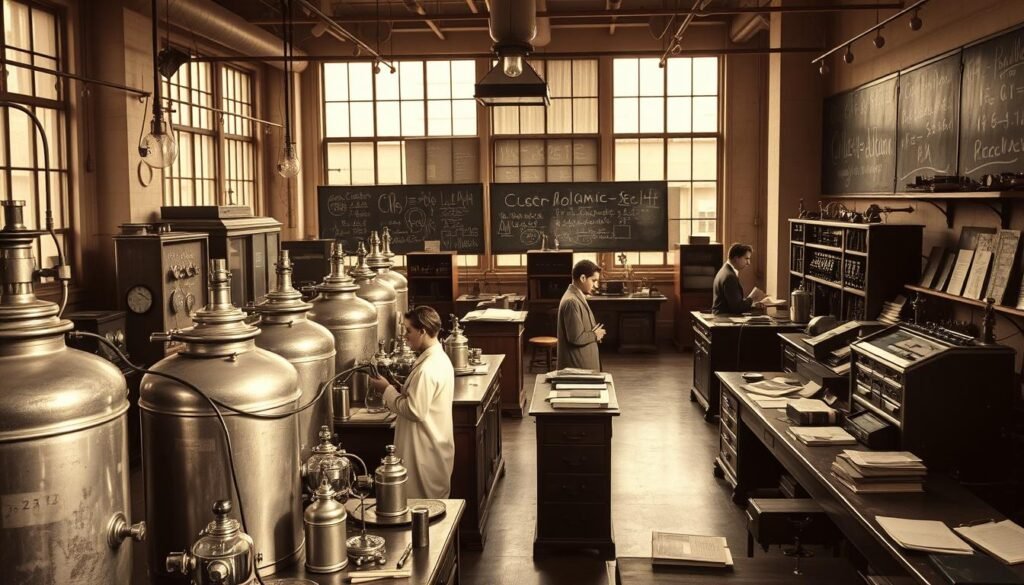
Otto Hahn and Lise Meitner split uranium for the first time in the late 1930s. Meitner named this process “fission.” Their discovery showed atoms can release a lot of energy. This inspired Robert Oppenheimer and his team.
The Einstein-Szilard Letter and America’s Response
Albert Einstein and Leo Szilard wrote to President Roosevelt on August 2, 1939. They warned about Germany’s atomic plans. This letter led to America’s nuclear program. By October 21, 1939, Roosevelt created the Advisory Committee on Uranium, starting the Manhattan Project.
The Manhattan Project: America’s Secret Nuclear Weapons Development
The Manhattan Project was a huge scientific effort. It brought together top scientists and resources to make nuclear weapons during World War II. This project created Little Boy and Fat Man, changing history forever.
Formation and Leadership Under General Leslie Groves
The Army Corps of Engineers started the Manhattan Engineer District on August 13, 1942. Colonel Leslie R. Groves took charge in September and was quickly promoted to Brigadier General. His skills were key in leading this massive project.
Key Sites: Oak Ridge, Los Alamos, and Hanford
General Groves picked three main sites for the project. Oak Ridge, Tennessee, focused on uranium enrichment. Los Alamos, New Mexico, was for weapons research. Hanford, Washington, worked on plutonium production. Each site was vital for the bombs.

J. Robert Oppenheimer and Project Y
J. Robert Oppenheimer led Los Alamos, known as Project Y. His genius and leadership were crucial. He guided the team in designing the bombs used in Japan.
The Chicago Pile and Enrico Fermi’s Achievement
On December 2, 1942, Enrico Fermi and Leo Szilard made a major breakthrough. They achieved a self-sustaining nuclear reaction under University of Chicago squash courts. This success led to President Roosevelt’s approval of the project, involving 600,000 people nationwide.
The Trinity Test: Dawn of the Atomic Age
On July 16, 1945, at 5:30 a.m., the world changed forever in the New Mexico desert. The Trinity Test marked a pivotal moment in atomic bomb history. Scientists detonated the first nuclear weapon at the Alamogordo Bombing Range, about 210 miles south of Los Alamos. This remote location called Jornada del Muerto witnessed the birth of the atomic age.
The plutonium implosion device, nicknamed “Gadget,” sat atop a 100-foot firing tower. Scientists had assembled the device by July 15 after transporting the plutonium core to the test area on July 12. Three observation bunkers stood 10,000 yards away in different directions from ground zero. Weather conditions forced a delay from the planned 4:00 a.m. detonation to 5:30 a.m.

The explosion exceeded all expectations. Scientists initially estimated the yield at 10,000 tons of TNT, but the actual blast reached 21 kilotons of explosive power. The fireball formed a distinctive mushroom cloud that would become the signature image of nuclear weapons development. The steel container “Jumbo,” weighing over 200 tons and positioned half a mile away, was knocked askew by the blast force.
This successful test proved both uranium and plutonium bomb designs worked. Within weeks, Little Boy struck Hiroshima on August 6, and Fat Man hit Nagasaki on August 9. Japan surrendered shortly after, ending World War II. The Trinity Test had demonstrated humanity’s ability to harness atomic power for destruction.
Little Boy and Fat Man: The Two Atomic Bombs
The Manhattan Project made two atomic bombs that changed history. These bombs, little boy and fat man, showed different ways to make a nuclear explosion. Each bomb used a special fuel and faced unique engineering challenges.
Design Differences Between Gun-Type and Implosion Methods
The little boy fat man bombs worked in different ways. Little Boy used a gun-type design, firing one uranium piece into another. This was like shooting a bullet to combine two pieces into one.
Fat Man used an implosion method. It compressed plutonium into a super-critical state. Thousands of pounds of explosives surrounded the plutonium, squeezing it from softball to tennis ball size. This needed precise timing and symmetrical blasts.

The Role of Plutonium and Uranium in Each Bomb
Little Boy and Fat Man used different materials. Little Boy had 140 pounds of uranium, but only 1.38% fissioned. Fat Man, with just 13.6 pounds of plutonium-239, was ten times more efficient.
The 509th Composite Group and Delivery Systems
The 509th Composite Group handled both bombs from Tinian Island. B-29 Superfortress bombers carried them. Little Boy weighed 9,700 pounds, and Fat Man was 10,800 pounds.
Colonel Paul Tibbets flew the Enola Gay with Little Boy. Major Charles Sweeney piloted Bockscar with Fat Man.
Hiroshima and Nagasaki Bombings: The First Nuclear Attacks
In August 1945, the world saw the power of atomic weapons. The United States dropped two bombs on Japan. These attacks changed history forever.
The Enola Gay and the Bombing of Hiroshima
On August 6, 1945, Colonel Paul Tibbets Jr. flew the Enola Gay over Hiroshima. At 8:15 AM, “Little Boy,” an atomic bomb, was dropped. It exploded with the force of 15,000 tons of TNT.
The explosion was as hot as the sun’s surface. Within half a mile, nine out of ten people died instantly.

Bockscar’s Mission to Nagasaki
Three days later, Bockscar carried “Fat Man” to Nagasaki. The second bomb fell on August 9, killing about 40,000 people right away. By 1945’s end, the death toll in both cities was huge.
In Hiroshima, 120,000 died, and in Nagasaki, 70,000. Radiation sickness caused more deaths over time.
Immediate Casualties and Destruction
The bombings destroyed entire neighborhoods in seconds. Buildings vanished, leaving only shadows. The initial blast killed around 80,000 in Hiroshima alone.
Survivors suffered severe burns, radiation poisoning, and long-term health issues. These problems lasted for decades.
Japan’s Surrender and the End of World War II
On August 15, 1945, Emperor Hirohito announced Japan’s surrender. This was six days after Nagasaki. The formal surrender ceremony happened on September 2 aboard the USS Missouri in Tokyo Bay.
The Atomic Bomb Aftermath and Long-Term Effects
The atomic bomb aftermath showed us the true horrors of war. Before Hiroshima and Nagasaki, American firebombing had destroyed 66 Japanese cities. This had killed about 900,000 civilians and left 8.5 million homeless. The atomic bombs had an even bigger impact.
Radiation sickness was a new medical problem doctors had never seen before. Survivors suffered from burns to internal damage that showed up weeks or months later. The true scale of suffering became clear only gradually, as thousands died from radiation-related illnesses in the months following the bombings.

After the war, opinions on nuclear weapons changed in America. A Fortune Survey in 1945 showed that 35.6% of Americans thought the bombs shortened the war by six months to a year. Meanwhile, 17.6% believed they saved over a year of fighting. These views reflected the wartime mentality, where half of American soldiers thought all Japanese needed to be killed for peace.
John Hersey’s 1946 New Yorker article changed how Americans saw the atomic bomb. His stories of six survivors showed the human cost of nuclear weapons. Long-term health studies of survivors have tracked radiation effects for generations, showing the lasting damage of nuclear war.
The Cold War Nuclear Arms Race and Global Proliferation
After World War II, the world saw a new era of tension. The United States and Soviet Union started a race for nuclear power. This race changed atomic energy from a weapon to a tool for diplomacy and defense.
Soviet Union’s Nuclear Program Development
Joseph Stalin started the Soviet nuclear program in 1943. He wanted to match the U.S. in atomic energy. The Soviets got their first nuclear chain reaction just 18 months after Japan was bombed.
In 1949, they tested “First Lightning,” surprising the West. The nuclear race grew when the Soviet Union tested “Tsar Bomba” in 1961. This bomb was huge, with a mushroom cloud as tall as Mount Everest.
The Cuban Missile Crisis and Nuclear Brinkmanship
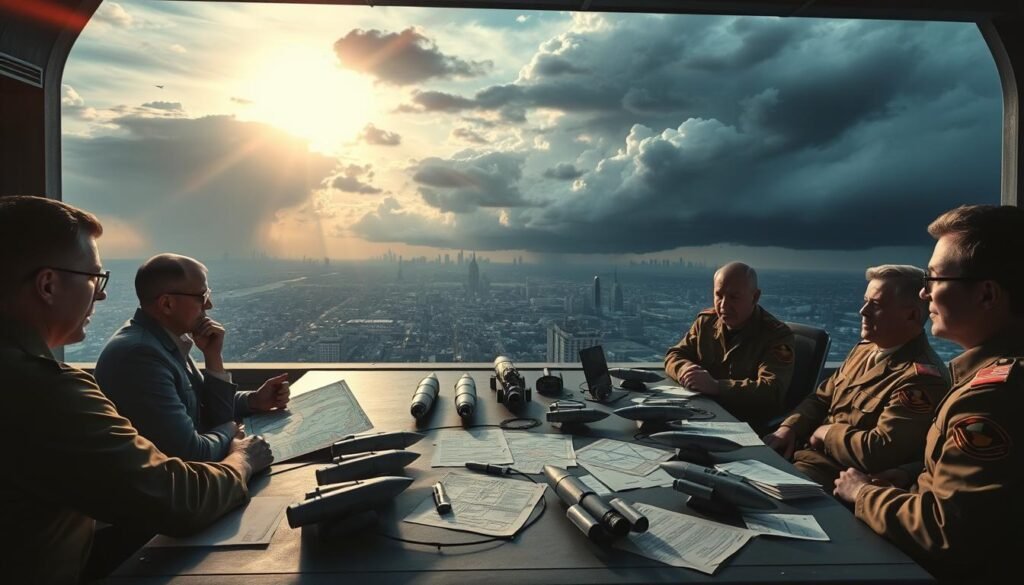
The 1962 Cuban Missile Crisis was a close call to nuclear war. Soviet missiles in Cuba led to a tense standoff. During this time, nuclear threats and alerts became a part of diplomacy, showing both sides’ readiness.
Nuclear Non-Proliferation Treaty and International Agreements
The Cuban Missile Crisis led to arms control efforts. The 1963 partial test ban treaty limited nuclear tests. The 1968 Nuclear Non-Proliferation Treaty aimed to stop nuclear weapons spread.
By 2020, nuclear weapons had dropped from 70,300 to 13,410. Russia and the U.S. still have 91% of these. France, China, the U.K., Israel, Pakistan, India, and North Korea have the rest.
The Social and Political Impact of Nuclear Weapons
Nuclear weapons changed society forever. Scientists who made these weapons became their strongest critics. Many who worked on the Manhattan Project later fought against them.
Their voices sparked a movement that shaped politics for decades.
The Anti-Nuclear Movement and Public Protests
The anti-nuclear movement grew strong in the late 1950s. People were scared of radioactive fallout from tests. Mass protests broke out in America and Europe.
Citizens demanded an end to nuclear testing. The fear of these weapons drove millions to join peace marches and sign petitions.

Three Mile Island and Nuclear Energy Concerns
The 1979 accident at Three Mile Island shocked America. A partial meltdown released radioactive gases into Pennsylvania’s air. This event made people doubt nuclear power.
People linked civilian nuclear energy to atomic bomb history. Trust in nuclear technology plummeted. Many nuclear plants were canceled after this disaster.
Women Strike for Peace and Civil Society Response
In 1961, Women Strike for Peace organized 50,000 women across 60 cities. They protested nuclear proliferation and demanded a test ban treaty. Their slogan “End the Arms Race—Not the Human Race” became famous worldwide.
These mothers and grandmothers changed how society viewed nuclear weapons. Their activism pushed the government toward arms control agreements.
Conclusion
The Trinity Test was a huge success, exceeding everyone’s expectations. It gave America a powerful edge as World War II ended. President Truman saw these bombs as a new, better kind of weapon.
General Dwight Eisenhower agreed with Truman. They both thought these bombs were more effective than traditional ones. This view changed how wars were fought.
The Manhattan Project was a groundbreaking effort in modern warfare. Japan became the first major nation to surrender without being invaded. This was a major victory for the United States.
The project started to keep nuclear power from Nazi Germany. It ended by showing America’s military strength. The decision to use atomic weapons was made for several reasons. It was to end the war fast and show America’s power to the Soviet Union.
The atomic age brought a new threat to humanity. The United Nations Office for Disarmament Affairs warns of dangers from nuclear weapons. Scientists’ concerns 75 years ago are still valid today.
The history of the atomic bomb reminds us of human achievement and responsibility. It shows the power and danger of such weapons.