
Imagine a world where every particle has a twin with opposite properties. This isn’t just science fiction. It’s the real world of antimatter. Scientists study these mysterious particles to learn about our universe.
Antimatter is a key discovery in particle physics. Each regular particle has a mirror twin with the same mass but opposite charge. When an electron meets its twin, the positron, they both disappear in a burst of energy.
The big question for physicists is why our universe is mostly regular matter. The Big Bang should have made equal amounts of matter and antimatter. But our universe is mostly regular matter. Stars, planets, and even we exist because matter won the cosmic battle long ago.
Quantum physics reveals something amazing about antimatter. According to CPT symmetry, antimatter acts like regular matter moving backward in time. This helps scientists understand how tiny particles interact.
Scientists have shown that complex antimatter atoms can exist. At places like CERN, researchers have made antihydrogen atoms. These findings suggest that anti-elements could exist in the universe too.
What Is Antimatter and How Does It Differ from Regular Matter?
Antimatter is not just science fiction; it’s real. Every particle has a twin that looks like its mirror. These twins act almost the same as regular particles, but they have one big difference: their electrical charges are opposite.
The Basic Definition of Antiparticles
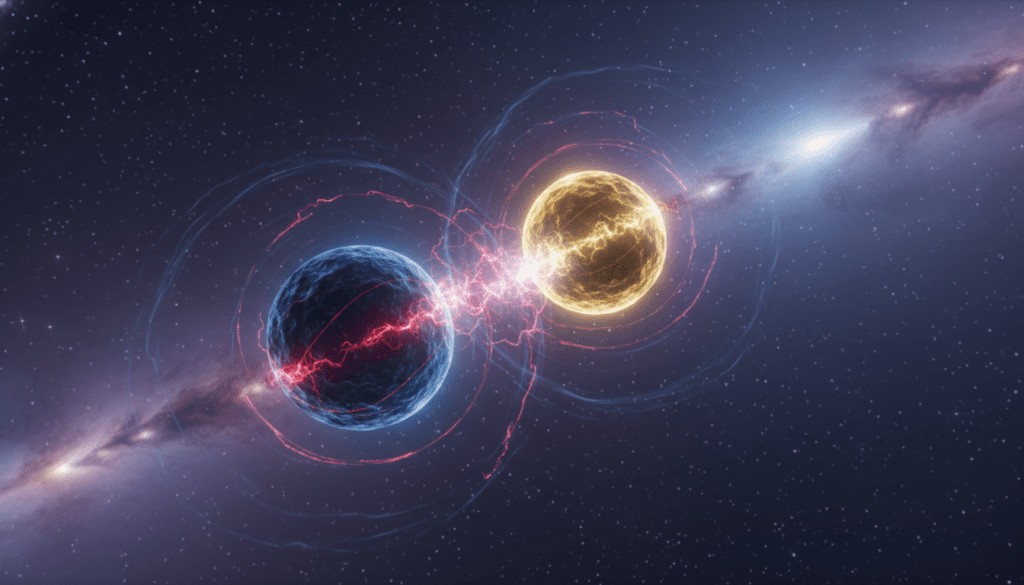
Antiparticles are like regular particles but with opposite charges. A positron is like an electron but has a positive charge. An antiproton is like a proton but has a negative charge.
At CERN, scientists dropped thousands of antihydrogen atoms. They fell just like regular matter, showing antimatter is affected by gravity too.
Charge Reversal and Quantum Properties
Antimatter particles have opposite quantum numbers. Protons have a baryon number of +1, while antiprotons have -1. Electrons have a lepton number of +1, but positrons have -1. These differences affect how they interact during annihilation.
Mass-Energy Equivalence in Antimatter
When matter meets antimatter, they both disappear in a burst of energy. This follows Einstein’s famous equation E=mc². Electron-positron pairs turn completely into gamma rays, releasing all their mass as energy.
The ALPHA experiment in 2016 showed antihydrogen’s energy transitions are the same as regular hydrogen. This confirms antimatter follows the same laws as matter.
The Discovery and History of Antimatter Theory
The idea of antimatter started long before scientists could prove it existed. In 1898, physicist Arthur Schuster wrote to Nature magazine. He suggested that matter might have a mirror twin. This idea was the start of a major discovery in physics.
Paul Dirac and the Revolutionary Equation
In 1928, British physicist Paul Dirac made a big breakthrough. He was working on quantum mechanics when he came up with the Dirac equation. This equation combined Einstein’s special relativity with quantum theory.
The Dirac equation predicted particles with negative energy states. At first, scientists were confused by these strange solutions.
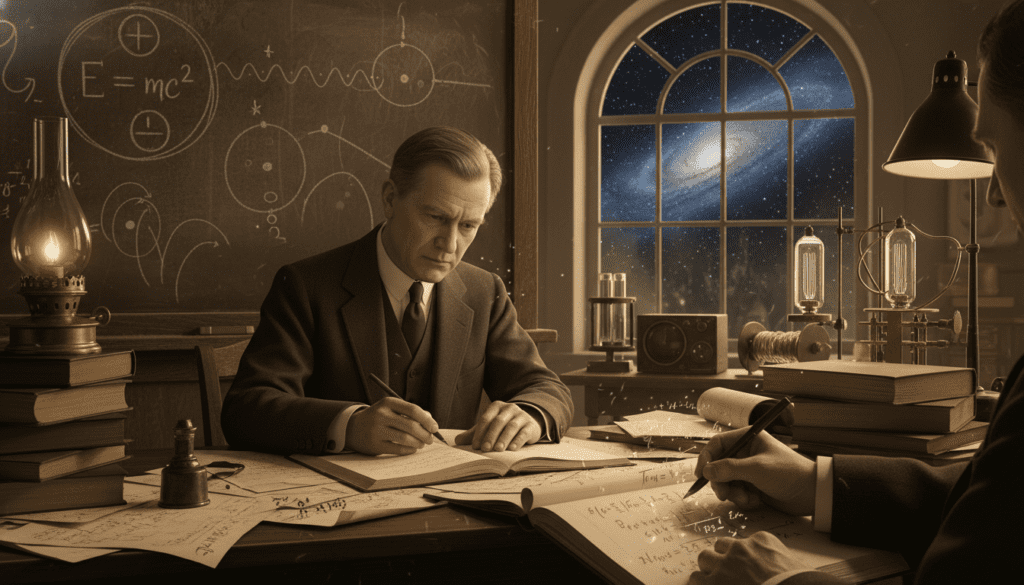
By 1931, Paul Dirac understood what his equation meant. It showed that there were “anti-electrons,” particles like electrons but with opposite charge. Dirac’s equation had predicted antimatter before it was seen.
Carl Anderson’s Cloud Chamber Discovery
On August 2, 1932, American physicist Carl Anderson made a groundbreaking discovery. He used a cloud chamber to study cosmic rays. He found strange particle tracks that curved the wrong way in magnetic fields.
These particles had the same mass as electrons but positive charge. Anderson’s discovery proved Dirac’s predictions were right.

Cosmos
by Carl Sagan
If this article expanded your mind, Cosmos will transform it. Carl Sagan's masterpiece takes you on an unforgettable journey through 13.8 billion years of cosmic evolution—from the Big Bang to the emergence of consciousness.
Written with Sagan's signature blend of scientific rigor and poetic wonder, Cosmos answers the same questions you just explored—but with the depth and storytelling that made it a global phenomenon.
From Theoretical Prediction to Experimental Confirmation
The journey from theory to proof was a turning point in physics. Today, places like CERN create antimatter particles to study them. The Feynman-Stueckelberg interpretation later explained that antiparticles follow the same laws as regular particles, but with opposite properties.
Fundamental Particles and Their Antiparticle Counterparts
Every particle in the universe has a twin made of antimatter. These twins follow the same rules as regular matter but with opposite charges. Scientists have found that this balance is true for all tiny particles, from the smallest to the more complex.
Positrons: The Anti-Electrons
Positrons are the antimatter version of electrons. While electrons have a negative charge, positrons have a positive one. They show up in radioactive decay. Interestingly, even everyday things like bananas produce positrons — one banana makes a positron every 75 minutes because of potassium-40 decay.
Antiprotons and Antineutrons
Antiprotons are like regular protons but with a negative charge. They are marked with a bar symbol (p̅). Regular protons have two up quarks and one down quark. Antiprotons have two anti-up quarks and one anti-down quark.
Antineutrons have no charge, just like regular neutrons. But they have different quarks inside. When antiprotons and antineutrons come together, they form anti-atoms that act just like regular atoms.
Quarks, Antiquarks, and Subatomic Particles
All quarks have partners in antimatter. The Relativistic Heavy Ion Collider at Brookhaven National Laboratory made antimatter helium-4. This shows that complex antimatter can exist and behave like regular matter.
Matter-Antimatter Annihilation: The Ultimate Energy Release
When regular matter meets antimatter, a powerful event happens. This collision causes both particles to disappear, turning into pure energy. This follows Einstein’s famous equation E=mc², showing how a lot of energy comes from a small amount of mass.
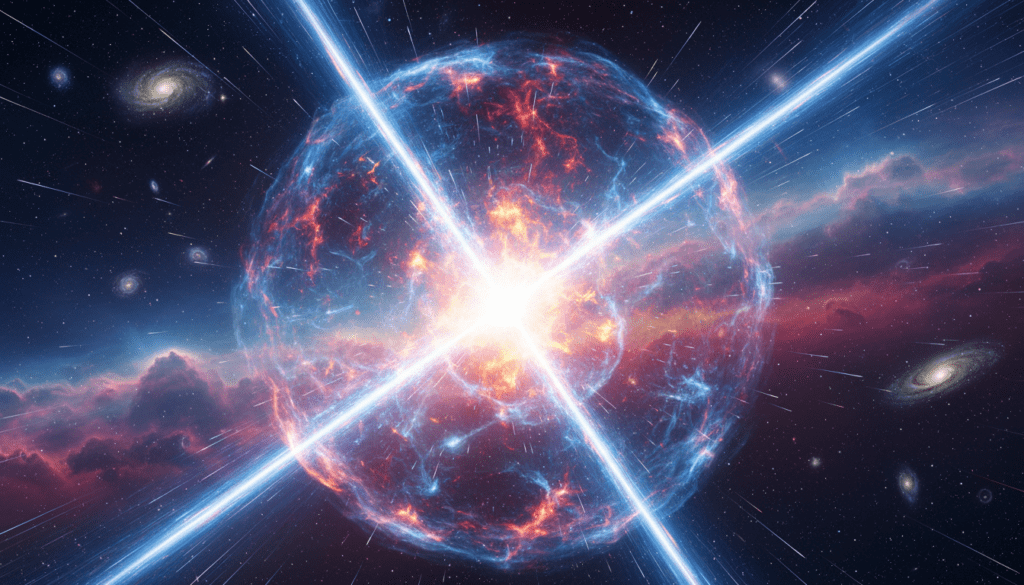
In an annihilation reaction, all the mass of both particles turns into energy. A positron and an electron colliding produce two gamma rays. Each gamma ray has 511 kiloelectron volts of energy. This is much more energy than what stars produce through nuclear fusion.
The annihilation process creates several types of radiation:
- Gamma rays – high-energy photons that travel at light speed
- Neutrinos – nearly massless particles that rarely interact with matter
- Particle-antiparticle pairs – formed from the intense energy release
Scientists in quantum physics study these reactions to understand fundamental forces. The energy from annihilation first appears as ionizing radiation. This radiation is then absorbed by surrounding matter, turning into heat or visible light.
If large-scale antimatter regions existed in space, we would see distinctive gamma ray signatures. These would come from where matter and antimatter meet.
“The total conversion of matter into energy represents the ultimate limit of energy extraction from mass” – Lawrence Krauss, theoretical physicist
Natural Production of Antimatter in the Universe
Scientists make antimatter in labs, but nature does it too. It happens in the sky and deep in space. Antimatter is created through natural events that scientists are still learning about.
Cosmic Ray Collisions and Antimatter Creation
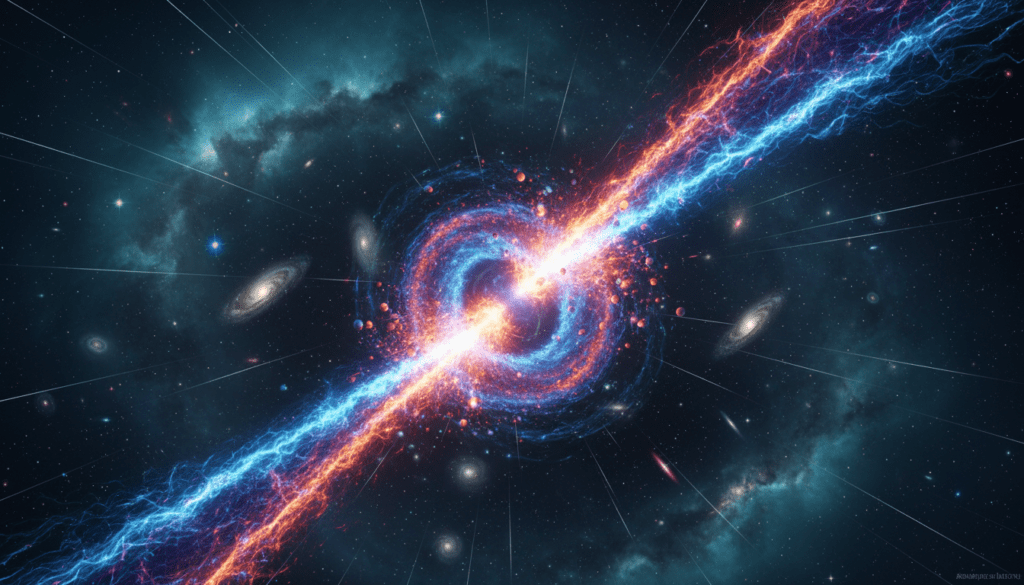
High-energy particles from space hit Earth’s atmosphere. This creates small amounts of antimatter. These cosmic ray collisions happen all the time, making positrons and other antiparticles.
The energy from these collisions turns into matter-antimatter pairs. This follows Einstein’s famous equation E=mc².
Radioactive Decay and Positron Emission
Some radioactive elements naturally make positrons. For example, potassium-40 in bananas decays by positron emission. This happens when a proton turns into a neutron, releasing a positron and a neutrino.
Medical PET scans use this principle with artificial tracers.
Antimatter in Thunderstorms and Van Allen Belts
In 2011, scientists found that thunderstorms produce antimatter. Earth gets about 500 terrestrial gamma-ray flashes daily. Each flash creates positrons in the storm clouds.
The PAMELA satellite module found antiprotons in Earth’s Van Allen radiation belts. Scientists think Jupiter, Saturn, Neptune, and Uranus might have similar belts too.
CERN Research and Artificial Antimatter Production
Scientists at CERN have made science fiction a reality by creating and storing antimatter. The European research facility runs several groundbreaking experiments. These experiments produce antiparticles for study.
These achievements help physicists understand the universe’s laws and its beginning. It’s a big step in understanding the cosmos.
The Antiproton Decelerator Facility
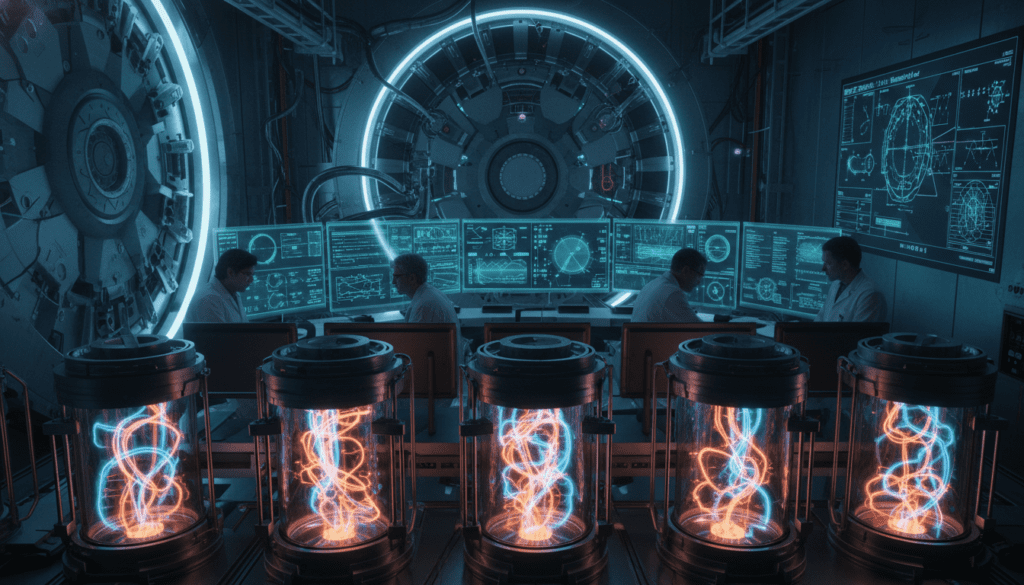
The Antiproton Decelerator at CERN is the world’s only antimatter factory. It slows down antiprotons to speeds where scientists can capture them. Five major experiments use these particles to study antimatter’s properties.
Creating and Studying Antihydrogen Atoms
CERN research teams have successfully made antihydrogen atoms. They combine antiprotons with positrons. The ALPHA experiment traps these atoms using magnetic fields for antimatter containment.
In 2023, Oxford University researchers at CERN’s facility created the first electron-positron beam-plasma. They used a 440 GeV proton beam.
BASE Experiment Precision Measurements
The BASE experiment made a precise measurement in 2017. They measured the antiproton magnetic moment to 1.5 parts per billion accuracy. This confirms CPT symmetry—a key principle.
Despite these achievements, making antimatter is very expensive and technically challenging. Particle accelerators produce only nanograms of antimatter.
Antimatter Containment Using Penning Traps and Magnetic Fields
Scientists have a big challenge with antimatter: keeping it from regular matter. When the two meet, they instantly destroy each other. So, antimatter containment is a huge task in physics. They use strong magnetic fields to trap antiparticles in midair, creating invisible walls.
A penning trap acts like a magnetic bottle. It uses superconducting coils to hold charged antiparticles in place. This setup creates a vacuum where antiparticles float, unable to touch the sides. At CERN, researchers have trapped thousands of antihydrogen atoms in vertical shafts with magnetic fields.
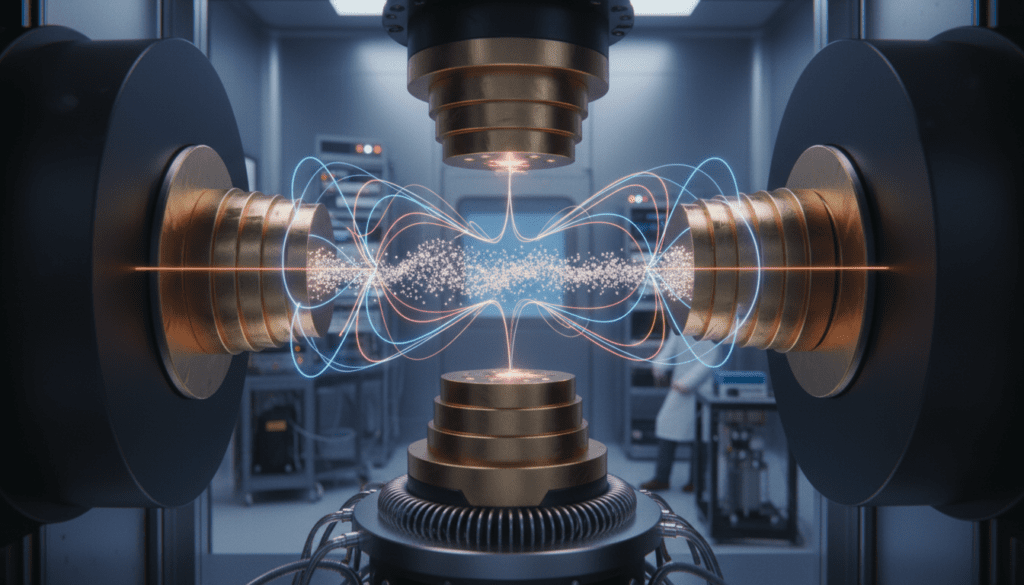
Keeping antimatter trapped requires great precision. Scientists can hold it for minutes or hours with the right magnetic fields. When they want to study it, they slowly weaken the antimatter confinement system. Special sensors track the antiparticles as they escape, allowing scientists to study them without causing destruction.
Recently, scientists made big strides. In 2018, Marco Giammarchi’s team at the Positron Laboratory L-NESS in Como, Italy, did the first antimatter quantum interferometry experiment. This showed that a penning trap can keep antimatter stable for quantum measurements. But, they’ve only managed to hold tiny amounts. We’re still far from seeing antimatter with our eyes.
The Great Mystery: Matter-Antimatter Asymmetry in Our Universe
The universe has a big mystery in particle physics. At the Big Bang, we should have equal amounts of matter and antimatter. But today, our world is mostly made of matter. This matter-antimatter asymmetry makes us question the laws of nature.
Baryogenesis and the Big Bang Theory
Right after the Big Bang, the universe was full of matter and antimatter pairs. When these pairs meet, they turn into energy. But, about one extra matter particle survived for every billion pairs.
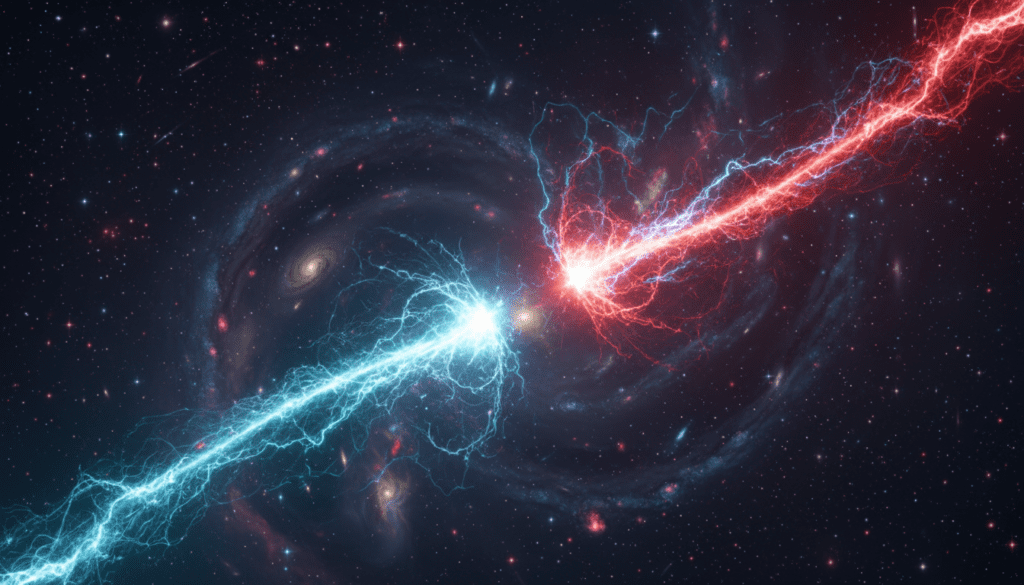
Scientists call this process baryogenesis. They still don’t know how it happened.
CP Violation and Quantum Mechanics
Quantum mechanics gives us hints through CP violation. At places like the Large Hadron Collider, particles turn into antiparticles millions of times a second. These changes might explain why matter won over antimatter.
The Search for Antimatter Galaxies
NASA is looking for antimatter galaxies with special satellites. They search for X-ray and gamma-ray signs. The INTEGRAL satellite found a big antimatter cloud near our galaxy’s center.
Finding antimatter galaxies is hard because they look the same as regular galaxies.
Practical Applications: From Medical Imaging to Future Propulsion
Antimatter might seem like something from science fiction, but it’s real and important today. It helps save lives in hospitals and could power spaceships to other stars. Antimatter applications show how science research leads to real benefits.
Positron Emission Tomography in Medicine
Positron emission tomography (PET) scans use antimatter to help doctors. Patients get radioactive tracers that release positrons. These positrons meet electrons in the body, creating gamma rays.
Special cameras catch these rays, making detailed images. These images show how active body tissues are. They help doctors find cancer, heart disease, and brain issues early.
Industrial Applications and Cancer Treatment
Antimatter also has a role in treating cancer with great precision. Researchers at places like CERN study how antiprotons can target cancer cells. This could reduce harm to healthy tissue.
Industries use similar imaging methods for checking aircraft parts and material stress. This way, they can find problems without damaging the items.
Theoretical Spacecraft Propulsion Systems
Antimatter propulsion could change space travel forever. NASA says one gram of antimatter could power a Space Shuttle for a long time. But making enough antimatter is a big challenge.
Scientists are working on ways to make and contain antimatter. Their goal is to make space travel to other stars possible in a few hundred years.
Dark Matter, Dark Energy, and Their Relationship to Antimatter
Many people mix up antimatter with dark matter, but they are quite different. Antimatter destroys itself when it meets regular matter, releasing a lot of energy. On the other hand, dark matter goes right through regular matter without any interaction.
This difference makes dark matter invisible to our telescopes. Unlike antimatter, which we can spot through gamma rays when it annihilates.
The Alpha Magnetic Spectrometer (AMS-02) on the International Space Station has found interesting clues. It saw positron levels peak at 16% around 275 GeV of energy. Some scientists think these positrons might come from dark matter particles colliding and making antimatter in space.
This could mean dark energy and dark matter might create antimatter in ways we’re still learning about.
Quantum physics also links these mysteries through neutrinos. These invisible particles might be Majorana particles, acting as their own antiparticles. The Deep Underground Neutrino Experiment, backed by the Department of Energy, looks into neutrinos’ role in our universe’s matter-antimatter balance.
Scientists are studying neutrinoless double beta decay. This process could create matter without antimatter, helping us understand why our universe exists.
Today, particle accelerators are searching for tiny differences in how heavy particles and their antiparticles decay. These studies aim to see if dark energy affects antimatter differently than regular matter. This could solve a big mystery in quantum physics.
Conclusion
Antimatter research is a thrilling field in particle physics today. Scientists at CERN and Fermilab are exploring these mirror particles. They aim to understand why our universe is mostly matter.
Each experiment brings us closer to this answer. It drives physicists to improve detection and measurement tools. This quest is essential to understanding our universe.
Antimatter research has already changed medicine, thanks to PET scans and cancer treatments. These discoveries show how quantum mechanics can benefit our lives. Creating and storing antiparticles is still expensive and hard, but scientists are making progress.
The limits of physics guide how we work with antimatter in labs. This is crucial for future research.
Future studies will explore how antimatter interacts with gravity and if it exists in space. They also look into using antimatter for space travel. The next decade could bring big discoveries about our universe’s origins.