
The ancient civilizations collapse that swept across the Mediterranean world around 1200 BC remains one of history’s greatest puzzles. From Egypt to Greece, from Anatolia to the Balkans, powerful empires fell like dominoes in just a few decades. Cities burned, palaces crumbled, and writing systems disappeared almost overnight.
The fall of early empires during this period was catastrophic and swift. The Mycenaean Greeks lost their palace culture. The Hittite Empire vanished from Anatolia. Egyptian power retreated back to the Nile Valley. Trade networks that had connected these civilizations for centuries simply stopped working.
German historian Arnold Hermann Ludwig Heeren first identified this turning point in 1817. He noticed that something terrible happened around 1200 BC that changed the ancient world forever. The reasons ancient civilizations collapsed during this time were not simple. Violence destroyed many Bronze Age cities, but that was just part of the story.
The rise and fall of civilizations follows patterns we can study today. When the Bronze Age ended, people forgot how to write in many regions. Trade routes that brought tin from Afghanistan and amber from the Baltic Sea stopped functioning. Complex palace economies gave way to smaller village communities. This transformation reshaped human history and left questions that archaeologists still work to answer.
Understanding Ancient Civilizations Collapse Through Archaeological Evidence
Scientists studying the collapse of early societies face a challenge: separating fact from fiction. Recent investigations reveal that many supposed destructions never actually occurred. Archaeologist Jesse Millek examined 148 sites with 153 reported destruction events from around 1200 BC. His findings shocked the academic world—94 of these events (61%) were either incorrectly dated, based on weak assumptions, or simply fictional.
Physical Destruction Patterns in Bronze Age Sites
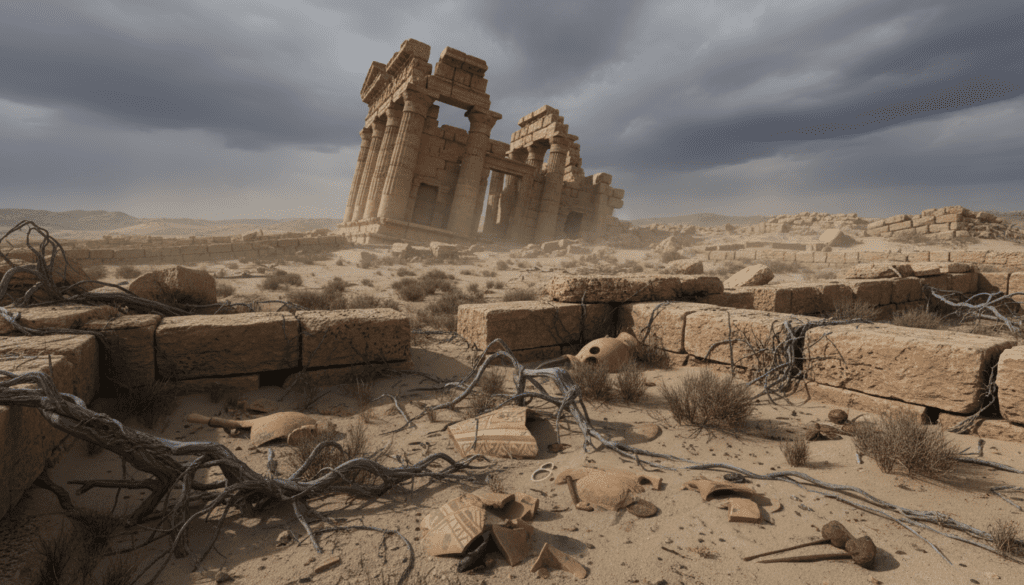
Archaeological evidence of societal collapse requires careful examination. Many famous sites show no actual destruction layers despite popular beliefs. Cities like Lefkandi, Orchomenos, Athens, Knossos, and Byblos remained intact during periods when scholars previously thought they burned. Robert Drews documented 60 destructions in his influential work, yet new analysis proves 31 of these (52%) never happened. Understanding these patterns helps researchers identify genuine ancient empire decline versus misinterpreted data.
Dating Methods and Historical Records
Historical records and inscriptions provide vital clues about timing. The Merneptah Stele from approximately 1200 BC lists specific peoples—Putrians, Ekwesh, Shekelesh, Lukka, Shardana, and Teresh—who attacked Egypt. These inscriptions help date events precisely and connect different regional collapses.
Distinguishing Between Myth and Archaeological Reality
Ann Killebrew’s work on Jerusalem demonstrates the importance of careful analysis. The city flourished during 1800-1550 BC and again from 720-586 BC. During the Late Bronze Age, Jerusalem remained small and unfortified—contradicting dramatic collapse narratives. This research shows why examining physical evidence matters when studying ancient empire decline.
The Late Bronze Age Collapse and Its Global Impact
Around 1200 BC, the ancient world experienced one of history’s most devastating events. The Late Bronze Age Collapse saw thriving civilizations across the Mediterranean crumble within decades. This catastrophe rivals the fall of Mayan civilization in its scope and mystery. Cities burned, trade stopped, and writing systems vanished as complex societies fell into darkness.
Timeline of Destruction from Pylos to Gaza
The ancient societies downfall began around 1250 BC when earthquakes struck Mycenae. The city rebuilt, only to burn in 1190 BC. Pylos faced intense fires around 1180 BC that left nothing but ash. Tiryns suffered earthquake damage in 1200 BC. The Hittite capital Hattusa burned to the ground while bodies lay unburied in Karaoğlan near modern Ankara. These lost ancient civilizations fell like dominoes across the eastern Mediterranean.
📚 Want to See How the Myth Was Created?

Charles Berlitz's 1974 bestseller is a masterclass in persuasive storytelling—even when the facts don't quite add up. While we now know the scientific truth, his book remains a fascinating study in how compelling narratives shape public perception.
Perfect for: Psychology students, writers, skeptics, and anyone interested in critical thinking and media literacy.
📖 Get on AmazonReading Berlitz's book after learning the real science makes it even more fascinating. You'll spot exactly where drama replaced data.
The Fall of Palace Economies in the Mediterranean
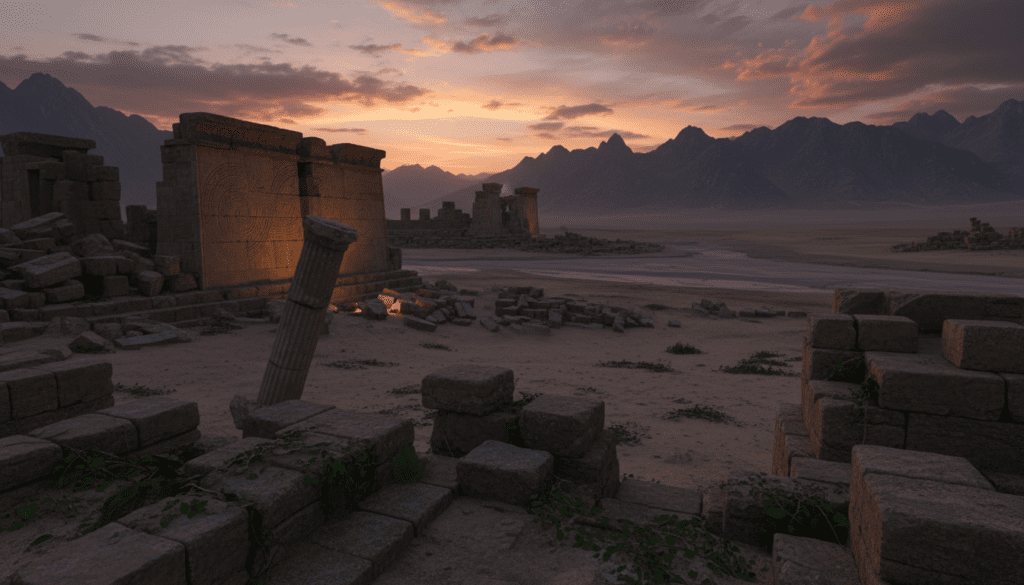
Palace economies controlled Bronze Age wealth through central bureaucracies. Kings and nobles collected taxes and redistributed goods. When palaces burned, entire economic systems collapsed. The Mesopotamian society downfall pattern repeated across regions as administrative centers failed.
Transformation from Complex Societies to Village Cultures
After the collapse, 90% of settlements in Greece’s Peloponnese region stood empty. Survivors abandoned cities for small villages. The Greek Dark Ages lasted from 1100 to 750 BC. Writing disappeared, trade routes closed, and monumental architecture ceased. These lost ancient civilizations left behind ruins that puzzle archaeologists today.
Climate Change Effects on Ancient Societies
Scientists have uncovered striking evidence that climate change in ancient times played a major role in the rise and fall of early civilizations. From the deserts of Mesopotamia to the icy shores of Greenland, environmental factors in civilization collapse left their mark in soil layers, ice cores, and abandoned cities.
Evidence of Prolonged Droughts in Mesopotamia
Pollen records from Syria reveal a dramatic story of prolonged droughts and famine that began around 1400 AD and lasted nearly 500 years. At the ancient site of Tell Leilan, archaeologists discovered a thick layer of wind-blown sand covering what was once a thriving city. For three centuries, no one lived there. Soil scientist Marie-Agnes Courty found wind-blown pellets and dust deposits that tell of harsh, dry conditions that made farming impossible.
The Little Ice Age and Viking Greenland Settlements
Erik the Red established Viking colonies in Greenland in 985 AD with 5,000 settlers. By 1450 AD, these settlements stood empty. The Little Ice Age brought shorter growing seasons and blocked shipping routes with sea ice. What seemed like prime farmland became frozen wasteland, forcing Vikings to abandon homes their families had occupied for centuries.
Abrupt Climate Shifts Around 2200 BC
Around 2200 BC, Mesopotamia experienced sudden climate shifts that devastated entire regions. These environmental factors in civilization collapse appear in geological records across multiple continents, suggesting a global event that reshaped human history.
Environmental Data from Ice Cores and Lake Sediments
Scientists gather evidence of climate change in ancient times from:
- Ocean floor sediments
- Cave stalagmites
- Glacier ice cores
- Lake bed deposits
These natural archives preserve a detailed record of temperature changes, rainfall patterns, and volcanic activity spanning thousands of years.
Resource Depletion and Agricultural Failure
Ancient societies depended heavily on their natural resources and farming systems for survival. When these critical foundations failed, entire civilizations faced catastrophic consequences. The pattern of resource depletion historical collapse appears repeatedly throughout the archaeological record, revealing how even powerful empires could fall when their agricultural and material bases crumbled.
The Bronze Age provides a striking example of why civilizations fail when resources run dry. The Únětice culture collapsed around 1600 BC after exhausting their tin mining operations. These societies relied on bronze production for tools, weapons, and trade goods. When tin sources in the Erzgebirge mountains declined, their entire economic system unraveled. This dependency on finite metal resources created vulnerability that agricultural societies had never faced before.
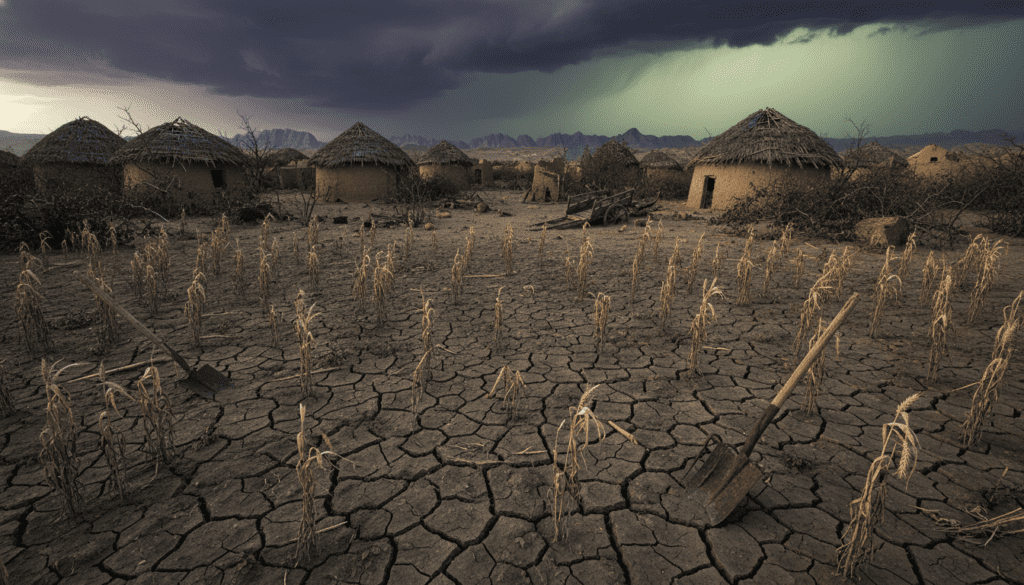
Environmental degradation struck agricultural regions with devastating force. Around 2200 BC, the thriving farms of Tell Leilan in Syria suddenly stopped producing grain. The Khabur Plains, once fertile farmland, became completely abandoned for centuries. These agricultural failures weren’t gradual declines but swift collapses that left populations without food supplies.
The shift from subsistence farming to centralized agricultural systems increased vulnerability to resource depletion. Palace economies demanded surplus production to support urban centers, armies, and bureaucracies. When drought struck or soil became exhausted, these complex systems had no backup plans. Athens survived longer than neighboring cities partly due to protected water sources, yet even they struggled when regional droughts made them dependent on imported grain.
Political Instability and the Fall of Empires
When powerful ancient empires crumbled, political instability often played a central role in their downfall. Great civilizations that once controlled vast territories found themselves torn apart from within. These empires faced challenges that weakened their foundations and left them vulnerable to complete collapse.
Internal Conflicts in the Hittite Empire
The Hittite Empire provides a striking example of how internal conflicts and civil wars destroyed a once-mighty civilization. By 1200 BC, this Anatolian powerhouse fragmented under multiple pressures. Famine and plague sparked fierce competition for resources among different regions. Archaeological evidence shows destruction layers at numerous sites across Anatolia, revealing the empire’s violent fragmentation into smaller, warring territories.
Civil Wars and Succession Crises
Ancient political instability often erupted when rulers died without clear successors. The Akkadian Empire collapsed suddenly around 2200 BC, partly due to succession disputes that drained imperial revenues. Egypt faced similar challenges during the New Kingdom period. Between 1300 and 1200 BC, the palace at Thebes suffered repeated attacks before burning to the ground. Each succession crisis weakened central authority and encouraged regional leaders to grab power for themselves.
Breakdown of Diplomatic Networks
The roman empire decline centuries later would echo patterns seen in Bronze Age collapses. Egypt’s economy crashed after expensive military campaigns in Asia left state treasuries nearly empty. The Assyrian Empire gradually abandoned its Anatolian territories during the 11th century BC. Without stable diplomatic relationships and trade agreements, these ancient powers lost their ability to project strength and maintain order across their domains.
The Mystery of the Sea Peoples and Foreign Invasions
The collapse of ancient civilizations around 1200 BC remains one of history’s greatest puzzles. A mysterious confederation known as the Sea Peoples swept across the eastern Mediterranean, leaving destruction in their wake. These foreign invasions played a crucial role in the societal complexity breakdown that ended the Bronze Age.
Egyptian records provide our clearest picture of these raiders. Pharaoh Ramesses III faced massive attacks between 1186 and 1155 BC from groups including the Peleset, Tjeker, Shardana, and Denyen tribes. The pharaoh’s inscriptions tell of desperate battles where “no land could stand fast” before Egyptian forces finally stopped the invaders at the Nile Delta.
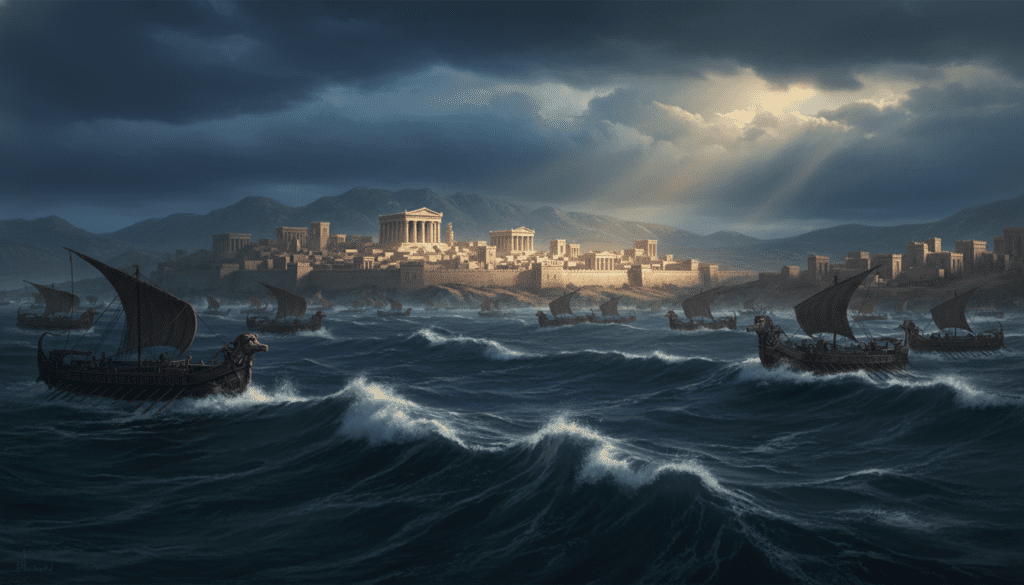
Ancient world collapse theories suggest these weren’t random pirates but organized groups fleeing their own disasters. Earlier attacks during Egypt’s Libyan Wars involved peoples from across the Mediterranean—the Ekwesh, Shekelesh, and Lukka joined forces with Libyan tribes. Clay tablets from Pylos in Greece mention “watchers guarding the coast” around 1180 BC, showing coastal cities expected seaborne attacks.
The scale of destruction was staggering. Cyprus’s fortified city of Maa Palaeokastro burned around 1200 BC. The mighty Hittite Empire vanished as Phrygian tribes crossed into Anatolia. Palace economies collapsed from Greece to the Levant. These foreign invasions transformed the ancient world from interconnected kingdoms into isolated village communities. The collapse of ancient civilizations during this period reshaped human history for centuries to come.
Economic Collapse and Trade Network Disruptions
The ancient world thrived on interconnected trade systems that moved copper, timber, and precious goods across vast distances. When these networks failed, entire civilizations faced economic collapse that triggered their downfall. The loss of trade networks proved just as devastating as wars or natural disasters in causing ancient civilizations collapse.
The End of Bronze Trade Routes
Bronze Age societies depended on copper from Cyprus and tin from Afghanistan to make bronze weapons and tools. The ancient empire decline accelerated when pirates and raiders disrupted shipping lanes around 1200 BC. Cities like Mycenae lost access to raw materials they needed for survival. Archaeologist Spyros Iakovidis found no signs of violent destruction at many Mycenaean sites. This evidence suggests that trade disruption alone caused their abandonment.
Collapse of the Walrus Ivory Market for Vikings
Viking settlements in Greenland exported walrus ivory to Europe for 400 years. In the 14th century, elephant ivory from Africa became cheaper and more available. The loss of trade networks left Greenland Vikings without income to buy essential supplies from Norway. Their settlements vanished within decades of the market crash.
Palace Economy Dependencies and Their Vulnerabilities
Palace economies controlled all trade and production in Bronze Age kingdoms. This rigid system worked during stable times but created dangerous weaknesses. When Egyptian garrisons at Deir al-Balah and Ashkelon withdrew, local economies collapsed without violence. The ancient empire decline often started with small disruptions that spread through interconnected trade networks like falling dominoes.
Pandemics and Population Movements in Ancient History
Ancient civilizations faced devastating health crises that triggered massive population shifts across continents. These pandemics in ancient history struck when cities grew crowded and trade routes expanded, creating perfect conditions for disease spread. The combination of illness, overpopulation, and environmental stress forced entire communities to abandon their homelands in search of survival.
Disease Outbreaks During the Bronze Age
The Hittite Empire struggled with plague around 1200 BC while battling famine and civil unrest. This triple threat revealed a failure of leadership as rulers could not protect their people from multiple disasters. Archaeological evidence shows that disease spread rapidly through densely packed urban centers where social inequality meant poor citizens lived in unsanitary conditions while elites occupied healthier quarters.
Mass Migrations and Habitat-Tracking Behaviors
When drought and disease struck, ancient peoples practiced “habitat-tracking” – moving to regions where agriculture still thrived. The Peloponnese region lost 90% of its small settlements as families fled to better lands. The wandering Shasu tribes became increasingly problematic during Ramesses II’s reign, forcing Egyptian armies to pursue them into Moab. These migrations reflected both overpopulation pressures and the desperate search for resources.
The Black Plague Theory for Greenland Vikings
The Vikings who settled Greenland may have succumbed to the Black Plague alongside climate changes. The Inuit arrived from Canada around 1200 AD, competing for scarce resources as temperatures dropped. Social inequality within Viking settlements left lower-status families vulnerable to starvation and disease, contributing to the colony’s mysterious disappearance.
Archaeological Sites Revealing Civilization Downfall
Archaeological evidence from ancient sites provides powerful insights into how civilizations met their end. These excavations reveal patterns of destruction that teach us valuable lessons from ancient history about societal collapse.
Tell Leilan in Syria stands as a dramatic example of ancient civilizations collapse. This site transformed from a small farming village into a thriving Mesopotamian city, only to be abandoned around 2200 BC. Excavations uncovered extensive grain storage facilities and administrative buildings used for collecting barley and wheat taxes. What makes Tell Leilan remarkable is the 300-year layer of wind-blown sand that buried the city—clear evidence of complete abandonment during a severe drought.
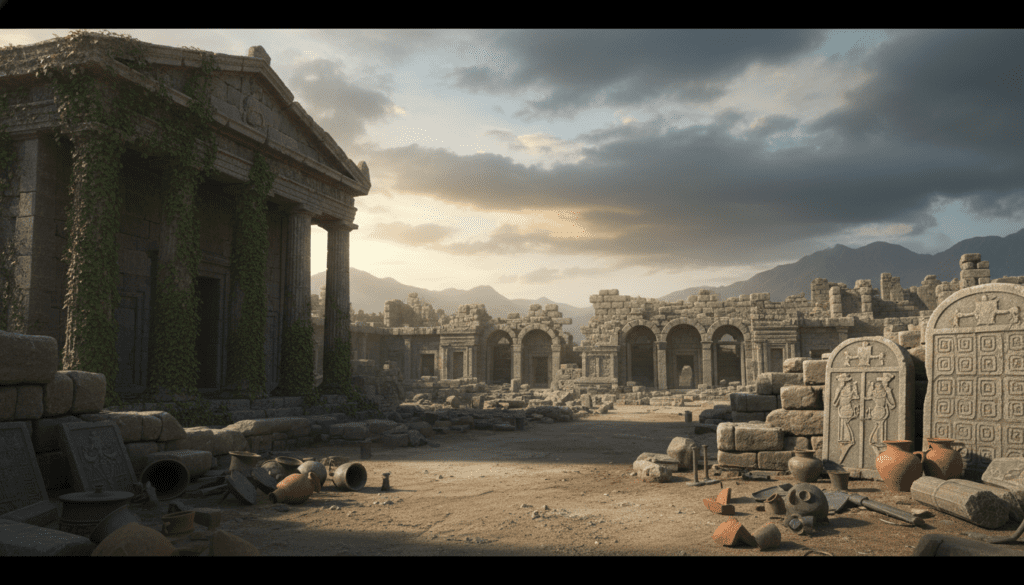
Greece preserves some of the most striking archaeological evidence from the Bronze Age collapse. Major sites tell stories of sudden destruction:
- Pylos and Mycenae show signs of intense burning and warfare
- Knossos and Tiryns reveal layers of ash and collapsed structures
- Thebes and Nichoria display evidence of rapid abandonment
- Lefkandi and Menelaion indicate population decline and technological stagnation
Not all sites show violent ends. Cyprus presents a different picture—Enkomi had limited fire damage with most rooms intact. Sinda contained only ash deposits without collapsed walls or burnt debris, suggesting abandonment rather than destruction.
Egyptian and Levantine sites add complexity to our understanding. Aphek fell to warfare in the late 13th century BC. Jaffa’s gate complex was destroyed between 1134-1115 BC, according to carbon-14 dating. Beit She’an shows earthquake damage from the mid-12th century, reminding us that natural disasters played their part in ancient civilizations collapse alongside human conflicts.
Lessons from Lost Ancient Civilizations for Modern Society
The rise and fall of civilizations throughout history offers crucial insights for our interconnected world today. When we examine why civilizations fail, patterns emerge that feel surprisingly familiar. Ancient societies faced many challenges we recognize: climate disruption, resource scarcity, and the fragility of complex systems.
Parallels Between Ancient and Modern Climate Challenges
The lessons from ancient history show us that climate shifts have toppled empires before. The Khabur River region once supported thriving dry farming communities without irrigation. These societies prospered until sudden climate fluctuations destroyed their agricultural base. Natural climate events, not human activity, drove these changes. Ancient peoples lacked the tools to predict or adapt to environmental shifts that we take for granted today.

The Importance of Agricultural Resilience
Among the reasons ancient civilizations collapsed, agricultural vulnerability stands out. When farming became commodified to support central governments, societies grew more fragile. A single bad harvest could trigger cascading failures across entire empires. Archaeological discoveries reveal that diversified food systems lasted longer than monocultures dependent on palace distribution.
Understanding Societal Complexity and Vulnerability
Scholar Guy Middleton observed that physical destruction alone cannot explain civilization collapse. The rise and fall of civilizations involves multiple interconnected factors. Palace economies created rigid systems that couldn’t adapt to distant disruptions. This mirrors our modern global supply chains, where problems in one region quickly spread worldwide. Complex societies bring prosperity but increase vulnerability to systemic shocks.
Conclusion
The fall of early empires wasn’t caused by a single disaster but by multiple problems hitting at once. Climate change dried up farmlands, trade routes fell apart, and political systems crumbled under pressure. The collapse of ancient civilizations like the Hittite Empire and Mycenaean Greece shows how even powerful societies can fail when too many challenges pile up. Archaeological digs at sites like Pylos reveal burned buildings and abandoned palaces, telling the story of societies that couldn’t adapt fast enough to survive.
Ancient world collapse theories have changed as scientists uncover new evidence. Not every city met a violent end during the Bronze Age collapse. Some settlements were simply abandoned as people moved to find better living conditions. Others faced attacks from groups like the Sea Peoples. The transformation from grand palace economies to small farming villages took hundreds of years. This slow change shows that the ancient civilizations collapse was a gradual process rather than a sudden catastrophe.
These ancient failures teach us important lessons about our own world. The same forces that destroyed Bronze Age societies still threaten us today. Climate shifts, economic breakdowns, and political chaos can weaken any civilization. The fall of early empires reminds us that complex societies need strong foundations to survive tough times. By studying how past civilizations failed, we can better prepare for the challenges our own society faces.