
The journey of artificial intelligence began many years ago. It all started in 1956 when John McCarthy first used the term “artificial intelligence“. This marked the start of AI as we know it today.
The story of artificial intelligence is closely linked to computer science, mathematics, and psychology. Over time, AI has grown a lot. It has moved from just ideas to real changes in many industries today.
Key Takeaways
- AI’s development spans several decades, with its terminology being coined in 1956.
- The field of AI is interdisciplinary, drawing from computer science, mathematics, and psychology.
- Understanding AI’s history is crucial for appreciating its current capabilities and future potential.
The Theoretical Foundations of Artificial Intelligence
The history of AI’s theoretical roots is rich and deep. It starts with early automata and grows through key milestones. Today’s AI is shaped by historical ideas, Alan Turing‘s work, and advances in math and computing.
Ancient Automata and Early Concepts
Long ago, people dreamed of machines that could act on their own. Ancient Greeks had myths about mechanical beings. These stories set the stage for later thoughts on intelligence and machine simulation.
Alan Turing and the Turing Test
Alan Turing made a big impact with the Turing Test. It checks if a machine can seem as smart as a human. Turing’s idea has led to many debates on intelligence and consciousness. For more on AI, check out Understanding the Mechanics of AI.
Mathematical Foundations of Computing
The math behind computing is key for AI. Advances in algorithms and data structures have made AI systems possible. Important math areas, like probability and statistics, help AI learn and decide.
- Probability theory
- Linear algebra
- Statistical inference
These math areas are the core of today’s AI. They help in machine learning and more.

The Birth of AI: The Dartmouth Conference of 1956
The 1956 Dartmouth Conference is seen as the start of artificial intelligence research. It brought together top minds, laying the groundwork for AI’s growth.
The Historic Summer Workshop
In 1956, Dartmouth College hosted a summer workshop that changed AI history. John McCarthy, Marvin Minsky, Nathaniel Rochester, and Claude Shannon organized it. They aimed to make machines that could think like humans.

Key Participants and Their Visions
At the conference, leaders shared their AI dreams. John McCarthy, Marvin Minsky, and others talked about teaching machines to learn and solve problems. Their ideas set the stage for AI’s future.
Coining the Term “Artificial Intelligence”
At this event, John McCarthy came up with “Artificial Intelligence.” This was a key moment. It named the field and made it a recognized area of study. Today, the term represents the effort to make smart machines.
| Key Participant | Contribution |
|---|---|
| John McCarthy | Coined the term “Artificial Intelligence” |
| Marvin Minsky | Presented ideas on machine learning and reasoning |
| Nathaniel Rochester | Organized the conference and contributed to AI research |
The Golden Age of AI Research (1956-1974)
The Golden Age of AI lasted from 1956 to 1974. It was a time of big changes, with the start of early AI programs and more government support. This era saw big steps forward, thanks to new ideas and lots of funding.
Early AI Programs and Demonstrations
Many important AI programs came out during this time. They showed what AI could do. Two examples stand out:
Logic Theorist and General Problem Solver
The Logic Theorist was created by Allen Newell and Herbert Simon. It was the first AI program, designed to solve problems like humans do. It could even prove theorems in Principia Mathematica.
The General Problem Solver (GPS) aimed to solve any problem. It was a big step towards making a machine that could solve all problems.
ELIZA and Early Natural Language Processing
ELIZA was made by Joseph Weizenbaum. It could have a conversation by matching keywords and giving answers. Simple as it was, ELIZA showed how machines could understand and use natural language.

Government Funding and Academic Expansion
During the Golden Age, the government gave more money to AI research. Schools also started teaching AI. This help let researchers try new things and make new tech. Important places and events helped everyone work together and move the field forward.
Overpromising and Limitations
Even with all the progress, there were problems. People often said AI could do more than it really could. This made people think AI was more advanced than it was. Also, the tech at the time had its limits, making it hard to scale up and solve complex problems.
But, these lessons helped make AI better later on. Researchers learned from these early days and worked to fix the problems they faced.
The First AI Winter: Disillusionment and Funding Cuts (1974-1980)
From 1974 to 1980, AI faced a major setback. This time was called the First AI Winter. It was marked by disappointment and a big drop in AI research funding.

The Lighthill Report and Its Impact
In 1973, the Lighthill Report came out. It was a detailed look at AI’s progress. It showed AI’s limits and the big challenges it had, leading to a rethink of AI research.
Criticism of AI’s early promises and the lack of real results were key. The report’s findings changed how people and governments saw AI. This led to less money for AI research.
Shifting Research Priorities
After the Lighthill Report and funding cuts, researchers changed their focus. They started looking for more practical uses of AI. They also began to understand the real challenges of making AI work.
This shift led to new ways of doing AI research. It also started the work on better AI systems. This set the stage for future AI progress, with a more careful and realistic approach.
The History of Artificial Intelligence: Expert Systems Era (1980-1987)
AI research took a new direction in the 1980s with expert systems. This period, from 1980 to 1987, focused on creating knowledge-based systems. These systems were designed to think like humans.
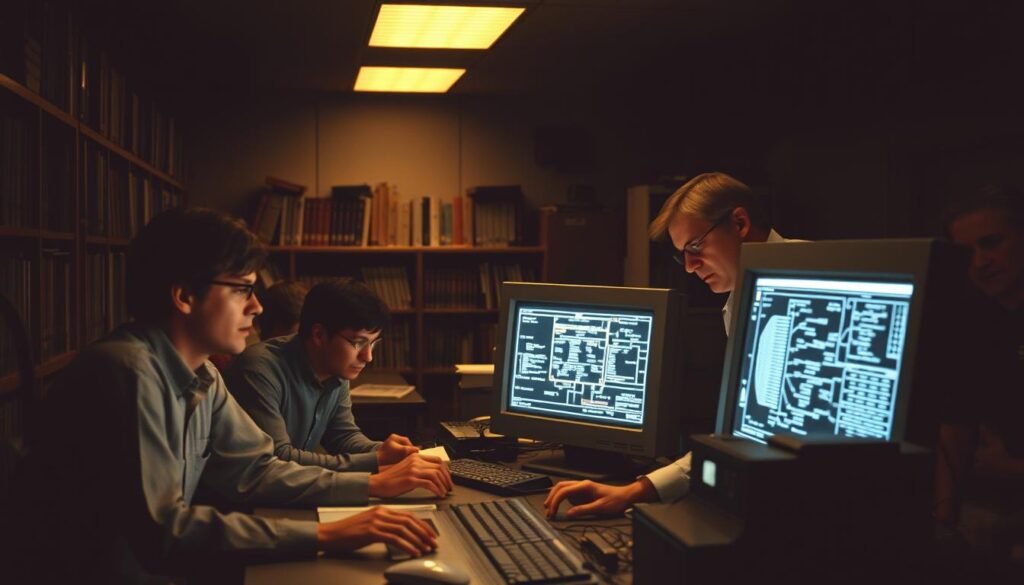
Knowledge-Based Systems Architecture
Knowledge-based systems aimed to capture human expertise. They used rules to reason and make decisions, just like experts.
Commercial Applications and Industry Adoption
The Expert Systems Era saw AI used in business. Companies used it for tasks like financial analysis and medical diagnosis. This was because expert systems could make work more efficient and cheaper.
The Fifth Generation Computer Project
In 1981, Japan started the Fifth Generation Computer Project. It aimed to create computers that could reason and interact with humans better. Though it faced hurdles, it was a big step in AI research.
The Second AI Winter and Paradigm Shifts (1987-1993)
In the 1980s, AI faced a major setback known as the Second AI Winter. This time, funding and interest in AI research plummeted.
The Collapse of the AI Market
The AI market crashed because expert systems failed to live up to their hype. Many AI apps didn’t meet expectations, losing investor trust. This led to less funding and financial woes for AI companies.
Many AI firms struggled financially, with some shutting down. The history of AI shows a shift in focus during this time. Researchers started looking at new ways to approach AI.
Emergence of New Approaches
Despite the downturn, new ideas began to emerge. Researchers turned to machine learning and neural networks. These innovations set the stage for AI’s comeback.
These new methods marked a big change in AI research. As new technologies and techniques emerged, AI moved past old limitations.
Machine Learning Renaissance (1993-2011)
Between 1993 and 2011, machine learning saw a big leap forward. This was thanks to the use of statistical methods and the creation of support vector machines. The field made huge strides, thanks to bigger datasets and better computers.
Statistical Methods and Probabilistic Reasoning
The Machine Learning Renaissance brought a focus on statistical methods and thinking probabilistically. Bayesian networks and probabilistic graphical models became key. They helped model complex data in a more robust and flexible way.
Support Vector Machines and Decision Trees
Support Vector Machines (SVMs) became a top choice for classification and regression. They shone in high-dimensional spaces, becoming a mainstay in machine learning. Decision Trees, with their simple yet effective approach, also played a big role in modeling complex decision boundaries.
Early Neural Network Research
This period also saw a comeback in neural network research. Though still in its early days, it set the stage for the deep learning era. Researchers started exploring new architectures and training methods, setting the stage for future breakthroughs.
| Technique | Key Features | Applications |
|---|---|---|
| Statistical Methods | Probabilistic reasoning, Bayesian networks | Data modeling, prediction |
| Support Vector Machines | High-dimensional space handling, kernel trick | Classification, regression |
| Early Neural Networks | Multi-layer perceptrons, backpropagation | Pattern recognition, complex data modeling |
The Deep Learning Revolution (2011-Present)
The Deep Learning Revolution started in 2011 and has changed AI forever. It lets machines learn from huge amounts of data with amazing accuracy. This change came from new neural network designs, better computing power, and lots of data.
Breakthroughs in Neural Network Architecture
One big step forward in the Deep Learning Revolution is the creation of advanced neural network designs. These include:
- Convolutional Neural Networks (CNNs): Great for recognizing and processing images.
- Recurrent Neural Networks (RNNs) and Transformers: Key for understanding sequential data and natural language.
Convolutional Neural Networks
CNNs have changed computer vision by making image recognition fast and accurate. They use the spatial structure of images to their advantage.
Recurrent Neural Networks and Transformers
RNNs and Transformers have greatly improved natural language processing. They handle sequential data well and are used in tasks like language translation and text generation.
Computing Power and Big Data Influences
The Deep Learning Revolution also owes a lot to better computing power and more data. GPUs and TPUs have made training deep learning models much faster. Also, the huge amounts of data available today help these models learn and get very accurate.
Major AI Achievements and Competitions
The Deep Learning Revolution has led to many big wins in AI, shown in competitions. For example, deep learning models have won top spots in image recognition contests like ImageNet. This shows they are better than old machine learning methods.
Some key achievements are:
- Image Recognition: Deep learning models now match human levels in image recognition tasks.
- Natural Language Processing: Models like BERT have set new standards in NLP tasks.
- Game Playing: AI systems have beaten human champions in games like Go and Poker.
Global Development of AI Technologies
The world has come together to develop AI. Each region brings its own strengths and research skills to the table.
North American AI Research Ecosystem
North America, led by the United States, is a leader in AI. Big tech companies like Google, Microsoft, and Amazon are pushing AI forward. They invest a lot in research and hiring the best talent.
Top universities like Stanford and MIT also play a big role. They help create a culture of AI research and business.
European Approaches to AI Development
Europe focuses on ethical AI and making rules for it. The European Union sets guidelines for responsible AI use.
Countries like the UK, Germany, and France are leading the way. They invest in AI research and startups, building a strong AI community.
Asian AI Initiatives and Advancements
Asia, mainly China and Japan, is growing fast in AI. Government support and big investments are driving this growth. China is a leader in AI for things like facial recognition.
Japan is also making big moves. They’re working on AI in robotics, manufacturing, and healthcare. This shows the variety of AI efforts in Asia.
Contemporary AI Applications and Impact
AI has changed many industries, making businesses work differently and opening up new chances for growth. It’s making a big difference in healthcare, finance, and transportation. This is thanks to AI’s work in natural language processing, computer vision, and more.
Natural Language Processing and Generative AI
NLP has made big strides, letting machines understand and create human-like language. Generative AI, a part of NLP, has led to chatbots, language tools, and text summarizers. These tools help in customer service, making content, and translating languages.
Computer Vision and Perception Systems
Computer Vision lets machines see and understand visual data. It’s used in self-driving cars, facial recognition, and medical imaging. Perception systems also help in robotics and surveillance.
AI in Healthcare, Finance, and Transportation
In healthcare, AI helps analyze images, diagnose diseases, and tailor treatments. In finance, it’s used for risk analysis, managing portfolios, and spotting fraud. The transportation sector uses AI for better routes, predictive maintenance, and self-driving cars.
| Industry | AI Application | Benefit |
|---|---|---|
| Healthcare | Medical Image Analysis | Early Disease Detection |
| Finance | Risk Analysis | Improved Investment Decisions |
| Transportation | Autonomous Vehicles | Enhanced Safety |
Conclusion: Reflecting on AI’s Journey and Future Horizons
The journey of artificial intelligence (AI) has seen many important milestones. It has brought about new technologies and opened up many possibilities. Looking back, we see how AI’s growth has been influenced by tech advancements, new research, and what society needs.
The arrival of generative AI and Quantum AI is set to change many areas. This includes content creation, healthcare, solving big problems, and even helping with climate issues. As AI keeps getting better, we must think about what new doors these advancements will open.
Knowing AI’s history helps us face the future’s challenges and chances. Moving forward, using AI’s power to boost innovation, efficiency, and progress is key. We also need to tackle the complex issues and effects of these new technologies.