
How did a single settlement along the Tiber River grow to dominate the known world for centuries? This remarkable civilization’s story begins with humble origins but unfolds into one of history’s most impressive achievements.
Starting around 753 BC, this mighty civilization expanded across three continents. At its peak, it governed territories spanning 5 million square kilometers. The reach extended from Britain to the Persian Gulf, encompassing 40 modern nations.
The capital city achieved an unprecedented milestone in the 2nd century BC. It became the first urban center to record a population of one million people. Residents came from Europe, Asia, and Africa, creating a truly global metropolis.
This ancient society’s influence lasted over 700 years. Its innovations in engineering, law, and governance continue to shape our modern world. The legacy remains visible in architecture, language, and political systems today.
Exploring these fascinating details reveals why this civilization captivates historians and enthusiasts alike. The organization and scale of their achievement still astonishes people centuries later.
Origins of Rome: Myths and Realities
A she-wolf and a fratricidal conflict form the core of Rome’s legendary creation story. This powerful myth, central to their identity, explained the city’s fierce and ambitious character.
Romulus and Remus Legend
According to legend, the twins Romulus and Remus were abandoned as infants. A she-wolf discovered and nursed them back to health. When they grew up, Romulus killed his brother in a dispute over where to build their new city.
This act of fratricide was seen as a necessary, if brutal, step to ensure strong, singular leadership. The she-wolf became an enduring symbol, appearing on the city’s earliest coins by the 4th century BC.
The Early Roman Kingdom
Legend states Romulus became the first king in 753 BC, founding the settlement on the Palatine Hill. Tradition holds that seven kings ruled in this early period of history.
Archaeology confirms a settlement existed around this time, validating the myth’s timeframe. The last king, Tarquin the Proud, was overthrown in 509 BC, leading to the birth of the Republic.
These stories, blending myth and reality, defined the values of strength and unity that propelled the ancient city’s rise.
📚 Want to See How the Myth Was Created?

Charles Berlitz's 1974 bestseller is a masterclass in persuasive storytelling—even when the facts don't quite add up. While we now know the scientific truth, his book remains a fascinating study in how compelling narratives shape public perception.
Perfect for: Psychology students, writers, skeptics, and anyone interested in critical thinking and media literacy.
📖 Get on AmazonReading Berlitz's book after learning the real science makes it even more fascinating. You'll spot exactly where drama replaced data.
The Rise from City to Empire
Rome’s ascent to imperial dominance began with a revolutionary approach to conquered peoples that set it apart from other ancient civilizations. After winning the Latin War, they granted citizenship rights to defeated foes. This integration model created loyalty instead of rebellion.
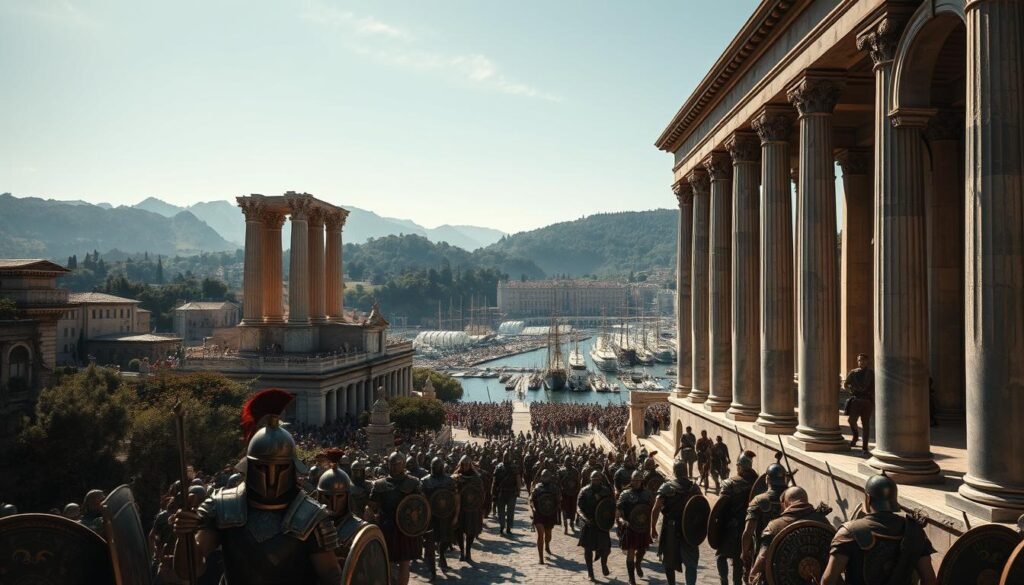
Expansion Across the Mediterranean and Beyond
Victory in the Pyrrhic War established Roman control throughout Italy by 264 BC. The three Punic Wars against Carthage transformed Rome into a Mediterranean power. The final conflict ended with Carthage’s complete destruction.
During Trajan’s reign, the territory reached its maximum extent. It spanned from Britain to the Persian Gulf. This vast domain covered approximately 5 million square kilometers.
The civilization built magnificent urban centers throughout its holdings. The three largest cities were:
- Rome itself as the capital
- Alexandria in Egypt
- Antioch in modern Syria
Each of these metropolitan areas dwarfed European cities that would emerge centuries later. This expansion took place over hundreds of years through both military strength and administrative skill.
Powerful Roman Army and Military Might
Rome’s legendary fighting force evolved from early militia units into a professional standing army. This military organization became the foundation of the civilization’s expansion and control.
The basic unit was the legion, consisting of about 3,000 infantry and 300 cavalry. These regiments could march up to 40 kilometers each day. This endurance allowed rapid deployment across vast territories.
Legion Tactics and Battle Strategies
Roman soldiers followed a specific combat sequence. They first hurled their spears to disrupt enemy formations. Then they engaged in close combat with short swords.
Each legionary carried protective gear including a wooden shield, metal helmet, and body armor. This equipment gave them significant advantages in battle.
At its peak under Hadrian, the military maintained approximately 375,000 men. This professional force was unprecedented in the ancient world.
The army experienced both devastating defeats and brilliant victories. At Cannae in 216 BC, Hannibal inflicted massive casualties. But Julius Caesar’s victory at Alesia secured domination over Gaul.
Success came from superior organization and adaptability. The military learned from defeats and constantly improved tactics. This flexibility was a key part of their lasting power.
Ingenious Engineering and Architectural Feats
Beyond their military conquests, the Romans demonstrated extraordinary genius in construction and urban planning. Their innovations in materials and design created structures that remain functional and impressive even today.

Aqueducts, Roads, and Concrete Innovation
The development of revolutionary concrete enabled ambitious building projects. This material mixed dry aggregate with water-absorbing mortar to create flexible, strong construction elements.
Roman concrete closely resembles modern Portland cement. The Pantheon’s dome remains the world’s largest unsupported concrete dome after nearly 2,000 years.
Aqueduct systems transported fresh water across vast distances. These networks of channels and bridges supplied public baths and sanitation facilities.
By the third century, Rome had 11 major aqueducts spanning nearly 800 kilometers. The Aqua Vergine, built in 19 BC, still supplies the Trevi Fountain with water today.
Monumental Structures That Endure
Roman roads were engineering marvels built with deep, layered foundations. Many modern European highways follow these ancient routes.
The civilization perfected architectural elements like arches and vaults. This allowed large roofed buildings without excessive supporting pillars.
These innovations supported urban life on an unprecedented scale. They provided clean water and efficient transportation for populations exceeding hundreds of thousands.
Impactful Roman Infrastructure: Roads and Bridges
The ancient civilization’s infrastructure network became its true circulatory system. This incredible web of roads enabled the rapid movement of armies and efficient trade across vast distances.
The Appian Way and Other Enduring Routes
Europe’s first major paved highway, the Appian Way, began construction in 312 BC. It initially connected the capital city to Capua, later extending for hundreds of miles to Brindisi.
These roads were engineering marvels built to last for centuries. Construction involved digging ten feet deep and layering stone, sand, and gravel. The top surface used durable volcanic rock for a perfectly straight, resilient path.
By the first century AD, a vast network spread throughout Italy and into North Africa. This expansion made the famous saying “All roads lead to Rome” a reality. Engineers even carved tunnels when necessary, like the 1-kilometer passage at Portus Julius.
Many modern European highways follow these ancient foundations today. Remarkable bridges also endure, like Spain’s Alcántara Bridge completed in 106 AD. An inscription on it reads, ‘I have built a bridge which will last forever.’ It remains functional after nearly two thousand years.
Roman Empire Facts: Unveiling Historical Insights
While monuments and military achievements often dominate discussions, the civilization’s most enduring contributions lie in systems that still organize our daily lives. These foundational things continue to shape how we measure time, record information, and administer justice.
Timeless Legacies and Influences
The ancient society established the first comprehensive legal framework with the Twelve Tables in the 5th century BCE. This written code evolved into an extensive body of law that formed the basis for Western legal traditions.
Julius Caesar revolutionized how we track time by adopting Egypt’s solar calendar in 46 BC. The resulting Julian system became the top calendar throughout Europe for over 1,500 years.
Roman numerals, adapted from their alphabet, served as the standard numbering system across the ancient world. They remain visible today on clock faces and in educational settings.
These remarkable facts demonstrate how the civilization pioneered public information systems. From the 1st century BCE, news displays in the Forum kept citizens informed about debates, trials, and social events.
The administrative systems developed for record-keeping and governance earned them the title “fathers of bureaucracy.” Modern governments still emulate these organizational methods that proved so effective across vast territories.
Daily Life in Ancient Rome
The reality of urban living for most Romans differed dramatically from the grand villas and palaces we often imagine. Common people experienced a crowded existence in multi-story apartment buildings called insulae.
These structures reached seven floors high with the poorest residents climbing 100-200 steps daily. Upper floors posed serious fire hazards due to wooden construction.
Social Customs, Dining, and Public Baths
Dining customs revealed social distinctions. Wealthy citizens reclined on couches while eating exotic foods like stork and flamingo. They used their hands or occasional spoons rather than knives and forks.
Most people relied on thermopolia – ancient snack bars serving hot takeaway food. These establishments catered to residents without cooking facilities in their cramped apartments.
Public baths served as essential social centers. The phrase Sana Per Acquam (health through water) defined their spa culture. Elaborate bath complexes offered luxurious facilities accessible to all social classes.
These communal spaces became hubs for business discussions and news exchange. With limited private plumbing, public toilets and baths formed crucial infrastructure for urban life.
Demographic realities shaped daily existence. High mortality rates meant society skewed young, with life expectancy around 25-30 years. This created a population dominated by teenagers and young adults navigating crowded urban conditions.
The Pantheon of Roman Gods and Mythology
The religious world of this ancient civilization was populated by hundreds of deities, each overseeing a specific domain of existence. This complex system of beliefs was fundamentally practical, with people engaging in rituals to seek favor or give thanks for blessings received.

Elaborate temples were built throughout the lands to honor these powerful figures. Worshippers would visit these sacred spaces with offerings, creating a direct, transactional relationship with the divine.
Worship Practices and Divine Influences
Major gods held sway over crucial aspects of life and nature. Citizens prayed to specific gods depending on their immediate needs.
For instance, a sailor would seek Neptune’s protection before a voyage. A general would ask Mars for victory in battle. Jupiter was revered as the king of all the gods.
The most important deities included:
- Jupiter: King of the gods and god of the sky
- Mars: God of war
- Neptune: God of the sea
- Venus: Goddess of love and beauty
This society demonstrated remarkable flexibility by adopting deities from conquered cultures. Greek gods were often simply renamed. The Egyptian goddess Isis and the Persian god Mithras gained widespread followings.
Mithras became particularly popular with soldiers. His temples have been found from Britain to the eastern frontiers. This openness defined the religious landscape of ancient rome before the rise of monotheism.
Gladiators, Colosseum, and Roman Entertainment
Public entertainment reached unprecedented scale in ancient Rome’s massive arenas. These spectacles served multiple purposes beyond mere amusement.
Spectacles, Games, and Public Performances
The Colosseum took just eight to ten years to construct between 70-80 AD. This engineering marvel could hold 80,000 spectators for various games.
Gladiators fought in deadly combat while exotic animals faced hunters in venationes. These animal hunts featured lions, tigers, and crocodiles from across the known world.
The Circus Maximus dwarfed even the Colosseum in size. Dating to the 6th century BCE, it accommodated 150,000-250,000 people for chariot races.
Over 200 amphitheaters throughout the territories hosted similar events. The capital city’s naumachia even featured full-scale naval battles with real ships.
These elaborate games demonstrated power and controlled social dynamics. They reinforced values of courage while distracting the masses from political concerns.
Republic to Empire: Political Evolution
Rome’s political journey unfolded through three distinct phases that reshaped Western governance. Each transition marked a dramatic shift in how power was distributed and exercised.

The ancient state progressed from monarchy to republic to imperial rule. This evolution spanned over a thousand years of history. The republic emerged violently in 509 BC after the last king’s overthrow.
Governance, Legislation, and Triumvirates
At the Battle of Silva Arsia, the republic’s founder Lucius Junius Brutus met his death defending the new system. The deposed king Lucius Tarquinius Superbus attempted to reclaim his throne with Etruscan allies.
Julius Caesar accumulated unprecedented power but never became emperor. He ruled as dictator before his assassination. Following his death, he was worshipped as a divine figure.
Two triumvirates bridged the republic and empire periods. The first included Caesar, Crassus, and Pompey around 60 BC. The second featured Octavian, Lepidus, and Mark Antony after Caesar’s death.
The imperial period lasted more than 500 years with over 70 emperors. The year 69 AD alone saw four different rulers take power. Augustus established the longest reign at 44 years, creating stability that allowed cultural flourishing.
Economic and Cultural Vibrancy of Rome
Ancient Rome’s cultural diversity created a vibrant metropolis where ideas and goods from three continents converged. The capital became a true melting pot that attracted people from across the known world.
Trade, Markets, and the Free Grain Dole
The city pioneered state welfare with the grain dole system. This program provided free food to approximately 200,000 citizens who met eligibility requirements.
Entire provinces dedicated their agriculture to feeding the capital. Sicily, Sardinia, Spain, and Egypt grew grain specifically for Rome’s needs.
Citizenship extended beyond birthright in this society. People could become citizens through legal processes and adopting local values. This created constant influx from the outside world.
At its peak, the administration governed about 65 million people. This represented roughly a quarter of the world’s population during the 2nd century AD.
Sophisticated trade networks brought luxury goods from Asia and metals from Spain. These economic systems supported the city’s remarkable growth and cultural exchange.
Architectural Marvels: From the Colosseum to the Pantheon
From triumphal arches to defensive walls, architectural marvels communicated Rome’s strength and organizational capabilities to both citizens and conquered peoples. These structures served as powerful statements of imperial authority across the ancient world.

Iconic Structures That Define Roman Power
Emperors cemented their reputations with grand public works. The Arch of Constantine stands 21 meters high as the largest surviving triumphal arch. Completed in 315 AD, it celebrated military victory and later inspired London’s Marble Arch.
Hadrian ordered a massive defensive wall in Britain during 122 AD. This impressive barrier stretched 73 miles and reached 10 feet high. It served to separate the civilized territories from barbarian lands.
St Peter’s Basilica remains the tallest building in the city of Rome. Michelangelo’s dome reaches 136.6 meters to the top of its ball. No structure in the capital can legally exceed this height today.
Wealthy citizens invested fortunes in elaborate tombs along major roads. The Mausoleum of Cecilia Metella and pyramid of Gaius Cestius displayed status to passing travelers. These monuments ensured their names would be remembered for generations.
Roman architectural achievements were designed for permanence. Structures like the Pantheon continue to stand after nearly 2,000 years. This engineering excellence demonstrates their mastery of construction techniques.
Extraordinary Facts and Unusual Roman Innovations
Ancient Roman society contained fascinating contradictions that reveal a civilization as complex and human as our own. Beyond the marble monuments, daily life buzzed with activities that might surprise modern observers.
Food, Fast-Food Culture, and Daily Quirks
Romans would gamble passionately on chariot races and gladiator fights. Archaeologists have found weighted dice, showing cheating occurred just like today.
The classical white marble image is misleading. Buildings and statues were originally painted in bright colors that faded over centuries. This fact changes how we imagine ancient aesthetics.
Clothing signaled social status through purple stripes on togas. Only emperors could wear full purple garments due to the dye’s extreme cost. The width of the stripe indicated importance.
An unusual story involves Julius Caesar’s kidnapping by pirates around 78 BC. He promised to crucify them after complaining their ransom was too low. Upon release, he fulfilled this promise but showed mercy by cutting their throats first.
Rome today contains more Egyptian obelisks than Egypt itself. Thirteen ancient obelisks decorate the city, brought by emperors as power symbols.
Influence of Ancient Rome on Modern Society
When you turn on a faucet or drive on a highway, you’re experiencing the lasting impact of Roman engineering. This civilization’s innovations continue to shape our world in profound ways that many people overlook today.
The legal principles developed in ancient Rome form the foundation of Western justice systems. Concepts like “innocent until proven guilty” and written contracts originated during this time. These ideas spread across the world and remain central to modern law.
Legacy in Law, Engineering, and Urban Planning
Roman engineering marvels still function after more than 2,500 years. The Cloaca Maxima sewer system, dating to the 6th century BCE, still drains into the Tiber River today. This demonstrates remarkable construction quality that withstands the test of time.
Modern Rome maintains over 2,000 public fountains providing free water to citizens. This tradition reflects the ancient commitment to water as a public good. The city’s nasone drinking fountains continue this practical legacy.
Rome holds the unique distinction of containing another country within its borders. Vatican City covers just 44 hectares with about 800 residents. This makes it the world’s smallest independent state.
Italy itself is a relatively new nation, founded in 1871 when the Italian army took Rome from papal control. Despite Rome’s ancient heritage, the modern Italian state is younger than the United States.
Timeless Lessons from the Roman World
A key lesson from ancient Rome is that both growth and decay are gradual processes, not sudden events. The famous saying reminds us that this mighty civilization was not built in a day. Its decline also unfolded over centuries, shaped by complex factors.
Analyzing the Rise and Fall of an Empire
The long history of this civilization spans more than a thousand years. It evolved from a small village into a republic and then a vast power. At its peak, it governed about a quarter of the world’s population.
Daily life in the capital was harsh. Malaria, meaning “bad air,” was a major killer for centuries. People did not know mosquitoes caused the disease.
More than half of all children died before age two. Average life expectancy was only 25 to 30 years. This created a society dependent on constant immigration to sustain itself.
Success came from remarkable flexibility. The state integrated conquered peoples and adopted foreign ideas. Later, an inability to adapt contributed to its challenges.
This long history teaches us about infrastructure, political unity, and the integration of diverse populations. It shows that even the greatest powers in history are not permanent.
Conclusion
The true measure of a civilization’s greatness lies in its lasting impact on future generations. This ancient society’s achievements spanned military might, legal systems, and remarkable engineering.
Their infrastructure transformed urban life across three continents. Aqueducts brought fresh water to millions, while massive wall systems defined territorial boundaries. Public baths promoted health and social connection.
These fascinating facts reveal a society of complex contradictions. They created sublime philosophy alongside brutal entertainment. Their legal innovations coexisted with widespread slavery.
We still experience their legacy daily through our calendar, laws, and architectural principles. Studying this empire’s rise and fall offers timeless lessons about resource management and cultural integration.
The ultimate power of this civilization appears not in conquests but in systems that outlasted their political dominance. Their innovations continue shaping our world more than fifteen centuries later.