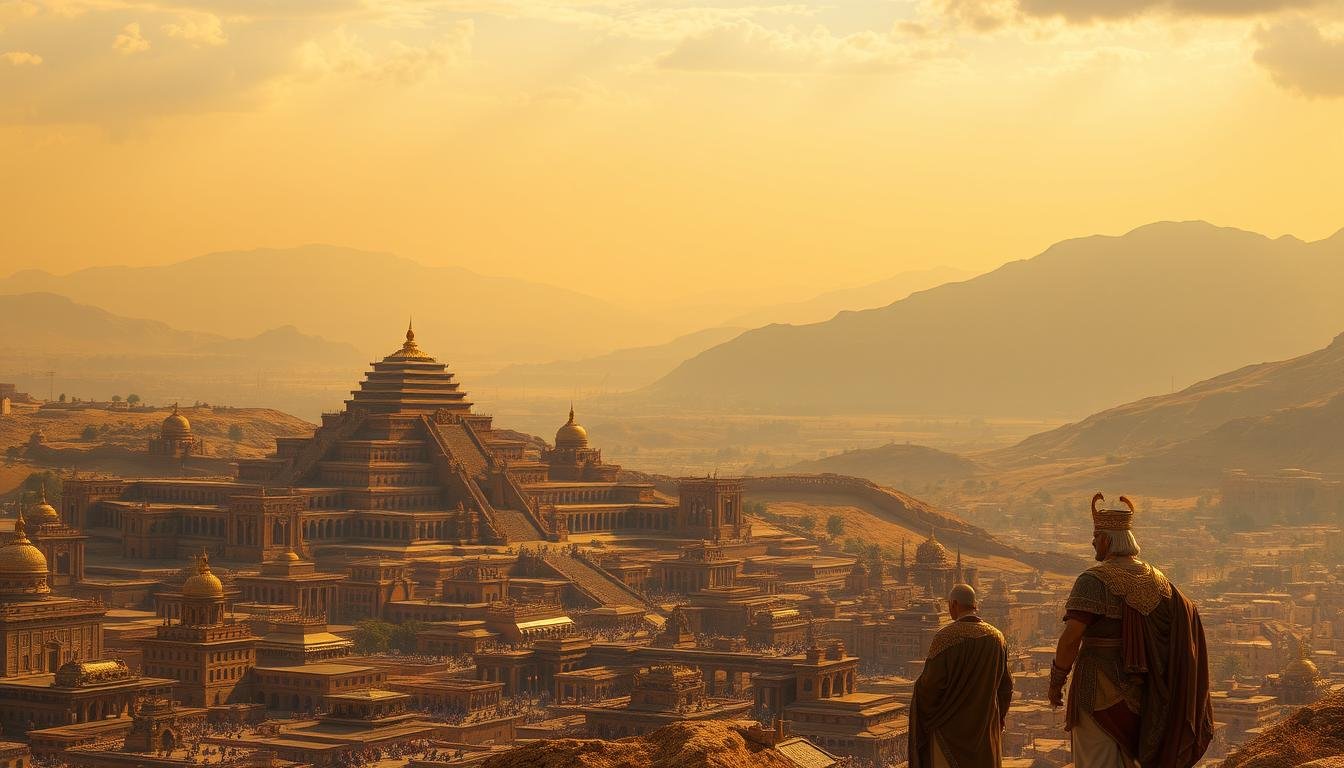
What if everything we think we know about the dawn of human society is just the surface of a much deeper story? The first great empires hold secrets that challenge our basic understanding of history.
This guide takes you on a journey through time to explore these foundational cultures. We will uncover the remarkable achievements of societies from Mesopotamia to the Indus Valley.
How did they build such complex structures without modern technology? What universal patterns of rise and fall can teach us about our own world? The answers lie buried in the secrets of the first great empires.
Introduction to Ancient Civilizations
Around 5,000 years ago, human societies underwent a revolutionary shift that would forever change our world. This period marks the beginning of what scholars call ancient civilizations, starting with Sumerian writing systems and extending through late antiquity.
These early cultures represented humanity’s first complex societies. They developed organized governments, social classes, and urban centers that distinguished them from simpler tribal communities. People transitioned from nomadic hunting to settled farming, eventually building the first cities.
Scholars identify several key characteristics that define a true civilization. These include urbanization, specialized jobs, central governments, monumental architecture, and writing systems. As one historian noted,
“The development of writing marked the boundary between prehistory and recorded history.”
Understanding these early societies requires examining archaeological evidence and written records. These sources provide insights into daily life, beliefs, and achievements of people who lived millennia ago. The broader study of this era is documented in ancient history resources.
Remarkably, these societies emerged independently across different regions. Yet they share similar development patterns, suggesting universal aspects of human social evolution. Their ingenuity in overcoming environmental challenges created lasting legacies that still influence our culture today.
The Rise of Civilization: From Prehistory to Urban Revolution
The establishment of permanent living spaces marked a turning point in human development that would lead to complex societies. This shift from nomadic existence to settled life enabled unprecedented social organization.

Neolithic Revolution and Sedentary Life
Around 12,000 years ago, the Natufian culture in the Levant began establishing year-round settlements. They took advantage of rich natural resources that allowed permanent habitation.
📚 Want to See How the Myth Was Created?

Charles Berlitz's 1974 bestseller is a masterclass in persuasive storytelling—even when the facts don't quite add up. While we now know the scientific truth, his book remains a fascinating study in how compelling narratives shape public perception.
Perfect for: Psychology students, writers, skeptics, and anyone interested in critical thinking and media literacy.
📖 Get on AmazonReading Berlitz's book after learning the real science makes it even more fascinating. You'll spot exactly where drama replaced data.
Agriculture emerged independently in multiple regions approximately 10,000 years ago. The Fertile Crescent led with wheat and barley cultivation while other areas developed their own crops.
This agricultural revolution freed people from constant food gathering. Some community members could specialize in crafts, trade, and governance.
Urban Growth and Monumental Architecture
Proto-urban settlements with thousands of inhabitants appeared during the Neolithic period. These represented the first step toward true urbanization.
By the 31st century BC, major cities like Uruk and Ur housed tens of thousands of residents. Their growth was supported by irrigation systems and other technological innovations.
Monumental architecture demonstrated the organizational capabilities of early civilization. Structures like ziggurats served religious, political, and community purposes.
Understanding the Cradle of Civilization
Across the globe, complex societies emerged independently in specific geographic regions that became known as civilization cradles. These areas witnessed humanity’s first experiments with urban living and state formation without outside influence.
Fertile Crescent and Mesopotamia
The Fertile Crescent stands as the world’s oldest cradle. This crescent-shaped region in West Asia includes Mesopotamia and the Levant. Agricultural practices began here around 10,000 BC.
This area’s elevated terrain and river systems created ideal conditions for settlement growth. The development in this region shaped early human history profoundly.
Independent Civilizations Worldwide
Scholars identify six primary cradles where civilizations arose independently. These include the Nile Valley, Indo-Gangetic Plain, and North China Plain. The Americas also saw independent development in Peru and Mexico.
Early theories suggested civilization spread from one location. Modern research confirms multiple independent origins across both hemispheres. Each area developed similar solutions to common challenges.
All cradles depended on agriculture to support their growth. Food surpluses enabled specialized workers and centralized governments. Geographic factors like river valleys determined where these societies could flourish.
The Role of Geography and Agriculture in Early Empires
The landscape itself became the architect of humanity’s first great societies. River valleys provided the perfect combination of fertile soil, reliable water sources, and natural transportation routes. This geographic advantage enabled agricultural surplus that supported urban growth.

In Mesopotamia, the Tigris and Euphrates rivers created ideal conditions for farming. Annual flooding deposited nutrient-rich silt across the region. This allowed intensive agriculture that fed dense populations.
Water management became a defining achievement of these societies. They developed sophisticated irrigation systems and canals to control river flows. This hydraulic engineering maximized agricultural productivity across the area.
The Nile River offered predictable flooding patterns that benefited Egyptian farming. This consistency created food abundance for centuries. It freed labor for construction projects and supported stable government.
Climate changes also shaped settlement patterns. The drying of North African lands around 8000 BC forced populations to concentrate along the Nile. This accelerated the transition to permanent farming communities.
Agricultural innovations increased food production efficiency significantly. Key developments included:
- Crop rotation systems
- Animal domestication
- Improved farming tools
Different geographic regions cultivated specific staple crops. Wheat and barley dominated Mesopotamia and Egypt. Rice became central to Chinese agriculture, while maize supported Mesoamerican societies.
Mesopotamia: The Birthplace of Urban Society
Between the Tigris and Euphrates rivers, humanity built its first permanent urban centers that would change human organization forever. This region became the cradle where true city life began around 4000 BC.
The Sumerian people established remarkable settlements like Uruk and Ur. These early cities housed thousands of residents and featured monumental temple complexes called ziggurats.
Sumerian Innovations
Sumerian creativity produced world-changing inventions. They developed the wheel around 3500 BC and created bronze metallurgy techniques.
Their mathematical system established concepts we still use today. This innovative culture also created the first writing system to record transactions and ideas.
Cuneiform and Trade Networks
Cuneiform writing emerged as wedge-shaped marks pressed into clay tablets. This writing system evolved from simple pictographs around 3000 BC.
Trade networks expanded throughout the Near East during the Early Dynastic Period. Merchants exchanged grain and textiles for precious metals and stones.
Mesopotamian culture influenced neighboring peoples for centuries. Their urban model spread through the region, creating a lasting legacy.
Ancient Egypt: Monuments, Mummies, and Mysteries
For thousands of years, the people of Egypt built a society that still captivates us. This remarkable culture developed along the Nile River’s life-giving waters. The river’s predictable flooding created ideal farming conditions.

Nile River and Agricultural Surge
The Nile served as Egypt’s lifeline for countless years. Its annual floods deposited rich silt across the floodplains. This natural fertilizer enabled abundant harvests of wheat and barley.
Agricultural surplus supported specialized workers and powerful rulers. This system allowed the Egyptian people to focus on grand projects. Their society flourished for approximately 3,000 years.
Pyramids, Royalty, and Rituals
Ancient Egypt is famous for its extraordinary monuments. The Great Pyramids represent the peak of Egyptian architecture. These structures required decades of coordinated labor.
The culture developed complex mummification practices for the afterlife. Royal rituals reflected deep religious beliefs about death and rebirth. This unique civilization left a lasting artistic legacy through hieroglyphics and tomb paintings.
The Indus Valley Civilization: Urban Planning and Enigma
While Mesopotamia and Egypt dominated historical narratives, another sophisticated culture was flourishing along the Indus River. The Indus Valley Civilization spanned from approximately 2600 to 1900 BC across modern Pakistan, Northwest India, and Northeast Afghanistan.
This remarkable society created some of history’s most advanced urban centers. Cities like Harappa and Mohenjo-Daro featured precise grid-pattern streets and standardized brick sizes.
City Layout and Sanitation
The Indus Valley population developed sanitation systems unmatched for millennia. Their cities had covered drainage networks, private wells, and sophisticated waste management.
The Great Bath at Mohenjo-Daro demonstrates their engineering excellence. This large public bathing facility featured waterproof construction and advanced drainage, likely serving ceremonial purposes for the city’s residents.
Undeciphered Script and Trade Connections
Despite extensive excavations, the Indus Valley writing system remains undeciphered. Hundreds of seals and inscriptions have been discovered, but without a translation key, the civilization’s language stays mysterious.
Trade connections extended throughout the Indus River region and beyond. Archaeological evidence shows commercial relationships with Mesopotamia, exchanging goods like carnelian beads and cotton textiles.
The decline of this valley civilization around 1900 BC remains one of archaeology’s great puzzles. Climate change and shifting river courses are among theories explaining its disappearance.
Writing Systems of Ancient Civilizations
Across five separate regions of the world, humanity independently developed systems to capture language in permanent form. This breakthrough created one of history’s most significant transitions from oral tradition to recorded knowledge.

The development of writing marked the boundary between prehistory and recorded times. Different cultures created unique solutions to preserve information for future generations.
Cuneiform and Hieroglyphs
Mesopotamia produced the world’s earliest writing system around 3400 BC. Cuneiform began as simple accounting marks pressed into clay tablets.
Egypt developed hieroglyphics shortly after, around 3200 BC. This pictorial system combined logographic and alphabetic elements on stone and papyrus.
Unique Scripts in the Indus and Beyond
The Indus Valley civilization created its own script by 2800 BC. Over 400 distinct symbols have been found, but the language remains undeciphered.
Chinese characters emerged independently during the Shang Dynasty. Oracle bone script featured inscriptions on animal bones for divination purposes.
Mesoamerican civilizations developed writing by 600 BC. The Maya perfected a complex system of glyphs to record their rich cultural heritage.
Architectural Wonders and Engineering Feats
The enduring structures left by early societies stand as testaments to human ingenuity. These remarkable achievements in architecture demonstrate how people overcame technological limitations through creative problem-solving.
Monumental buildings required sophisticated construction techniques that still impress modern engineers. The choice of materials, particularly various types of stone, determined both durability and aesthetic appeal.
Monumental Structures and Materials
Roman engineers revolutionized building methods with their concrete invention. This material enabled structures like the Pantheon’s massive dome to withstand centuries.
Incan builders perfected stone cutting to create earthquake-resistant walls. Their precisely fitted blocks at Machu Picchu required no mortar yet remain standing today.
Innovations in Engineering and Construction
Advanced hydraulic systems brought water to mountain cities through stone aqueducts. The Maya developed temple complexes aligned with astronomical events.
This architectural legacy reflects the organizational power of early civilization. The buildings embody both technical skill and cultural values of their creators.
Each society developed unique solutions to structural challenges. Their innovations in engineering continue to influence modern architecture and construction practices worldwide.
Religion, Mythology, and Cultural Beliefs
Mythology and religious practices provided the framework through which early peoples understood their place in the cosmos and organized their communities. These belief systems touched every aspect of life from farming to warfare.
Spiritual traditions helped societies make sense of natural events and human experiences. They created shared values that unified diverse populations across generations.
Myth, Rituals, and Deities
The Sumerian religion featured a pantheon that mirrored their political structure. Priest-kings served as intermediaries between people and powerful deities like Anu and Inanna.
Egyptian culture developed elaborate mummification practices reflecting complex beliefs about the afterlife. Their rituals ensured safe passage through the underworld to achieve eternal life.
Zoroastrianism emerged in Persia around 1500 BC and remains one of the oldest practiced religions. It introduced revolutionary concepts like monotheism and the cosmic battle between good and evil.
Many early societies practiced human sacrifice as part of their religious traditions. The Maya and Aztecs believed offering lives to gods ensured agricultural fertility and military victory.
Temples served as economic centers controlling vast lands for centuries. These institutions accumulated wealth through offerings and employed thousands of workers across the civilization.
Governance and Social Structures in Early Societies
Political organization emerged as a defining characteristic of complex human settlements during the formative periods of history. Early societies developed various governance models to manage growing populations and resources.
Theocratic Rule and Early Empires
Sumerian cities during the Uruk period established theocratic governance led by priest-kings called ensi. These rulers governed on behalf of city deities with assistance from councils of elders.
Social stratification became a hallmark of organized society. Hierarchical structures placed royal families at the top, followed by priests, merchants, farmers, and servants.
Mesopotamian city-states evolved from religious leadership to more secular rule under lugals. This transition reflected changing political authority over time.
Babylonian kingdoms under Hammurabi established comprehensive legal systems. The Code of Hammurabi featured 282 laws covering property rights and family relations.
The Persian Achaemenid Empire developed sophisticated administrative systems for governing vast territories. Their innovations included provincial administration and standardized communication networks.
Social mobility varied across different societies. Some maintained rigid class structures while others allowed advancement through military or administrative service.
Trade Networks and Cultural Exchange in the Ancient World
Long before modern globalization, sophisticated trade routes connected distant societies through the exchange of goods and ideas. These networks transformed isolated cultures into interconnected communities spanning vast regions.

Emergence of Trading Routes
Mesopotamian cities pioneered long-distance commerce during the Early Dynastic Period. Merchants from Uruk established routes extending to the North Caucasus and Persian Gulf area.
The Indus Valley civilization maintained extensive commercial connections throughout South Asia. Archaeological evidence shows their seals appearing in Mesopotamia and Central Asian sites.
Phoenician seafarers dominated Mediterranean trade from around 1200 BC. Their coastal cities established colonies from Cyprus to Spain, spreading alphabetic writing across cultures.
Cross-Cultural Influences and Innovations
Trade routes facilitated more than commercial exchange. They transmitted technologies, religious ideas, and artistic styles between civilizations.
Persia’s central location made it a cultural intermediary between East and West. This position allowed Persian intellectual ideas to spread throughout a wide region over centuries.
Maritime trade required advanced shipbuilding and navigational knowledge. These skills developed progressively as trade volume increased across the area.
Cross-cultural influences created distinctive hybrid cultures that reflected unique history and environments. This interconnected web accelerated development across multiple regions.
Art, Science, and Technological Innovations
Human creativity in early societies produced a legacy of innovation that continues to shape our modern world. Their advancements in art and science were deeply intertwined with their understanding of the cosmos and daily life.
This intellectual journey spanned many centuries and laid the groundwork for future discoveries.
Artistic Expressions and Cosmogony
Creative works were more than decoration; they expressed core beliefs. Artistic styles in each culture reflected their unique worldview and values.
From Egyptian tomb paintings to Greek sculpture, art communicated identity and spiritual concepts. These works often depicted stories of creation, known as cosmogony.
This visual language helped preserve their history and myths for generations.
Pioneering Scientific and Astronomical Advances
Scholars made remarkable progress without modern tools. Mesopotamian people developed a base-60 mathematical system we still use for time.
They tracked stars to create accurate calendars over thousands of years. Chinese innovators created paper, silk, and gunpowder, changing civilization forever.
Mayan astronomers calculated planetary cycles with stunning precision. Greek thinkers established scientific methods that remain fundamental today.
Military Strategies and the Rise and Fall of Empires
Military might often determined which societies would dominate the landscape of early history. Successful empires developed innovative weapons and organizational strategies that enabled territorial expansion.
These approaches maintained control over conquered people for many centuries. The Hittites revolutionized warfare around 1600 BC with iron metallurgy and light chariots.
Warfare, Conquest, and Defenses
Conquest characterized many successful civilizations. The Aztecs subjugated nearly 6 million subjects across 500 city-states through military excellence.
The Incas built South America’s largest empire through rapid expansion. Defensive strategies evolved alongside offensive capabilities.
Massive fortification systems protected territories from invasion. The fall of empires often resulted from military defeat combined with internal weaknesses.
Strategic Innovations in Battle
Strategic innovations included the Greek phalanx formation and Roman legion organization. Each society developed approaches that maximized their strengths.
Military competition between rival city-states drove technological innovation. Societies that failed to maintain competitiveness faced conquest.
This constant struggle shaped the way societies organized themselves. It ultimately determined their survival or end throughout history.
The Enduring Legacy of Ancient Civilizations
From the words we speak to the calendars we follow, the legacy of humanity’s first organized communities permeates every aspect of modern life. These foundational societies left marks that continue to shape our world in profound ways.
Modern Reflections and Inspirations
China represents the longest continuous civilization, maintaining cultural traditions for over 4,000 years. Millions of Maya descendants speak ancestral languages today, preserving their rich heritage.
When you use words like “chocolate” or “avocado,” you’re speaking Nahuatl, the Aztec language. Our calendar system and alphabet come directly from Roman innovations that survive to this day.
Preservation of Cultural Heritage
Protecting historical monuments requires constant effort. UNESCO World Heritage Sites safeguard irreplaceable treasures for future generations.
Archaeological work and digital documentation ensure these cultural achievements remain accessible. This preservation way connects us to our shared human history.
Legal systems and democratic concepts originating thousands of years ago still structure societies today. These enduring influences demonstrate the lasting power of early human achievement.
Conclusion
The remarkable journey of early human organization reveals patterns that still shape our modern world. These foundational societies transformed human existence through agricultural innovation and urban development.
Across different regions, people created similar solutions to common challenges. They established governance systems and cultural traditions that endured for centuries. Their achievements in architecture and writing continue to inspire us today.
The legacy of these early cultures reminds us that human progress follows recognizable patterns. Sustainable resource management and social cohesion determined their success over time.
Understanding this history provides valuable perspective for contemporary communities. The same principles that guided early civilization remain relevant in our complex world.
These first great empires demonstrated humanity’s capacity for innovation against all odds. Their story continues to inform our way of living thousands of years later.