
What if the so-called “Dark Ages” were actually one of history’s brightest periods for innovation?
This question challenges a common belief. The Middle Ages, spanning from the 5th to the 15th century, was far from a time of stagnation. It was a dynamic era that bridged ancient knowledge with the modern world.
During these centuries, societies across the globe developed remarkable solutions. They tackled big challenges in hygiene, defense, and communication. Thinkers and craftsmen created everything from precise mechanical clocks to revolutionary printing presses.
This article explores a list of ten groundbreaking creations from that period. These innovations fundamentally changed how people lived and worked. They laid the foundation for the world we know today.
Many of these ideas started in different parts of the world. They spread through trade and cultural exchange. Their lasting importance continues to shape our daily lives in ways we often take for granted.
Timekeeping Revolution: The Rise of the Mechanical Clock
Before mechanical clocks, societies relied on imprecise methods like sundials and water clocks. These tools worked well enough for rough estimates but couldn’t track time with real accuracy.
The 13th century brought a game-changing invention. Craftsmen developed mechanisms using falling weights and the verge escapement. This allowed clocks to measure hours, minutes, and seconds reliably for the first time.
The Evolution of Time Management
These early timekeepers first appeared in monasteries and town centers. They represented a fundamental shift in how communities organized their days.
Richard of Wallingford’s clock at St Albans Abbey showed remarkable craftsmanship. Such devices demonstrated the technical skill of clockmakers during this period.
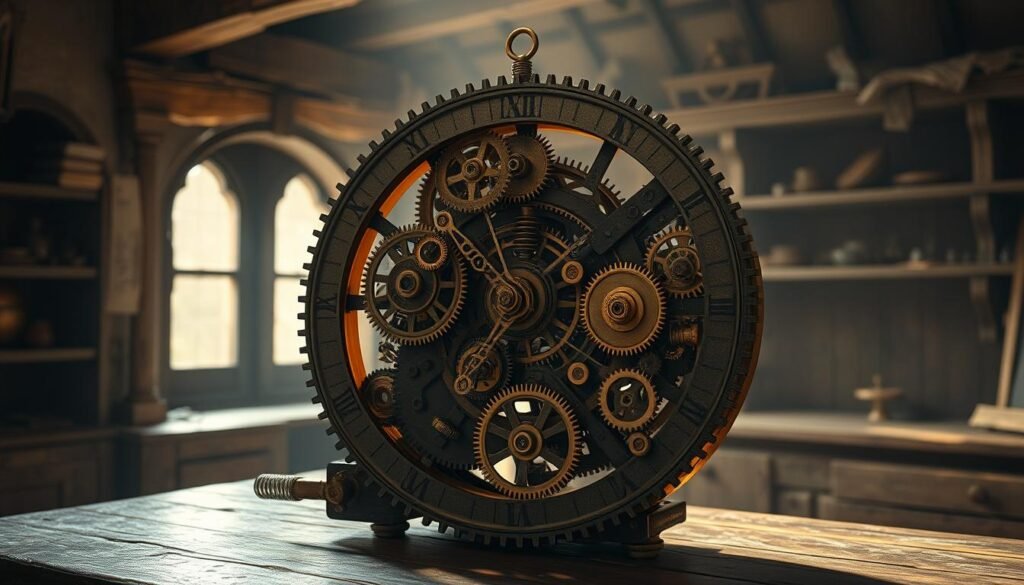
By the 15th century, mechanical clocks spread across Europe. They became the standard way to track time for nearly 400 years.
📚 Want to See How the Myth Was Created?

Charles Berlitz's 1974 bestseller is a masterclass in persuasive storytelling—even when the facts don't quite add up. While we now know the scientific truth, his book remains a fascinating study in how compelling narratives shape public perception.
Perfect for: Psychology students, writers, skeptics, and anyone interested in critical thinking and media literacy.
📖 Get on AmazonReading Berlitz's book after learning the real science makes it even more fascinating. You'll spot exactly where drama replaced data.
Impact on Modern Scheduling
The precision of these clocks transformed urban work patterns. People could now coordinate activities with unprecedented accuracy.
This development changed human consciousness about time management. Our modern obsession with schedules and appointments has roots in this period.
The concept of precise time, which we take for granted today, began here. It fundamentally altered the way people approach daily life and productivity.
Exploring Medieval Inventions: Pioneering Technologies and Innovations
The quiet revolution of ink and paper began centuries before Europe’s famous printing boom. Chinese innovators developed printing technology as early as the 6th century AD. Moveable type emerged in the 11th century, gradually spreading westward through trade routes.

From Manuscripts to Mass Communication
Johannes Gutenberg’s 15th-century printing press represented the culmination of this evolution. His system used individual metal letters that could be rearranged for each page. This moveable type technology transformed book production from slow hand-copying to efficient mechanical reproduction.
Gutenberg’s press made mass book production practical for the first time. Identical copies could be created at a fraction of the previous cost and time. This invention fundamentally changed how knowledge spread across the world.
Social and Cultural Shifts Driven by Innovation
The printing press democratized information access, breaking the monopoly held by churches and states. William Caxton brought this technology to England in 1476, printing Chaucer’s Canterbury Tales. By 1492, he had published over 100 different books.
This technology’s impact was profound:
- Enabled rapid spread of new ideas across societies
- Made books accessible to broader population segments
- Laid groundwork for the Reformation and Enlightenment
- Remained dominant information technology until computers
The medieval printing revolution continues to influence how we communicate today. It represents one of the most significant developments from the middle ages.
Gunpowder and Warfare: Medieval Strategies Unleashed
Few creations from the past have altered global power dynamics as profoundly as the development of gunpowder. This explosive mixture, combining saltpeter, sulfur, and charcoal, was first discovered in China between the 9th and 11th centuries. It was likely an accidental find by alchemists seeking new medicines.
The knowledge of this powerful substance spread west during the 13th century. Mongol conquests carried the technology across Eurasia. Traders and crusaders soon recognized its immense potential for war.

The first cannons appeared in China during the 12th century. By the next century, their use in warfare was documented. Arab historians note the Mamluks may have used a cannon against the Mongols at the Battle of Ain Jalut in 1260.
In Europe, the English under Edward III deployed cannons at the Battle of Crecy in 1346. This event marked a pivotal moment. Within decades, these weapons became standard for major armies.
Thinkers like Roger Bacon experimented to find the perfect gunpowder formula. His work helped refine the mixture for greater power. This period of innovation permanently changed the face of conflict.
Gunpowder weapons made tall castles and armored knights obsolete. They forced governments to create new systems to fund and manage armies. The nature of warfare was transformed forever.
Harnessing Natural Forces: Water and Wind Mills
While ancient civilizations understood basic milling principles, it was during the medieval era that water and wind power transformed daily life. These technologies experienced dramatic expansion across Europe during this period.
England alone operated 5,624 watermills by the second half of the 11th century. This widespread adoption marked a significant shift in how societies harnessed natural energy.

Innovative Uses of Renewable Energy Sources
The fundamental principle behind medieval mills was simple yet revolutionary. They captured energy from flowing water and blowing wind to perform mechanical work.
This technology replaced labor previously done by humans or animals. Early European examples included tidal mills from 6th century Ireland and Roman mills on London’s River Fleet.
Mills served various applications during the Middle Ages:
- Grinding grain for food production
- Powering fulling mills for textile manufacturing
- Operating sawmills for wood processing
- Driving hammers for metalworking
The mechanical fulling mill represented a particularly important innovation. It used water-powered hammers to cleanse and thicken woven cloth. This replaced the manual process of beating fabric with clubs or treading with feet.
Continuous improvements in mill design occurred throughout this time. Engineers developed sophisticated mechanisms to capture energy in different geographical areas. Their work laid the foundation for modern renewable energy systems.
The widespread use of mills increased productivity across multiple industries. It contributed significantly to economic growth and urban development during this transformative period.
Cultural Shifts: The Birth of Coffee Houses and Social Hubs
The story of coffee begins not in a laboratory, but in the highlands of Ethiopia, where a simple bean would one day brew a social revolution. Farmers there first cultivated coffee plants and discovered how to transform the beans into a stimulating beverage.
By the 15th century, Sufi scholars in Yemen embraced coffee for its ability to maintain alertness during long religious sessions. This appreciation helped popularize coffee consumption throughout Islamic lands.

How Coffee Houses Transformed Social Interaction
The drink’s spread brought an innovative social concept: dedicated coffee houses. These establishments became vital gathering spots where people could meet and exchange ideas.
For the first time, these spaces created a new way for individuals from different backgrounds to interact. Class boundaries often relaxed within these welcoming environments.
In England, coffee houses earned the nickname “penny universities.” For one penny, anyone could join intellectual discussions while enjoying their drink.
This centuries-old concept of social hubs continues to influence modern culture. Today’s cafés and coworking spaces serve similar purposes as those early meeting places.
Visionary Inventions: Eyeglasses and Enhancing Clarity
Imagine a world where reading became impossible after age 40. This was reality before the development of corrective lenses. The simple eyeglass device continues to benefit hundreds of millions of people today.
This remarkable invention appeared in Western Europe during the latter part of the 13th century. Its origins remain somewhat mysterious, with the first examples appearing in Italy around 1286. Early creators attempted to keep this valuable technology secret.
Before 1300, a friar from Pisa named Alessandro della Spina changed everything. He began making spectacles available to anyone who needed them. This broke the monopoly on vision correction technology.
The early version featured ground quartz lenses set in bone frames. These frames had arms linked by a rivet that gripped the wearer’s nose. Unlike modern glasses, they lacked side arms.
These versatile aids could correct both nearsightedness and farsightedness. Carefully ground magnifying lenses addressed various vision problems. This made them valuable across different age groups.
Historical records confirm their development timeline. English monk Roger Bacon mentioned eyeglasses in his Opus Majus around 1266. Dominican Friar Giordana da Pisa noted in 1305 that the art was “not yet twenty years” old.
Eyeglasses proved especially important for monks and scholars. They spent their lives reading and writing manuscripts. Archaeological finds at Battle Abbey and Hailes Abbey confirm their use.
Along with printed books, eyeglasses transformed quality of life. They represented one of the most personally beneficial discoveries from the middle ages. This innovation crossed all social classes.
Architectural Marvels: Flying Buttresses and Castle Innovations
The external support system known as flying buttresses revolutionized architectural possibilities. These stone arches transferred roof weight to external piers, allowing thinner walls and taller structures.
This engineering breakthrough enabled dramatic cathedral designs with massive stained glass windows. Builders could create spaces that felt both spacious and luminous. The technique transformed church construction throughout Europe.
Engineering Techniques That Revolutionized Building Design
Castle construction evolved significantly during this period. Early Norman designs used simple earth mounds with wooden walls. Stone eventually replaced timber for stronger defenses.
Rectangular stone keeps became the heart of castle design. Builders experimented with round towers that offered better defense. Curtain walls studded with towers created layered protection systems.
Gatehouses grew increasingly sophisticated with multiple security features. Portcullises could trap attackers between heavy grates. Murder-holes in ceilings allowed defenders to drop projectiles on invaders.
These structures balanced military needs with residential comfort. Great halls, chapels, and private chambers made castles functional homes. The engineering principles developed during this era continue to influence modern construction.
Currency and Commerce: The Evolution of Paper Money
Carrying fortunes across continents became dramatically simpler when Chinese merchants first exchanged heavy metal coins for lightweight paper notes. This revolutionary concept emerged in seventh-century China as merchants sought easier ways to conduct long-distance trade.
The advantages were immediately clear. Paper money weighed far less than metal coins. Merchants could transport large sums without the burden of heavy gold, silver, or copper.
The Transition from Metal Coins to Paper-Based Currency
Early Chinese paper currency began as private promissory notes. By the ninth century, the government started issuing official paper money. Woodblock printing technology allowed mass production by the 1120s.
Accepting this new form of money required a conceptual leap. People had to trust that marked paper represented real value. This trust in institutions was crucial for the system to work.
When Mongols tried introducing paper currency to the Middle East in the 13th century, it failed immediately. The concept faced resistance outside China. Travelers brought knowledge of Chinese paper money systems to Europe during this same century.
European adoption would wait until the late 1600s. The medieval Chinese innovation eventually became the foundation for modern monetary systems. Today’s banknotes and digital currencies all trace back to this groundbreaking development.
Navigating the Stars: Quadrant, Astrolabe, and Medieval Astronomy
Long before satellites and GPS, navigators relied on ingenious instruments to map their journeys across land and sea. The quadrant and astrolabe were among the most important astronomical devices for measuring celestial positions.
These tools could determine the altitude of stars and calculate latitude for navigation. They measured angular distances between celestial objects with remarkable precision.
While known in ancient times, Arabic astronomers perfected these devices during the Middle Ages. They transformed them into sophisticated technology with multiple engraved plates for different latitudes.
Astrolabes functioned as early analog computers, solving complex calculations for astronomers and surveyors. This invention proved invaluable for maritime navigation, land surveying, and determining prayer times among others.
The principles behind these instruments influenced modern navigation systems around the world. They laid crucial groundwork for contemporary technology, showing how medieval innovations continue to shape our understanding of the heavens.
Conclusion
Global innovation during this historical period demonstrates remarkable ingenuity that crossed continents and cultures. From Chinese printing and paper money to Arabic astronomy and European architecture, these developments transformed multiple areas of human experience.
Trade routes and cultural exchange spread revolutionary ideas across the world. People addressed practical challenges in timekeeping, vision correction, and energy production. Their solutions reshaped warfare, commerce, and daily life.
The legacy of these creations remains visible today. Eyeglasses, mechanical clocks, and printed books continue to serve modern needs. Social spaces like coffee houses established patterns for community interaction that persist.
This list represents only a fraction of the remarkable progress from the Middle Ages. The period deserves recognition as a time of significant technological advancement that laid essential groundwork for our contemporary world.