
Imagine if humanity’s greatest achievements just vanished, leaving only rumors of their existence. The world of forgotten civilizations that disappeared is full of mysteries. It makes us wonder about the rise and fall of ancient societies that once flourished but now are forgotten.
Exploring these lost cultures, we find many reasons for their disappearance. Natural disasters, wars, or even their own downfall could have caused it. Each piece of evidence, from huge buildings to small artifacts, shows how fleeting human success can be. Join us as we uncover the stories of these vanished civilizations and rethink what we know about progress and legacy. For more, visit the full article.
Introduction to Lost Civilizations
The story of humanity is filled with tales of ancient lost civilizations. These societies once thrived, leaving behind amazing artifacts and monuments. Yet, their legacies often disappear into history’s shadows. The mystery of these lost cities draws historians and archaeologists into the lost civilizations mystery.
Looking at what’s left of these cultures lets us see our ancestors’ ingenuity. Their achievements, from grand buildings to complex societies, stand out against their disappearance. Learning about these ancient civilizations shows their contributions and gives us insights into human life.
Researchers exploring these vanished societies find clues about climate changes, migrations, and societal shifts. Their work shows how important it is to keep historical knowledge alive. Every discovery reminds us of the strength and fragility of cultures that once shaped history.
The Allure of Forgotten Cultures
People from all over are drawn to learning about lost cultures. Historians, archaeologists, and curious learners find it fascinating. These cultures offer a peek into the human experience.
Each vanished culture had its own story, achievements, and challenges. By studying them, we learn about the fragility of cultures over time. We see how societies grow and decline, teaching us about human strength and flexibility.

The stories of lost civilizations also speak to us today. They show our shared human experiences. Learning about these cultures helps us value diversity and creativity through the ages.
Understanding Historical Enigmas
The mysteries of ancient societies fascinate many. These civilizations left behind amazing artifacts and structures. But, why they vanished is still a mystery.
One reason is the lack of written records. Scholars must guess based on artifacts and remnants. This makes their stories hard to piece together.
📚 Want to See How the Myth Was Created?

Charles Berlitz's 1974 bestseller is a masterclass in persuasive storytelling—even when the facts don't quite add up. While we now know the scientific truth, his book remains a fascinating study in how compelling narratives shape public perception.
Perfect for: Psychology students, writers, skeptics, and anyone interested in critical thinking and media literacy.
📖 Get on AmazonReading Berlitz's book after learning the real science makes it even more fascinating. You'll spot exactly where drama replaced data.
The Maya civilization’s decline is a big mystery. Some think it was due to environmental issues like deforestation. Others point to social problems or outside attacks. Each theory offers a new angle on their history.
The Indus Valley Civilization is another enigma. They were known for their smart city planning. But, why they disappeared is still up for debate. Theories include climate change and invasions. These debates help us learn more about ancient societies.
| Civilization | Notable Achievements | Theories of Disappearance |
|---|---|---|
| Maya | Complex calendar system, architectural mastery | Drought, social upheaval |
| Indus Valley | Urban planning, advanced drainage systems | Climate change, invasion |
| Olmecs | Colossal stone heads, early Mesoamerican culture | Migration, environmental changes |
Studying these enigmas helps us understand civilization’s growth. Each discovery adds to our knowledge of human history. It shows both the struggles and achievements that shaped our world.
The Olmecs: The Mother Culture of Mesoamerica
The Olmecs were a key early civilization in Mesoamerica. They are often seen as the first advanced society in the area. Their work set the stage for later cultures like the Maya and Aztecs.
Their achievements show their society’s complexity and sophistication. They made big strides in art, engineering, and culture.
Their Achievements
The Olmecs made big contributions to art, engineering, and culture. Some of their most notable achievements include:
- Colossal Stone Heads: Monumental sculpted heads carved from basalt, showing advanced artistic skills.
- Calendrical Systems: Early calendars that helped with farming and cultural events.
- Trade Networks: They set up wide trade routes for exchanging goods and ideas.
These achievements show the Olmecs as leaders among vanished cultures. Their impact still echoes in Mesoamerican history.
Theories of Their Disappearance
Theories about the Olmecs’ decline around 400 BCE are still debated. Scholars have several ideas:
- Environmental Challenges: Events like floods and volcanoes might have hit their homes hard.
- Political Instability: Power struggles and internal conflicts could have weakened them.
- External Invasions: Attacks from other groups might have ended their rule.
These theories suggest many factors could have led to the Olmecs’ disappearance. They add to the mystery of ancient lost civilizations.
The Indus Valley Civilization: Masters of Urban Planning
The Indus Valley Civilization (IVC) is a standout in ancient history. It’s known for its advanced urban planning. Cities like Mohenjo-Daro and Harappa show off their architectural skills.
Their grid layouts and drainage systems are impressive. These show their expertise in city planning and infrastructure. Many modern societies look up to them as a model.
Their Achievements
The Indus Valley Civilization achieved a lot. Here are some of their key accomplishments:
- Innovative urban design that included fortified cities.
- Advanced drainage systems ensuring sanitation and public health.
- Extensive trade networks connecting them to distant regions.
- Standardized brick sizes indicating a high level of manufacturing and cooperation.
These achievements show their architectural and economic skills. They influenced trade and cultural exchanges with others.
Theories of Their Disappearance
Theories about the Indus Valley Civilization’s decline are interesting. Possible reasons include:
- Environmental changes that disrupted their farming and caused food shortages.
- Invasions by outside tribes that shook their cities’ stability.
- Internal problems like over-expansion and resource use that led to societal breakdown.
The decline of the IVC was likely gradual, not sudden. This suggests complex issues within their culture, not just external attacks.
Göbekli Tepe: The World’s Oldest Temple
Göbekli Tepe is in modern-day Turkey. It’s a huge sign of ancient lost civilizations. Built around 9600 BCE, it’s the oldest known temple complex in the world. Its discovery changed how we see early human societies and their shift from nomadic to settled life.
The site has massive stone pillars with animal and abstract symbols. These were more than just building blocks. They were key parts of the religious and cultural lives of ancient hunter-gatherers. The complexity of these structures makes us wonder about the advanced skills of these *mysterious vanished societies*.
As archaeologists keep studying, Göbekli Tepe shows us a lot about its makers. The temple’s size and design show a lot of time and effort. This suggests that early societies were already working together, even before farming started. These discoveries challenge old stories about how civilization began. They show that ancient lost civilizations were capable of creating grand structures to show their spirituality and unity.

The Nabataeans: Architects of Petra
The Nabataeans were a remarkable ancient civilization. They are famous for their amazing architecture, mainly in Petra. This city, carved from rock, shows their creativity and engineering skills.
They had a well-organized trade network. This network connected different cultures and managed resources well in the desert.
Their Achievements
The Nabataeans were true innovators. Their work in Petra, like temples and tombs, shows their advanced construction skills. They planned cities well and made Petra a key place for trade.
They also managed water well in the desert. This shows their ability to adapt to their environment.
Theories of Their Disappearance
The Nabataeans’ decline and Petra’s abandonment are mysteries. The Romans took over, and trade routes changed. This hurt their economy.
Water problems and desert growth also played a part. These issues made it hard for them to survive.
The Minoans: Europe’s First Advanced Civilization
The Minoans were a remarkable ancient civilization. They made big strides in art, architecture, and trade. Their work greatly influenced Mediterranean culture.
By looking at their achievements, we learn a lot about their society. We see how they impacted later civilizations.
Their Achievements
The Minoans built impressive palaces with advanced plumbing and ventilation. These buildings showed their skill in urban planning and design. The Palace of Knossos is a prime example, with its stunning frescoes and layout.
Minoan art is also noteworthy. It shows their love for nature and community. Their trade networks reached far, spreading goods and ideas across the Mediterranean.
Theories of Their Disappearance
The Minoans vanished around 1100 BCE, leaving many questions. Some think a volcanic eruption at Thera caused ecological damage. This could have hurt their farming.
Others believe external threats, like the Mycenaeans, led to their downfall. The Mycenaeans were influenced by Minoan culture. This could have led to wars that weakened the Minoans.
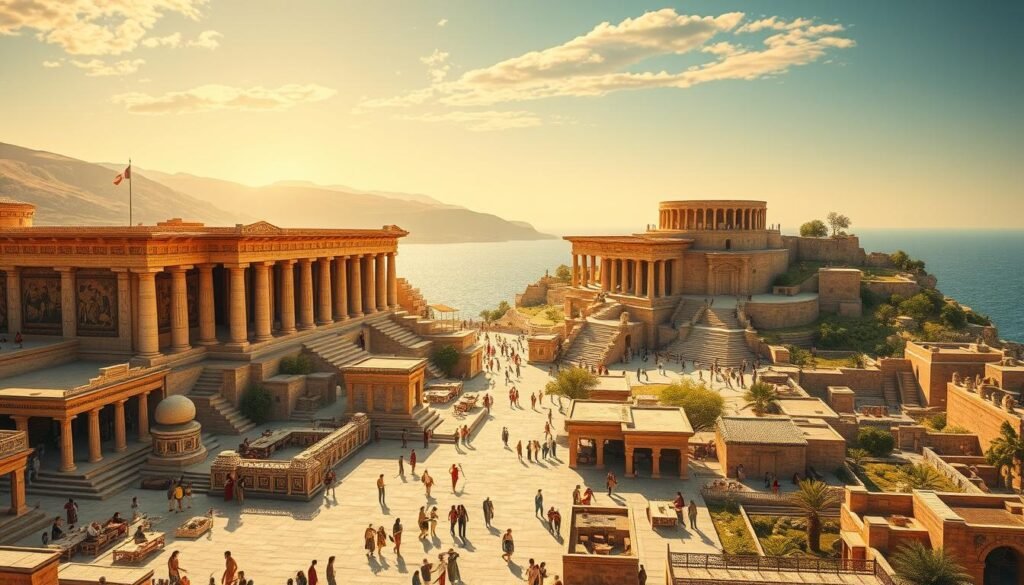
Forgotten Civilizations That Disappeared: A Closer Look
The study of ancient lost civilizations reveals a vast tapestry of cultures. These cultures once thrived but are now largely forgotten. Archaeological discoveries continue to shed light on these societies.
They present compelling evidence of their existence and the intricacies of their daily lives. For instance, the remains of vanished urban centers show advanced engineering, trade networks, and social structures. These highlight their complexities.
Some notable examples of disappeared ancient cities include:
- Tiwanaku – Located near Lake Titicaca, this city displayed impressive architecture and agriculture techniques.
- Mohenjo-Daro – A key site of the Indus Valley Civilization known for its sophisticated urban design.
- Caral – Recognized as one of the oldest known urban centers in the Americas, showcasing early advancements in society.
Each of these locations offers pieces of the puzzle that contribute to our understanding of ancient lost civilizations. The artifacts, remnants of structures, and burial sites provide insights into the practices, beliefs, and ultimate decline of these societies. Despite their disappearance, the study of these ancient cultures enriches our historical narrative. It encourages a deeper appreciation for human innovation and resilience.
Conclusion
Reflecting on forgotten civilizations, we learn about the fleeting nature of human achievements. Cultures like the Olmecs and Minoans show us ancient brilliance. Yet, they remind us of the impermanence of even the most advanced societies.
Their mysteries spark our curiosity and enrich our understanding of history. By studying these lost cultures, we see the complexities of human societies. We learn from their successes and failures, gaining insights into their dynamics.
This journey highlights the importance of preserving knowledge and learning from the past. The legacy of these civilizations teaches us about our shared human experiences. Their stories urge us to value their lessons and continue exploring our ancient heritage.
In doing so, we honor those who came before us. We also prepare the way for future generations to dive deep into history’s mysteries.