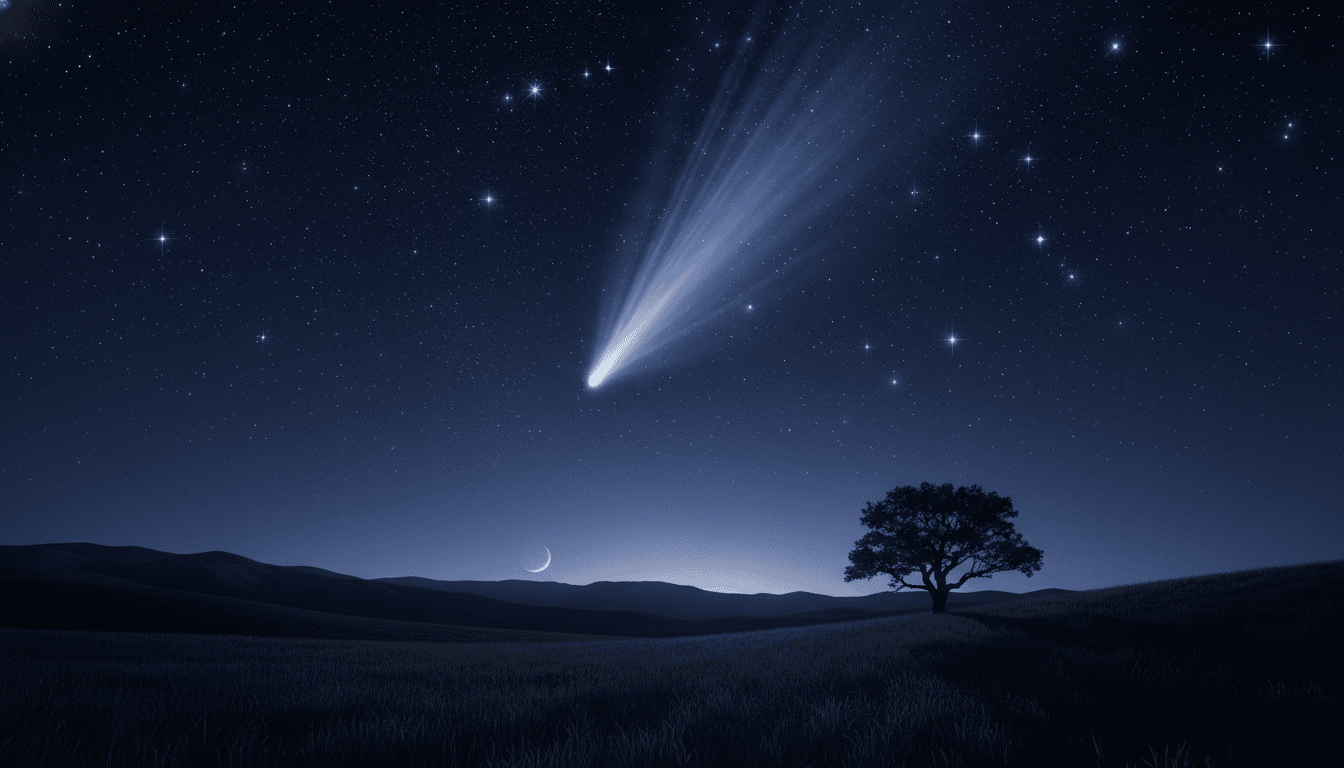
Every 76-year comet cycle brings one of the most spectacular sights in our night sky. Halley’s Comet stands out among famous comets as the only short-period comet visible from Earth without a telescope. This periodic comet has captivated stargazers for over two thousand years.

Comet Halley measures about 15 kilometers long and 7 kilometers wide. Its dark surface reflects only four percent of sunlight, making it one of the darkest objects in our solar system. The comet spins once every 53 hours as it travels through space.
The last time Halley’s Comet appeared was in 1986. Millions of people around the world watched this periodic comet pass by Earth. The next chance to see it will come on July 28, 2061, when it returns to our inner solar system.
Ancient astronomers first recorded Halley comet facts in 240 BC. Chinese observers documented its appearance in their star charts. Since that time, people have watched this famous comet return like clockwork. Edmond Halley became the first person to figure out that these sightings were all the same comet visible from Earth at regular intervals.
Scientists have calculated that Comet Halley weighs about 220 trillion kilograms. Its low density means it contains lots of empty space between ice and dust particles. This structure makes Halley’s Comet much lighter than a solid rock of the same size.
What Is Halley Comet and Why Is It Famous
The Halley comet stands as one of the most remarkable objects in our night sky. This famous celestial object has captured human imagination for thousands of years. Unlike other comets that appear randomly, comet 1P/Halley follows a predictable path that brings it close to Earth at regular intervals. Its bright tail and dramatic appearance have made it the most documented comet in human history.
The Most Famous Periodic Comet
Halley’s periodic comet holds the title of the brightest periodic orbit comet visible from Earth. What makes it special is its perfect balance of brightness and predictability. While other comets might be brighter, they appear only once. The Halley comet returns like clockwork, allowing multiple generations to witness the same cosmic visitor.

Visible to the Naked Eye Every 75-76 Years
The comet 1P/Halley completes its journey around the Sun every 76 years on average. This means a person might see this famous celestial object once or twice in their lifetime. Its orbit can vary slightly, taking anywhere from 74 to 79 years to complete one full cycle. When it approaches Earth, the Halley comet becomes bright enough to see without telescopes, creating a spectacular display that lasts several weeks.
First Comet Recognized as Periodic
Before Halley’s periodic comet was understood, people thought comets were one-time visitors from deep space. This periodic orbit comet changed everything astronomers knew about these icy travelers. It proved that some comets are permanent members of our solar system, orbiting the Sun just like planets do.
The Discovery and Recognition by Edmond Halley
The story of Edmond Halley’s discovery changed astronomy forever. In 1682, a bright comet streaked across the night sky, capturing the attention of the English astronomer. This observation sparked a journey that would revolutionize our understanding of comets and establish important milestones in Halley comet history.
Halley’s Groundbreaking Calculations in 1705
Between 1682 and 1705, Halley studied the paths of 24 different comets dating back to 1337. His work in Edmund Halley astronomy led to a remarkable publication called “Synopsis of the Astronomy of Comets.” In this groundbreaking work, he noticed something extraordinary. The comets seen in 1531 by Petrus Apianus, 1607 by Johannes Kepler, and his own 1682 observation shared nearly identical orbital paths.

Using Newton’s Laws to Predict the Return
Halley applied Isaac Newton’s new laws of gravity and planetary motion to compute these comet orbits. This mathematical approach to Edmond Halley’s comet was revolutionary. He boldly predicted the comet would return in 1758, marking the first time anyone had forecast a comet’s return using scientific calculations.
The Successful Prediction of 1758
Halley died in 1742, sixteen years before his prediction came true. On December 25, 1758, Johann Georg Palitzsch spotted the returning comet, confirming Halley’s calculations. Scientists Alexis Clairaut, Joseph Lalande, and Nicole-Reine Lepaute refined the prediction, calculating perihelion for April 13, 1759. The comet actually reached perihelion on March 13, 1759. Nicolas-Louis de Lacaille honored this achievement by naming it after Halley that same year.
Physical Characteristics and Composition
When scientists ask how big is Halley comet, the answer reveals a surprisingly small cosmic visitor. The nucleus measures approximately 15 kilometers long and 8 kilometers wide, shaped like a peanut or potato tumbling through space. This relatively modest size makes Halley comet appearance in our night sky even more remarkable.

Among the most fascinating comet Halley facts is its incredibly dark surface. With an albedo of just 0.04, the comet reflects less light than coal, making it one of the darkest objects in our solar system. This dark crust covers a “dirty snowball” interior made of frozen water, carbon dioxide, and ammonia mixed with dust particles.

Cosmos
by Carl Sagan
If this article expanded your mind, Cosmos will transform it. Carl Sagan's masterpiece takes you on an unforgettable journey through 13.8 billion years of cosmic evolution—from the Big Bang to the emergence of consciousness.
Written with Sagan's signature blend of scientific rigor and poetic wonder, Cosmos answers the same questions you just explored—but with the depth and storytelling that made it a global phenomenon.
The comet’s mass reaches 220 trillion kilograms, yet its density remains surprisingly low at 0.55 grams per cubic centimeter. This porous structure suggests the nucleus consists of loosely packed material rather than solid rock. Surface temperatures vary dramatically from 170 to 220 Kelvin in most areas, while sunlit regions can heat up to 400 Kelvin.
Halley’s comet dust trail forms when solar radiation heats the nucleus, causing gas and dust to eject into space. Water vapor makes up 80% of these emissions, with carbon monoxide contributing 17% and carbon dioxide adding another 3-4%. Only about 10% of the comet’s surface actively releases material, as most areas remain sealed beneath an insulating dust layer.
Orbital Path and Journey Through Space
The Halley comet orbit stands out as one of the most unusual paths in our solar system. This periodic comet travels in the opposite direction to all the planets, making its journey truly unique. The comet’s elliptical path takes it on an incredible voyage from the inner solar system to the outer reaches of space.
Retrograde Orbit Around the Sun
Unlike planets that orbit counterclockwise when viewed from above the Sun’s north pole, Halley’s comet orbit moves clockwise in what astronomers call retrograde motion. This backward movement tilts at an 18-degree angle to Earth’s orbital plane. The highly stretched elliptical path has an eccentricity of 0.967, making it one of the most elongated orbits we track regularly.

Distance from Perihelion to Aphelion
The periodic comet swings between extreme distances during its journey. At perihelion (closest approach), it comes within 87.8 million kilometers of the Sun, passing between Mercury and Venus. At aphelion (farthest point), it travels out to 5.2 billion kilometers, reaching nearly as far as Pluto. This vast orbital circumference spans about 7.6 billion miles total.
Classification as a Halley-Type Comet
Scientists classify this as a Halley-type comet based on its orbital period of 74 to 79 years. These comets typically have periods between 20 and 200 years with high orbital inclinations. Only 105 Halley-type comets exist compared to 816 Jupiter-family comets. Research suggests these rare objects originated in the distant Oort cloud, traveling from 20,000 to 50,000 astronomical units away. The Halley comet return date varies slightly each orbit due to planetary gravity influences.
Ancient Sightings and Historical Records
The story of Halley comet history stretches back over two thousand years. Ancient civilizations watched this spectacular visitor cross their skies and recorded what they saw. These early Halley comet sightings give us a remarkable window into both astronomical observation and cultural beliefs of ancient peoples.
The first certain recording of this historical astronomical phenomenon dates to 240 BC. Chinese astronomers wrote about a bright comet in their chronicle called the Records of the Grand Historian (Shiji). They described seeing the comet appear in the eastern sky before it moved northward. Chinese scholars kept the most detailed records of any ancient civilization, tracking each appearance with remarkable accuracy.
Babylonian astronomers left their own valuable records of Halley comet sightings. In August 1984, researchers at the British Museum discovered fragmentary tablets from 164 BC describing the comet. Another Babylonian tablet from 87 BC states that observers watched the comet “day beyond day” for an entire month. These ancient astronomers might have even noticed its regular returns. The Babylonian Talmud mentions a “star appearing once in seventy years” that caused ship captains to lose their way.
The 12 BC appearance provided the first truly detailed observations in Halley comet history. This historical astronomical phenomenon continued to fascinate ancient watchers who carefully documented its path across the sky. Their patient record-keeping now helps modern scientists calculate the comet’s past orbits all the way back to 837 AD and beyond.
Medieval and Renaissance Observations
Throughout medieval times, Halley comet history reveals fascinating stories of how people interpreted this famous celestial object. Ancient civilizations watched the skies with both wonder and fear, recording each appearance of this historical astronomical phenomenon in their chronicles and artwork.
The Battle of Hastings Omen in 1066
One of the most dramatic Halley comet sightings occurred in 1066, just before the Battle of Hastings. Saxon King Harold saw the comet as a terrible warning of doom approaching his kingdom. William of Normandy viewed the same bright streak across the sky as a positive sign for his invasion of England. The comet appeared in April 1066, and by October, William had defeated Harold in the battle that changed English history forever.

Appearances in the Bayeux Tapestry
The famous Bayeux Tapestry captures this historical astronomical phenomenon in stunning detail. The embroidered scene shows King Harold sitting unsteadily on his throne while the comet blazes overhead. His courtiers point at the sky in amazement and terror, their faces showing the fear this famous celestial object inspired in medieval minds.
Babylonian and Roman Documentation
Ancient records of Halley comet sightings go back even further. The Zuqnin Chronicle from 760 AD includes detailed drawings showing the comet’s position near the constellations Aries, Mars, and Saturn. Irish monks wrote about the 912 AD appearance in the Annals of Ulster, simply noting “a comet appeared.” Peter Apian carefully studied the 1531 return and published his observations in 1540. Johannes Kepler recorded the 1607 appearance, the last viewing before telescopes were invented.
The Spacecraft Missions to Study Halley
March 1986 marked a historic moment in astronomy when Halley’s Comet 1986 became the first comet studied up close by spacecraft. An international fleet of space probes converged on this famous solar system comet, giving scientists their first detailed look at a comet’s nucleus and structure. This unprecedented collaboration involved space agencies from Europe, the Soviet Union, Japan, and the United States.
ESA’s Giotto Mission in 1986
The European Space Agency’s Giotto spacecraft made the closest approach to Halley Comet 1986, flying within 596 kilometers of the nucleus on March 14. Named after the Italian painter who depicted the comet in 1301, Giotto captured the first images of a comet’s nucleus. The probe revealed that the nucleus was darker than coal and measured about 15 kilometers long by 8 kilometers wide.

Soviet Vega Program Encounters
The Soviet Union’s Vega 1 and Vega 2 spacecraft reached the solar system comet before Giotto. Vega 1 flew within 8,890 kilometers on March 6, while Vega 2 passed at 8,030 kilometers on March 9. These probes measured the comet’s temperature, shape, and surface properties, discovering that the nucleus was irregularly shaped like a potato.
International Fleet of Spacecraft
Japan contributed two probes: Sakigake and Suisei, which studied the comet’s interaction with solar wind. NASA repurposed several existing spacecraft, including Pioneer 7 and Pioneer Venus Orbiter, to observe Halley’s Comet 1986 from different angles. The International Cometary Explorer and International Ultraviolet Explorer satellites provided additional observations, creating a comprehensive picture of this remarkable celestial visitor.
Connection to Annual Meteor Showers
Every time this famous periodic comet swings past Earth, it leaves behind a spectacular gift that keeps on giving. As the solar system comet travels through space, it sheds tiny particles of ice and rock that create an extensive debris field along its orbital path.
This cosmic littering creates something amazing for sky watchers on Earth. The Halley’s comet dust trail produces not one but two annual meteor showers that light up our night sky:
- The Eta Aquariids appear in early May, treating Southern Hemisphere observers to up to 60 meteors per hour
- The Orionids peak in late October, producing about 20 meteors per hour visible from both hemispheres

Scientists have known about the connection between meteor showers and comets since the mid-1800s. When this solar system comet approaches the Sun, heat causes ice to turn directly into gas. This process releases dust particles ranging from microscopic specks as small as 0.001 micrometers to larger grains.
The escaping material doesn’t come from the entire surface. Jets burst from specific vents covering about 10% of the comet’s nucleus. These powerful jets don’t just create the Halley’s comet dust trail—they actually affect how fast the periodic comet moves through space by pushing against it, following Newton’s laws of motion.
Each October and May, Earth passes through these ancient debris streams, turning dust particles into brilliant streaks of light as they burn up in our atmosphere at speeds reaching 148,000 mph.
Scientific Discoveries from Close Encounters
When spacecraft finally reached this famous solar system comet in 1986, they revealed surprising comet Halley facts that changed our understanding of these celestial visitors. The fleet of international probes provided unprecedented data about the comet’s structure and composition during its most recent halley’s comet appearance.
The “Dirty Snowball” Theory Confirmation
Fred Whipple proposed in 1950 that comets were “dirty snowballs” made of ice and dust. The Giotto spacecraft confirmed this basic idea but with a twist. Scientists discovered the comet was actually more like a snowy dirtball than originally thought. The surface contained mostly non-volatile materials with only small patches of ice, revealing new comet Halley facts about its composition.

Surface Temperature and Composition Data
The Vega 1 probe measured surprising surface temperatures between 300-400 Kelvin, much warmer than expected for this solar system comet. Ice sublimation occurred at cooler temperatures of 170-220 Kelvin depending on surface brightness. Scientists detected carbon, nitrogen, and oxygen in the comet’s material, suggesting it formed in the cold outer regions of our solar system.
Nuclear Structure and Density Findings
The most shocking discovery was the comet’s extremely low density—just one-quarter that of water ice. With a volume of about 500 cubic kilometers, the nucleus is incredibly porous, like a cosmic sponge floating through space. The varied terrain includes hills, mountains, ridges, and at least one crater. The day side shows far more activity than the night side during each halley’s comet appearance.
When Will Halley Return Next
After decades of waiting, astronomy enthusiasts are eager to know when will halley’s comet return to our skies. The famous comet follows a predictable path that brings it back to Earth’s neighborhood every 75 to 76 years. Mark your calendars for the next spectacular show in the summer of 2061.
Expected Perihelion on July 28, 2061
The halley comet next return will reach its closest point to the Sun on July 28, 2061. This perihelion marks the peak of its activity when the comet shines brightest. The comet will begin entering the inner Solar System several months before this date. Planetary encounters will occur as it approaches:
- Mars crossing on May 16, 2061
- Earth crossing on June 19, 2061
- Venus crossing on July 9, 2061

Visibility Predictions for Earth Observers
The halley comet next appearance promises favorable viewing conditions from the Northern Hemisphere. Late spring and early summer 2061 will offer the best opportunities to spot the comet in the morning sky. The exact brightness will depend on the Earth-comet geometry during its approach.
Past appearances give us clues about what to expect. The 1986 passage reached a brightness comparable to Polaris at 39 million miles from Earth. The halley comet return date of 2061 should provide better viewing angles than the 1986 appearance. After 2061, the comet will return again around March 27, 2134.
The Lifecycle and Future of the Comet
Like all celestial wanderers, Halley’s Comet faces an inevitable decline. This famous periodic comet loses between 3 to 10 feet of material from its nucleus surface during each pass through the inner solar system. The intense heat from the Sun causes ice and dust to sublimate, creating the spectacular tail we see from Earth.
Scientists estimate that an average solar system comet can complete about 1,000 trips around the Sun before completely dissipating. Research by astronomer David Hughes in 1985 revealed that Halley has already lost 80-90% of its original mass over the past 2,000-3,000 orbits. Despite traveling in its current Halley’s comet orbit for over 16,000 years, the comet shows no obvious signs of aging in recorded appearances.
The future of this solar system comet remains uncertain. Computer models suggest several possible fates:
- Complete evaporation within tens of thousands of years
- Breaking apart into smaller fragments
- Ejection from the Solar System within a few hundred thousand years
Studies by physicists Boris Chirikov and Vitold Vecheslavov in 1989 showed that the comet’s long-term path is chaotic and unpredictable. Non-gravitational forces from gas jets on its surface cause small but significant changes to each orbit. These jets delay the periodic comet’s closest approach to the Sun by an average of four days each time. With a projected lifetime of about 10 million years, Halley will continue inspiring sky watchers for many generations to come.
Conclusion
Halley’s Comet stands as the most remarkable of all famous comets in our solar system. Its regular appearances have captivated people for thousands of years. Since 240 BC, cultures around the world have recorded this bright visitor that is visible from Earth without telescopes. Every person who lives past 75 years old has the rare chance to see this comet twice in their lifetime.
Edmond Halley changed astronomy forever when he predicted the comet would return in 1758. His work proved that comets follow predictable paths around the Sun. This discovery helped confirm Isaac Newton’s laws of gravity and motion. The 1986 visit brought another breakthrough when spacecraft like Giotto flew close to the comet. These missions showed us that comets are made of ice and dust, solving mysteries that puzzled scientists for centuries.
The next Halley’s comet return date is July 28, 2061. This future appearance will give new generations their turn to witness the same sight that amazed Julius Caesar, inspired medieval artists, and guided space missions. Halley’s Comet connects people across time through a shared wonder of the night sky. Its story reminds us that some natural events are so special they unite humanity across thousands of years.