
The universe harbors cosmic giants that challenge our understanding of size and scale. When exploring how big are black holes compared to stars, astronomers uncover mind-bending revelations about cosmic dimensions. From tiny stellar black holes to massive galactic centers, these astronomical objects represent extraordinary extremes of physical existence.
The size of black holes vs stars reveals stunning variations across space. A single supermassive black hole like the one in Messier 87 can weigh 6.5 billion times the mass of our Sun. By contrast, our galaxy’s central black hole, Sagittarius A*, measures approximately 4 million solar masses—a relatively modest cosmic entity.
Cosmic measurements demonstrate extraordinary diversity. The cosmic horseshoe galaxy hosts a supermassive black hole weighing 36 billion solar masses, located 5 billion light-years away. Such astronomical scales demonstrate the immense complexity of universal structures, challenging human comprehension of spatial dimensions.
Understanding these cosmic scales requires more than simple numerical comparisons. Physical dimensions, gravitational influence, and mass all contribute to our perception of astronomical objects. Black holes represent some of the most fascinating and extreme phenomena in our known universe.
Introduction to Black Holes and Stars
The universe contains two of the most fascinating celestial objects: black holes and stars. Understanding their nature helps us comprehend the intricate black hole diameter compared to stars, revealing the remarkable diversity of cosmic structures.

Stars and black holes represent complex astronomical phenomena that challenge our understanding of space and time. Their sizes and characteristics vary dramatically, creating an intriguing landscape of cosmic exploration.
What Are Black Holes?
Black holes are extraordinary regions in space where gravity becomes so intense that nothing, not even light, can escape. When examining black hole diameter compared to stars, these cosmic phenomena demonstrate remarkable characteristics:
- Formed through gravitational collapse of massive stars
- Contain an event horizon that marks the point of no return
- Generate immense gravitational forces
Understanding Different Types of Stars
Stars represent diverse cosmic entities ranging from tiny red dwarfs to massive supergiants. Their classification depends on multiple factors:
- Mass
- Temperature
- Luminosity
- Chemical composition
The complexity of stellar evolution provides a fascinating backdrop for understanding how these celestial objects interact with black holes and shape our universe’s intricate structure.
The Size Spectrum of Stars
Understanding the dimensions of stars provides crucial context when comparing black hole and star dimensions. Stars come in an astonishing range of sizes, from tiny red dwarfs to massive supergiants that dwarf our Sun.
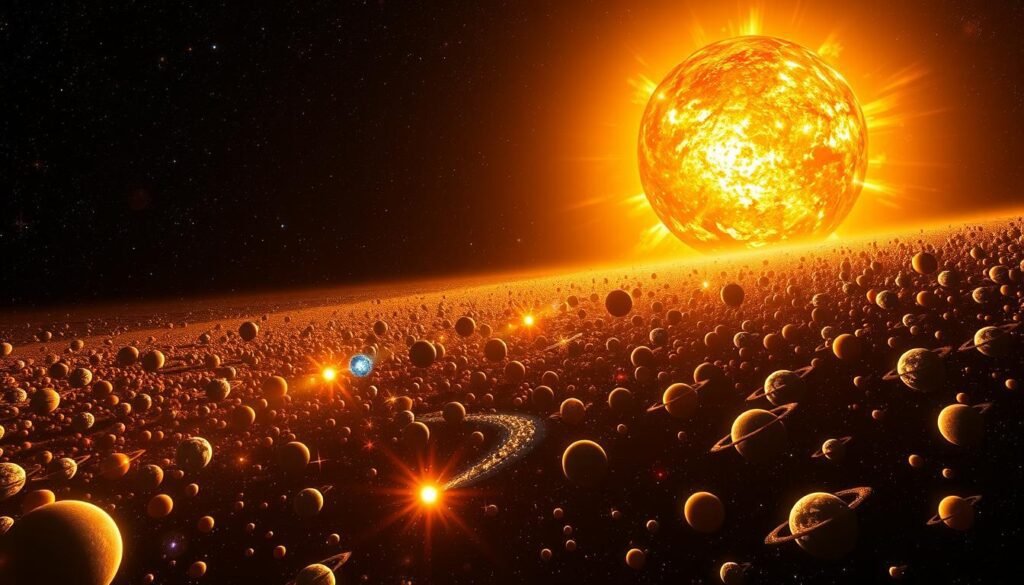
Our cosmic neighborhood contains a fascinating variety of stellar objects, each with unique characteristics and sizes that contribute to the intricate tapestry of the universe.
Small Stars: Red Dwarfs and Their Size
Red dwarfs represent the smallest true stars in the universe. These diminutive celestial bodies typically measure:
- Masses ranging from 0.08 to 0.5 solar masses
- Diameters between 10-50% of the Sun’s diameter
- Extremely long lifespans of trillions of years
Medium Stars: The Sun’s Place in the Cosmos
Our Sun serves as a critical reference point when comparing black hole and star dimensions. With a diameter of approximately 1.4 million kilometers, it represents an average-sized star in the cosmic landscape.
Massive Stars: Giants and Supergiants
At the opposite end of the spectrum, massive stars showcase extraordinary proportions:
- Red giants can reach 10-100 times the Sun’s diameter
- Supergiants like Betelgeuse expand to 1,000 times the Sun’s diameter
- These enormous stars have dramatically shorter lifespans
The incredible diversity of stellar sizes sets the stage for understanding the remarkable scale of black holes in our universe.
Understanding Black Hole Sizes
Black holes represent some of the most fascinating cosmic phenomena in our universe. These extreme gravitational objects come in various sizes, ranging from stellar mass black holes to massive galactic giants. Understanding their formation and scale provides insight into the complex dynamics of our cosmic neighborhood.


Cosmos
by Carl Sagan
If this article expanded your mind, Cosmos will transform it. Carl Sagan's masterpiece takes you on an unforgettable journey through 13.8 billion years of cosmic evolution—from the Big Bang to the emergence of consciousness.
Written with Sagan's signature blend of scientific rigor and poetic wonder, Cosmos answers the same questions you just explored—but with the depth and storytelling that made it a global phenomenon.
Stellar Black Holes: How They Form
Stellar black holes emerge through dramatic stellar transformations. When massive stars reach the end of their life cycles, they undergo catastrophic core collapses. The process involves several critical stages:
- Massive stars exhausting nuclear fuel
- Gravitational collapse of the stellar core
- Supernova explosion or direct collapse
Typically, stellar mass black holes range from 5 to 100 solar masses. Their event horizons measure just tens of kilometers across, creating incredibly dense cosmic objects.
Supermassive Black Holes: The Giants of Galaxies
Supermassive black holes dwarf their stellar counterparts, residing at galaxy centers with astonishing mass ranges. Some remarkable examples include:
- Sagittarius A*: 4 million solar masses
- Andromeda’s central black hole: Over 100 million solar masses
- Messier 87’s black hole: 6.5 billion solar masses
Despite their enormous mass, supermassive black holes maintain surprisingly compact event horizons. Stellar size comparisons reveal these cosmic behemoths pack tremendous mass into remarkably small volumes, demonstrating the universe’s extraordinary scale and complexity.
Comparing Average Sizes: Black Holes vs. Stars
The universe holds remarkable contrasts in size and scale, especially when comparing black holes to stars. Understanding the black hole scale relative to stars reveals fascinating insights into cosmic dimensions.

Stars and black holes present an extraordinary spectrum of sizes that challenge our cosmic understanding. The transformation from a massive star to a black hole creates dramatic changes in physical dimensions.
Typical Sizes of Stellar Black Holes
A typical stellar black hole demonstrates an astonishing density transformation. Consider a black hole formed from a star with 10 solar masses – its event horizon spans merely 60 kilometers in diameter. This compact size stands in stark contrast to its original stellar form, which might have stretched hundreds of millions of kilometers.
- Stellar black holes are significantly smaller than their parent stars
- Event horizon diameter remains incredibly compact
- Mass compression occurs in an incredibly tiny volume
The Enormous Scale of Supermassive Black Holes
Supermassive black holes represent another dimension of cosmic scale. Located at galactic centers, these cosmic giants contain millions or billions of solar masses. Sagittarius A*, our galaxy’s central black hole, contains 4 million solar masses within an event horizon smaller than Mercury’s orbit.
- Supermassive black holes far outweigh individual stars
- Central black holes represent a tiny fraction of galactic mass
- Density remains the key distinguishing factor
The black hole scale relative to stars demonstrates nature’s remarkable ability to compress immense mass into unimaginably small spaces, challenging our understanding of cosmic architecture.
The Formation Process: Stars & Black Holes
The cosmic dance between stars and black holes reveals an extraordinary transformation process that challenges our understanding of the universe. Largest stars play a critical role in creating some of the most mysterious objects in space: black holes.

Stellar evolution follows a remarkable path. Stars with immense mass—typically 20-25 times the solar mass—undergo dramatic changes that ultimately lead to black hole formation. Research from astrophysicists suggests these stellar giants experience multiple stages before their final collapse.
How Massive Stars Become Black Holes
The journey from star to black hole involves several key stages:
- Main sequence stellar burning
- Expansion into a supergiant phase
- Catastrophic core collapse
- Supernova explosion
When nuclear fuel exhausts, gravity becomes the dominant force. The largest black holes emerge from the most massive stellar remnants, creating incredibly dense cosmic objects.
Gravity’s Transformative Power
“In the cosmic ballet, gravity writes the final act for massive stars.” – Astrophysics Quarterly
Gravity transforms stellar matter in ways that defy imagination. A star spanning billions of kilometers can collapse into a black hole just tens of kilometers wide. This dramatic size reduction demonstrates the incredible power of gravitational forces in shaping our universe.
Understanding how the largest stars become the largest black holes continues to fascinate astronomers and challenge our comprehension of cosmic evolution.
Distances and Scales in the Universe
Exploring the vast expanses of space requires understanding the immense distances that separate celestial objects. Astronomers use sophisticated techniques to measure these incredible distances, revealing the true scale of our universe and the challenges in studying black hole event horizon size.
Measuring Distances Between Stars and Black Holes
Astronomers employ multiple methods to calculate cosmic distances:
- Parallax measurements for nearby stars
- Standard candle techniques like Cepheid variables
- Spectral redshift for distant galaxies
The black hole event horizon size presents unique measurement challenges. Scientists typically infer distances through:
- Analyzing companion star movements
- Studying host galaxy characteristics
- Observing gravitational interactions
The Concept of Light-Years: Understanding Scale
A light-year represents the distance light travels in one year—approximately 9.46 trillion kilometers. This measurement helps visualize cosmic scales that boggle the human imagination. Sagittarius A*, our galaxy’s central black hole, sits about 26,000 light-years from Earth, demonstrating the immense distances involved in astronomical research.
The universe’s scale challenges our perception, making even massive black holes appear as tiny points when viewed from billions of light-years away.
Understanding these astronomical distances helps us appreciate the complexity of studying black holes and their interactions with surrounding stars.
The Effects of Black Holes on Nearby Stars
The cosmic dance between black holes and stars reveals an extraordinary interplay of gravitational forces that challenge our understanding of the universe. Black holes possess an incredible ability to manipulate stellar environments, transforming the fate of nearby celestial bodies with their immense gravitational pull.

The black hole mass to star mass ratio plays a crucial role in determining how dramatically a black hole can influence surrounding stars. When stars venture too close to these cosmic behemoths, several dramatic scenarios can unfold:
- Stars can be stretched into long, thin streams
- Orbital paths can be dramatically altered
- Entire stellar systems can be disrupted
Gravitational Influence of Black Holes
Supermassive black holes at galactic centers exert powerful gravitational forces that can radically transform stellar trajectories. These cosmic giants can bend light, redirect stellar paths, and create incredible gravitational lensing effects that reveal the true power of their gravitational dominance.
The Fate of Stars That Wander Too Close
Stars approaching a black hole’s event horizon face extreme risks. Tidal disruption events can tear stars apart, converting them into long streams of stellar material. Some fragments may fall into the black hole, creating brilliant accretion flares visible across vast cosmic distances.
The universe demonstrates that size isn’t everything—a compact black hole can control the destiny of entire star systems.
The Role of Black Holes in Galaxy Formation
Black holes play a crucial role in shaping the cosmic landscape of our universe. Far from being passive entities, these gravitational giants actively influence the development and structure of galaxies in profound ways.

Scientists have discovered that nearly every galaxy contains a central supermassive black hole. The relationship between these cosmic behemoths and their galactic homes is intricate and dynamic.
How Supermassive Black Holes Sculpt Galactic Structures
Supermassive black holes are not merely residents of galactic centers but active sculptors of cosmic architecture. Their powerful gravitational influence and energy emissions can dramatically transform surrounding stellar environments.
- Black holes can expel gas from galaxy centers
- They regulate star formation through intense energy feedback
- Massive black holes influence galactic evolution
The Intricate Dance of Black Holes and Star Formation
The relationship between black holes and star formation is complex. While black hole activity can sometimes suppress stellar birth by heating and dispersing gas, it can paradoxically trigger star formation through compressed gas clouds and energetic jets.
Research from advanced telescopes suggests that in early galaxies, black holes might have formed before most stars, challenging previous understanding of cosmic evolution. This groundbreaking insight reveals a more nuanced picture of how galaxies develop and mature over billions of years.
Myth-Busting: Misconceptions About Black Holes
Black holes have long captured human imagination, sparking both fascination and fear. These cosmic phenomena are often misunderstood, shrouded in mystery and scientific complexity that can lead to wild misconceptions about their nature and power.

Common Myths About Size and Power
Many people believe black holes are cosmic vacuum cleaners that devour everything in their path. In reality, black holes operate under specific gravitational principles:
- Black holes do not indiscriminately consume nearby objects
- Gravitational effects follow standard physical laws
- Objects can maintain stable orbits around black holes
“Black holes are extreme objects, but they’re not magical monsters of the universe.” – Astrophysics Research Team
Clarifying the Mystique of Black Holes
Scientists have worked diligently to demystify these fascinating cosmic structures. Supermassive black holes, for instance, typically comprise only 0.1% of their host galaxy’s stellar mass. Their gravitational influence is powerful yet predictable.
Modern observations, including groundbreaking telescope images, have transformed black holes from theoretical concepts into measurable astronomical objects. They represent natural phenomena governed by complex but understandable physics.
- Event horizons mark boundaries of observable space
- Black holes have finite, calculable masses
- Scientific methods continue revealing their secrets
The Future of Stellar Evolution and Black Holes
The cosmos is a dynamic playground of celestial transformations, where stars and black holes engage in an eternal dance of creation and destruction. Our understanding of stellar life cycles and cosmic evolution continues to expand, revealing fascinating insights into the universe’s most mysterious processes.

What Happens to Stars When They Die?
Stars follow unique paths of destruction based on their initial mass. Different stellar masses lead to dramatically different endpoints:
- Low-mass stars gradually fade into black dwarfs
- Medium-mass stars become white dwarfs after expanding into red giants
- Massive stars explode as spectacular supernovae
- Extremely massive stars collapse directly into stellar black holes
Predictions for the Evolution of Black Holes
Black holes represent the universe’s most extreme cosmic laboratories. They grow through two primary mechanisms: matter accretion and gravitational mergers. Future space observatories like JWST and LISA will help astronomers track these remarkable cosmic events.
The lifecycle of stars and black holes represents a one-way progression – stars can become black holes, but black holes cannot revert to stars.
Theoretical predictions suggest that while black holes appear permanent, they slowly emit radiation. Smaller black holes will evaporate faster, though stellar and supermassive black holes will persist for incomprehensibly long timescales – far beyond the current age of the universe.
Conclusion: The Fascinating Scale of the Universe
The exploration of black holes and stars reveals a universe far more complex and awe-inspiring than we could have imagined. Understanding how big are black holes compared to stars challenges our fundamental perceptions of space and cosmic structure. From tiny stellar black holes to massive galactic centers, these cosmic entities demonstrate the incredible diversity of astronomical phenomena.
Recent observations from advanced telescopes like JWST have transformed our understanding of cosmic scale. The cosmic horseshoe’s 36-billion solar mass black hole represents just one example of the extraordinary objects populating our universe. Scientists now recognize that black holes play a crucial role in galaxy formation, with some massive black holes existing even before the first stars emerged.
Our journey through the cosmic landscape reveals that size is relative in the universe. A stellar black hole might be smaller than a giant star, yet contain incredible gravitational power. Supermassive black holes dwarf entire star systems, demonstrating the remarkable density gradients possible in nature. These discoveries push the boundaries of human knowledge and remind us how much remains to be explored.
Reflecting on Our Cosmic Perspective
Studying black holes and stars helps us appreciate our place in the vast cosmic ecosystem. Each discovery brings us closer to understanding the intricate mechanisms driving universal evolution. As technology advances, we continue to unravel the mysteries of these extraordinary celestial objects, expanding our comprehension of the universe’s fundamental structures.
The Importance of Continuous Scientific Exploration
The relationship between black holes and stars represents an ongoing scientific investigation. With each new observation, we challenge existing theories and develop more sophisticated models of cosmic interactions. Our quest to understand these celestial giants drives technological innovation and deepens our appreciation for the universe’s complexity.